

Key Takeaways
- Processing exists on a spectrum; not all processed foods carry the same nutritional or health implications.
- Ultra-processed foods, defined by extensive industrial formulation, are most consistently linked to adverse health outcomes in research.
- Minimally processed foods like frozen vegetables or canned beans can be nutritious, affordable, and practical choices.
- The NOVA classification system is a widely used research framework for categorizing foods by degree of processing.
- Focusing on overall dietary patterns — not individual food labels — is the most evidence-aligned approach to healthy eating.
- Consult a registered dietitian for personalized guidance on structuring your diet.
Option A
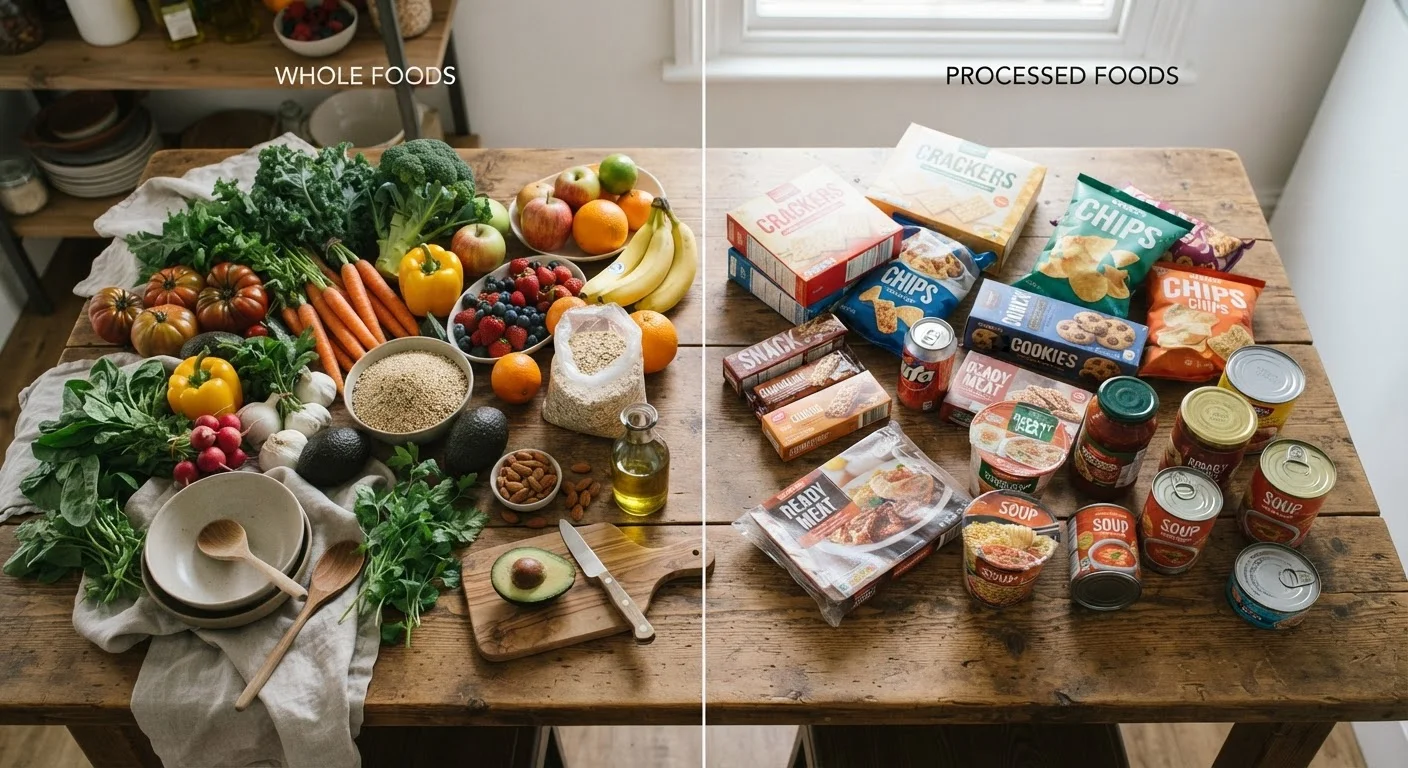
Whole Foods
The minimally altered, nutrient-dense foundation of most dietary guidance.
Best for: Individuals seeking maximum micronutrient density, fiber, and minimal additives in their daily eating patterns.
Option B
Processed Foods
A broad, often misunderstood category spanning minimally to heavily altered products.
Best for: Understanding how degree of processing — not processing itself — determines a food's place in a balanced diet.
If you want to maximize nutrient density in every meal
Whole Foods
Whole and minimally processed foods consistently deliver more fiber, vitamins, and minerals per calorie with fewer additives, aligning with USDA Dietary Guidelines.
If you need convenient, budget-friendly options without sacrificing nutrition
Processed Foods
Lightly processed items like canned legumes, frozen produce, and plain yogurt offer real nutritional value and often cost less than fresh equivalents.
If you are working to reduce chronic disease risk through diet
Whole Foods
Research, including large cohort studies, consistently associates higher whole-food intake and lower ultra-processed food intake with reduced risks of cardiovascular disease and type 2 diabetes.
If you are trying to build sustainable, lasting healthy eating habits
Whole Foods
A diet anchored in whole and minimally processed foods provides a flexible, evidence-based framework that doesn't require eliminating all convenience items.
Defining the Spectrum: What Do These Terms Actually Mean?
The phrase "whole foods" refers to foods that are either entirely unprocessed or altered minimally — think an apple, a raw chicken breast, or dry oats. They retain their natural nutritional structure largely intact. "Processed foods," by contrast, is a term that covers an enormous range: from a bag of pre-washed spinach to a shelf-stable snack cake engineered for maximum palatability.
The NOVA classification system, developed by researchers at the University of São Paulo, is one of the most widely adopted frameworks for making sense of this range. It organizes foods into four groups based on the extent and purpose of their processing:
- Group 1 – Unprocessed or minimally processed: Whole fruits, vegetables, plain meats, eggs, milk, and dried legumes. These form the dietary foundation recommended by most public health agencies.
- Group 2 – Processed culinary ingredients: Items like olive oil, flour, salt, and sugar — not typically eaten alone, but used to prepare Group 1 foods.
- Group 3 – Processed foods: Products made by adding Group 2 ingredients to Group 1 foods, such as canned tomatoes, smoked fish, or artisan bread. These are recognizable as food with altered but generally understandable ingredients.
- Group 4 – Ultra-processed foods (UPF): Industrially formulated products containing additives — emulsifiers, colorings, flavor enhancers — rarely found in home kitchens. Examples include packaged snack cakes, instant noodles, and many sweetened breakfast cereals.
Understanding where a food falls on this spectrum is far more informative than a blanket "processed is bad" judgment.
What the Research Actually Shows
The distinction between Groups 1–3 and Group 4 matters significantly in the scientific literature. Multiple large observational studies have found associations between high ultra-processed food (UPF) consumption and increased risks of obesity, type 2 diabetes, cardiovascular disease, and certain cancers. A landmark 2019 study published in The BMJ found that a 10% increase in UPF intake was associated with a statistically significant increase in overall cancer risk — though researchers acknowledged the observational nature of the data and the difficulty of isolating processing from other dietary patterns.
| Criterion | Whole / Minimally Processed | Ultra-Processed |
|---|---|---|
| Ingredient complexity | Single or few recognizable ingredients | Long list with additives and emulsifiers |
| Nutrient density | Generally high in micronutrients and fiber | Often high in calories, low in micronutrients |
| Food matrix integrity | Largely preserved | Significantly disrupted |
| Satiety signaling | Stronger satiety response per calorie | Associated with weaker satiety cues |
| Research-associated health risk | Lower risk in observational studies | Higher association with chronic disease risk |
| Shelf stability | Variable; often shorter | Extended; engineered for shelf life |
| Cost and accessibility | Variable; whole grains and legumes are affordable | Often low cost per calorie; widely available |
Importantly, the mechanisms under study include not just nutrient quality — such as high sodium, added sugars, and saturated fat — but also the role of additives, food matrix disruption, and the hyperpalatable nature of UPFs, which may disrupt satiety signaling. These are active areas of research, and conclusions continue to evolve.
Minimally processed foods, by contrast, tend to preserve the food matrix — the physical structure of a food that influences how nutrients are absorbed and how full you feel. Rolled oats, for example, produce a different glycemic response than instant oat powder with added flavorings, even when the macronutrient profiles appear similar on a label.
Practical Strategies for Navigating the Spectrum
Most American diets include foods across all four NOVA categories, and that's a realistic starting point — not a failure. The goal isn't binary elimination of anything packaged, but rather a gradual shift toward a higher proportion of minimally processed foods as the dietary foundation.
Evidence-aligned strategies include:
- Anchor meals in Group 1 foods. Build plates around vegetables, whole grains, lean proteins, and legumes, then add flavor through Group 2 ingredients like oils and herbs.
- Evaluate Group 3 foods by their ingredient list. Canned beans with no additives beyond salt, or plain frozen broccoli, are nutritionally comparable to fresh and often more convenient and affordable.
- Treat Group 4 foods as occasional rather than habitual. Research suggests the frequency and proportion of UPFs in the overall diet matters more than any single consumption event.
- Read beyond front-of-package claims. Terms like "natural" or "made with whole grains" are marketing language, not regulatory definitions tied to processing level.
Behavioral research supports the value of food environment design — making minimally processed options the default in your home pantry and routine shopping rather than relying on willpower alone.
This article is for general informational and educational purposes only and does not constitute medical or dietary advice. Consult a qualified registered dietitian or healthcare provider for guidance tailored to your individual health needs.