
Why Restrictive Diets Often Backfire—and What Sustainable Eating Looks Like Instead

Key Takeaways
- Highly restrictive diets often trigger physiological and behavioral responses that make them hard to sustain.
- Cutting entire food groups can create nutrient gaps and increase preoccupation with forbidden foods.
- Small, consistent dietary changes tend to produce more durable results than dramatic overhauls.
- Flexible, pattern-based eating is consistently supported by nutrition research over rigid rule-based dieting.
- Sustainable eating habits are built gradually — not achieved through a single, sweeping dietary reset.
Why Restriction Often Works Against You
Restrictive diets appeal to a simple logic: remove something problematic, and health improves. In the short term, that can hold — but nutrition science and behavioral research consistently show that strict elimination tends to undermine itself over time.
The reasons are both physiological and psychological. When caloric intake drops sharply or key food groups disappear, the body may respond by increasing hunger hormones, slowing metabolic rate, and intensifying food-related thoughts. Psychologically, labeling foods as forbidden tends to increase their appeal — a well-documented phenomenon sometimes called the forbidden fruit effect.
The result: a cycle of restriction, craving, eventual overindulgence, and guilt — none of which support a healthy long-term relationship with food. Understanding patterns that undermine weight management is a useful starting point for breaking this cycle.
Eliminating entire food groups without medical justification.
Why it happens: Popular diet narratives often frame carbohydrates or dietary fat as the singular cause of weight gain, making total elimination seem logical and effective.
Treating temporary restriction as a long-term eating identity.
Why it happens: Short-term results from a strict diet can feel validating, leading people to extend a plan that was never designed to last beyond weeks.
Relying on willpower alone rather than adjusting the food environment.
Why it happens: Many people believe dietary success is purely a matter of discipline, overlooking how environmental cues — such as what's stocked at home or meal timing — drive behavior.
Using an all-or-nothing mindset after an 'off-plan' meal.
Why it happens: Restrictive frameworks create rigid rules, and any deviation can feel like total failure, prompting a spiral of abandonment.
Setting overly aggressive calorie or portion targets from day one.
Why it happens: The motivation to change quickly leads many people to impose the most dramatic cut they can tolerate, not recognizing that the body and habits need time to adjust.
What Sustainable Eating Actually Looks Like
Sustainable eating isn't a single plan — it's a set of principles that can flex with your life while keeping your nutritional foundation solid. According to USDA Dietary Guidelines and a broad body of nutrition research, durable healthy eating is characterized by variety, balance, and moderation rather than strict exclusion.
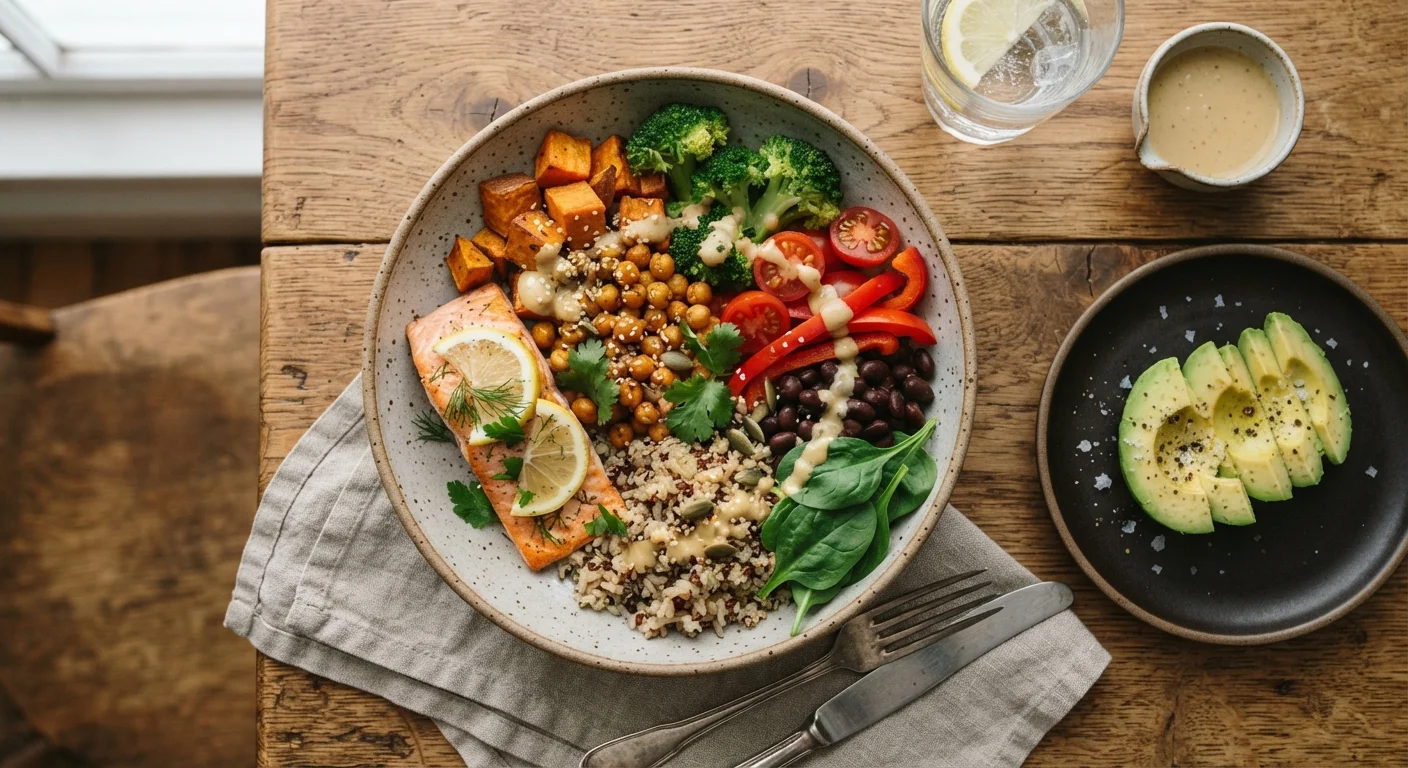
In practice, this means emphasizing whole or minimally processed foods most of the time, including a wide range of vegetables, whole grains, lean proteins, legumes, and healthy fats — while leaving room for occasional flexibility. It also means paying attention to how you eat: meal timing, hunger cues, and eating environment all influence outcomes.
~80%
Of dieters regain lost weight within 5 years
A frequently cited range in long-term diet outcome research suggests the large majority of people who lose weight through restrictive dieting regain most of it within a few years.
2x
Greater diet adherence with flexible vs. rigid approaches
Studies published in behavioral nutrition journals have found that individuals using flexible dietary strategies show significantly higher long-term adherence compared to those following rigid, rule-based plans.
Consistency beats intensity in dietary change, just as it does in exercise. Small repeated behaviors — drinking water before meals, adding one vegetable serving per day, cooking at home more often — compound meaningfully over months and years. For those new to rethinking their approach, a grounded introduction to healthier eating offers a practical starting framework.
Extreme Restriction Can Have Serious Consequences
Very low-calorie diets or plans that eliminate entire food groups can lead to nutritional deficiencies, disordered eating patterns, and metabolic changes. These approaches should only be undertaken under close medical supervision. If you feel unable to control eating behaviors or have an anxious relationship with food, please speak with a healthcare professional.
This article is for informational purposes only and does not constitute medical or dietary advice. Consult a registered dietitian or qualified healthcare provider before making significant changes to your diet.