

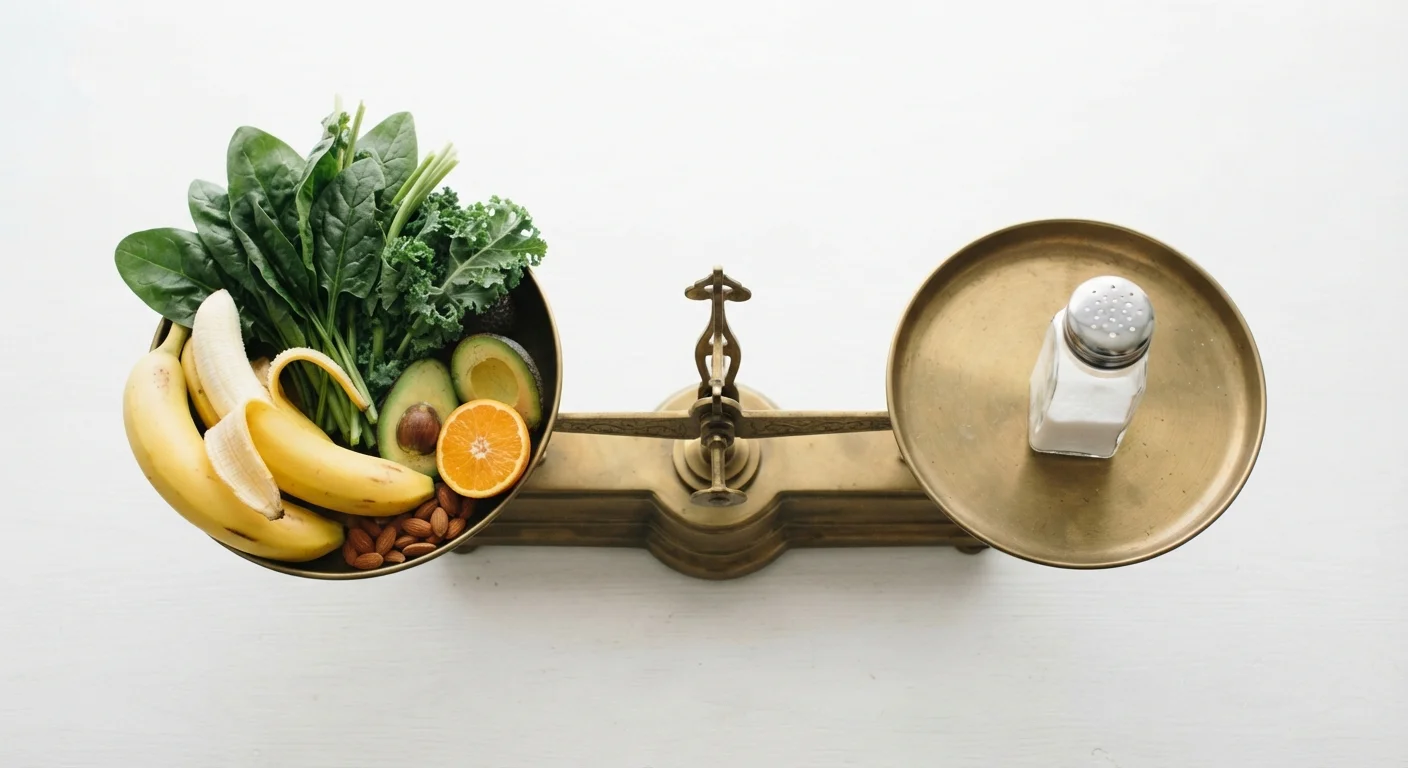
Key Takeaways
- Sodium and potassium are electrolytes that must be balanced — not simply minimized or maximized independently.
- Most Americans consume far too much sodium and far too little potassium, which skews the ratio in a health-damaging direction.
- Potassium helps counteract some of sodium's blood-pressure-raising effects, making dietary ratio as important as total intake.
- The richest potassium sources are whole foods: leafy greens, legumes, potatoes, and certain fruits.
- Processed and packaged foods drive high sodium intake for most Americans, often without obvious taste cues.
- People with kidney disease or certain conditions should consult a healthcare provider before changing potassium intake.
Sodium-Potassium Balance
Sodium and potassium are two electrolyte minerals that work together inside and around every cell in your body. Sodium is the primary mineral in the fluid outside cells, while potassium dominates the fluid inside cells. Together, they regulate fluid balance, blood pressure, muscle contractions, and nerve signal transmission. Getting the right ratio of both — not just limiting one — is what matters most for health.
The sodium-potassium pump (Na⁺/K⁺-ATPase) is an enzyme embedded in cell membranes that actively maintains the concentration gradient between these two minerals, consuming roughly one-third of the body's resting energy in the process.
Why These Two Minerals Are Always a Pair
Sodium and potassium are almost never discussed together in popular health advice — sodium gets the warning labels, while potassium barely makes the conversation. But treating them separately misses the point. These two minerals are biological partners, and your body maintains their balance with extraordinary precision at the cellular level.
Every cell in the human body runs on a system called the sodium-potassium pump. This mechanism moves sodium out of cells and potassium into them, maintaining the electrical charge differences that allow nerve signals to fire and muscles — including the heart — to contract. When that balance is disrupted, nothing works quite right: blood pressure climbs, muscle cramps emerge, and heart rhythm can become irregular.
Just as vitamin D and calcium depend on each other for bone health, potassium and sodium function as a paired system where the ratio matters as much as the raw amount of either mineral.
The American Ratio Problem
For most of human history, people consumed far more potassium than sodium — estimates suggest ancestral diets provided roughly a 5:1 potassium-to-sodium ratio. Today, the typical American diet flips that relationship dramatically in the other direction.
3,400 mg
Average daily sodium intake in the US
According to the CDC, this is roughly 48% above the Dietary Guidelines recommendation of fewer than 2,300 mg per day.
<2,600 mg
Potassium intake for most American women
NHANES data indicates that most American women consume less than the 2,600 mg Adequate Intake for potassium, and men fall short of the 3,400 mg target as well.
~70%
Of sodium from processed and restaurant foods
The CDC estimates that approximately 70% of American sodium intake comes from packaged, processed, and restaurant foods — not the salt shaker.
The culprit is overwhelmingly processed food. Bread, deli meats, canned soups, condiments, and fast food account for the majority of sodium intake for most Americans — often in amounts that are not obvious from taste alone. Meanwhile, potassium-rich whole foods like legumes, leafy vegetables, and potatoes have been largely displaced from everyday plates.
The health consequence is significant. A high-sodium, low-potassium diet is consistently associated with elevated blood pressure and greater risk of cardiovascular disease and stroke. Studies suggest the ratio of sodium to potassium in the diet may predict cardiovascular risk even more accurately than sodium intake alone.
What Potassium Actually Does in the Body
Beyond its partnership with sodium, potassium plays several independent roles. It helps regulate the fluid volume inside cells, supports normal kidney function, and contributes to bone mineral density over the long term. In the cardiovascular system, potassium helps relax blood vessel walls and signals the kidneys to excrete more sodium through urine — a direct mechanism by which higher potassium intake can ease blood pressure.
Potassium deficiency (hypokalemia) at clinical levels is uncommon in healthy people eating varied diets, but low-normal intake — common in the US — may still carry cardiovascular consequences that develop gradually over years. Symptoms of significant deficiency include muscle weakness, fatigue, and in severe cases, heart rhythm disturbances.
It is worth noting that for people with chronic kidney disease or those on certain medications such as ACE inhibitors or potassium-sparing diuretics, potassium can accumulate to unsafe levels. These individuals should not change their potassium intake without guidance from a healthcare provider.
Practical Ways to Improve Your Ratio
Improving the sodium-potassium balance does not require a dramatic dietary overhaul. It primarily means shifting toward whole foods and away from heavily processed ones. Here are practical strategies grounded in everyday eating patterns:
- Build meals around potassium-dense foods. Cooked potatoes (with skin), white beans, lentils, cooked spinach, and avocado are among the most potassium-rich foods per serving. These are affordable, widely available, and versatile.
- Read sodium on labels — not just the front of the package. A food that seems healthy can carry 600–900 mg of sodium per serving. Checking the Nutrition Facts panel helps you track where sodium is actually coming from.
- Cook more at home. Home-prepared meals using herbs, citrus, and spices instead of salt-heavy sauces allow you to control both minerals simultaneously.
- Don't rely on supplements to fill the gap. Over-the-counter potassium supplements are typically capped at 99 mg per dose — far less than what food provides — and higher-dose supplements carry risks without medical supervision.
A Simple Plate-Based Strategy
Aim to fill half your plate with vegetables and legumes at most meals — this single habit naturally drives up potassium while crowding out high-sodium processed sides. Spinach, white beans, edamame, and sweet potatoes are all particularly potassium-dense options. You do not need to count milligrams to move the ratio in the right direction.
Small, consistent changes — adding a serving of beans to a few meals each week, choosing lower-sodium canned goods, swapping salty snacks for fresh fruit — shift the ratio meaningfully over time without requiring perfection.
This article provides general nutrition information and is not a substitute for personalized medical advice. If you have a health condition or take medications that affect electrolyte levels, consult a qualified healthcare provider before making significant dietary changes.