
Skin Cancer Screenings: Self-Exams, Dermatologist Visits, and When Each Makes Sense

Key Takeaways
- Skin cancer is one of the most common cancers in the U.S. and is highly treatable when caught early.
- Monthly self-exams help you notice new or changing spots between professional appointments.
- A dermatologist uses specialized tools and training to detect lesions that self-exams can miss.
- Your personal risk profile — including sun history, skin tone, and family history — shapes how often you need professional screening.
- Neither self-exams nor dermatologist visits alone are sufficient; both serve distinct and complementary roles.
Our Verdict
Self-exams and professional dermatologist screenings are not competing approaches — they work best in tandem. Self-exams keep you familiar with your own skin month to month, while a dermatologist brings diagnostic tools and clinical expertise that no mirror can replicate. The right balance depends on your individual risk factors, which your healthcare provider can help you assess.
| Best for | Recommended |
|---|---|
| Low-risk individuals maintaining baseline awareness | Monthly self-exams with periodic professional screening |
| Those with elevated risk factors (fair skin, UV history, family history, many moles) | Annual or more frequent dermatologist visits plus regular self-exams |
| Anyone who notices a new, changing, or unusual skin lesion | Prompt dermatologist evaluation — do not wait for a scheduled exam |
Why Skin Cancer Screening Matters
Skin cancer is the most commonly diagnosed cancer in the United States, according to the American Academy of Dermatology. The encouraging news: when detected at an early, localized stage, the five-year survival rate for melanoma — the most dangerous form — is markedly higher than when it is caught after spreading. That statistic underscores why proactive screening, rather than waiting for obvious symptoms, is central to preventive skin health.
Skin cancer broadly falls into three main categories: basal cell carcinoma, squamous cell carcinoma, and melanoma. Basal and squamous cell carcinomas are far more common and typically less aggressive, while melanoma carries a higher risk of spreading if not identified early. All three can be identified through a combination of regular self-monitoring and professional evaluation.
To understand how screenings fit into a broader preventive care picture, see why screenings and checkups serve different purposes.
Self-Exams: Your Monthly Baseline
A skin self-exam is a structured, head-to-toe visual inspection you perform at home, ideally once a month. The goal is not to diagnose anything — it is to build familiarity with your own skin so that new or changing spots become obvious over time.
Dermatologists commonly teach the ABCDE rule as a practical guide during self-exams:
- Asymmetry: One half of a mole does not match the other.
- Border: Edges are ragged, notched, or blurred.
- Color: Variation in shades of brown, black, red, white, or blue.
- Diameter: Larger than approximately 6 millimeters (roughly the size of a pencil eraser).
- Evolving: Any change in size, shape, color, or a new symptom such as bleeding or itching.
Self-exams work best in good lighting, using a full-length mirror and a hand mirror to inspect hard-to-see areas like the scalp, back, and soles of the feet. Enlisting a partner to check areas you cannot see clearly adds reliability.
Make Self-Exams More Reliable
Take brief notes or photos of spots you want to track, noting their location and approximate size. This makes it much easier to recognize genuine change at your next self-exam. Consistency in timing — same day of the month, same lighting — improves the reliability of your observations.
Limitations exist. Self-exams cannot replicate the clinical precision of a trained eye or the magnification tools a dermatologist uses. They also rely on the examiner's ability to distinguish a benign spot from a suspicious one — a judgment that takes clinical training to make confidently.
Dermatologist Screenings: What Professionals Add
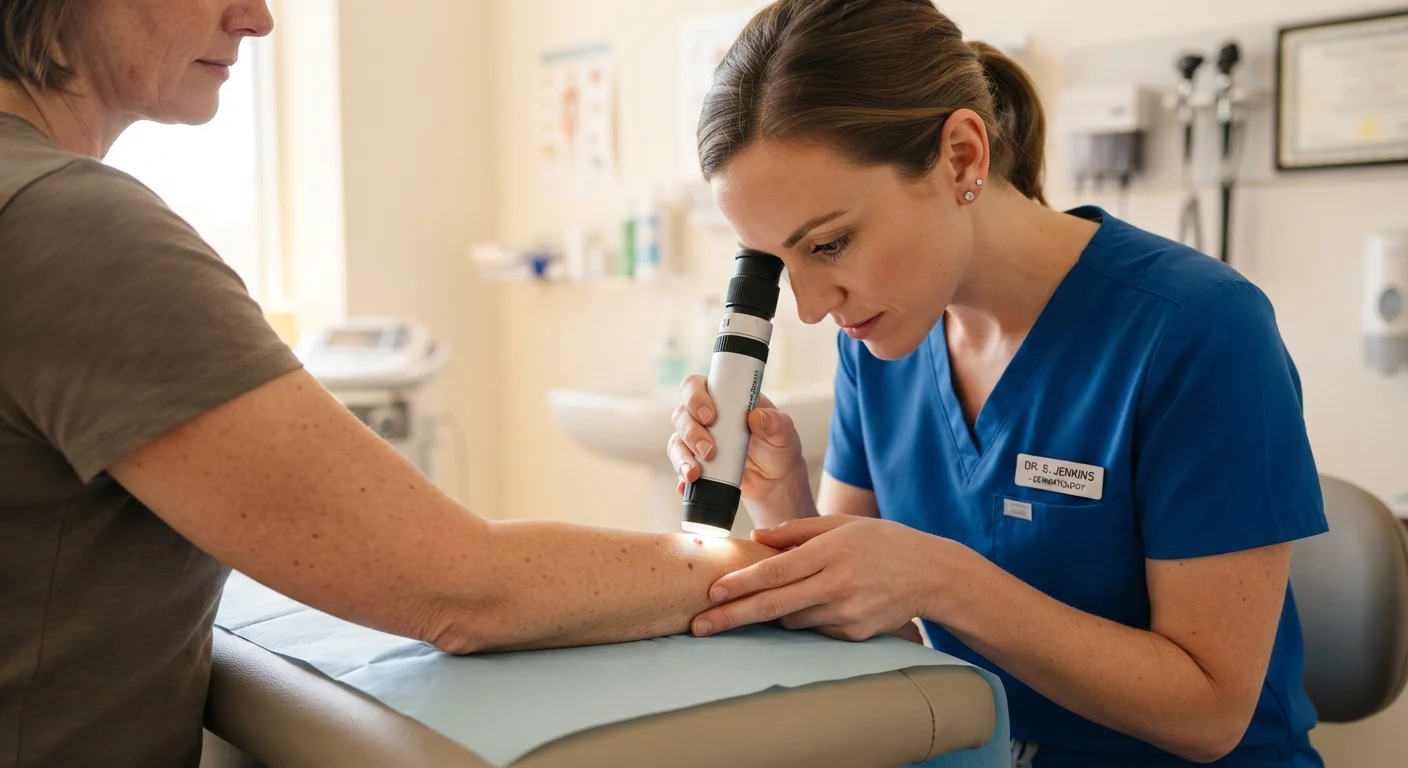
A full-body skin exam by a board-certified dermatologist goes considerably further than a home check. Using a dermoscope — a handheld device that magnifies and illuminates the skin — a dermatologist can evaluate pigment patterns, vascular structures, and architectural features invisible to the naked eye. Some practices also use digital imaging systems to map and track moles over time, enabling direct comparison between visits.
During a professional exam, the clinician evaluates every skin surface systematically, including areas patients commonly overlook: between toes, under fingernails, the genitals, and the back of the scalp. Suspicious lesions may be biopsied in the office — a minor procedure that provides a definitive tissue diagnosis.
| Self-Exam | Dermatologist Screening | |
|---|---|---|
| Who performs it | The individual at home | Board-certified dermatologist |
| Frequency | Monthly recommended | Varies by risk; annually for many adults |
| Tools used | Mirror, good lighting | Dermoscope, digital imaging, biopsy capability |
| Areas covered | Most accessible surfaces | Full body including hard-to-see areas |
| Diagnostic accuracy | Limited by layperson judgment | High — clinical training and magnification |
| Cost | No direct cost | Varies; often covered by insurance |
| Best role | Early change detection between visits | Definitive evaluation and biopsy if needed |
How often you should see a dermatologist varies. Major dermatology organizations generally recommend that adults with average risk have a baseline professional exam in their twenties or thirties, with frequency thereafter guided by findings and risk profile. Those with elevated risk — a history of skin cancer, numerous atypical moles, significant cumulative sun exposure, or a family history of melanoma — may warrant annual or even more frequent visits.
For women navigating multiple preventive care milestones, a lifespan overview of women's preventive screenings can help contextualize skin screening within a broader care schedule.
Matching Your Approach to Your Risk Profile
No single screening schedule fits everyone. Key risk factors that influence how closely your skin should be monitored include:
- Fair skin, light eyes, or a tendency to burn rather than tan
- A personal or family history of skin cancer or atypical moles
- A high lifetime dose of UV exposure, including indoor tanning
- A history of severe or blistering sunburns, especially in childhood
- Immunosuppression due to medication or medical conditions
If several of these apply to you, a conversation with a dermatologist about a personalized surveillance plan is warranted. If you are uncertain whether your risk level calls for more frequent professional exams, talking to your doctor about screening recommendations offers practical guidance on framing that discussion productively.
It is also worth recognizing that skipping professional screenings because nothing looks visibly wrong is a common pattern with real consequences. Treating screenings as optional explores how that mindset can delay detection in ways that are difficult to reverse.
This article is for general informational and educational purposes only and does not constitute medical advice. Always consult a qualified healthcare professional regarding any skin concerns, changes you notice, or questions about appropriate screening frequency for your individual situation.