

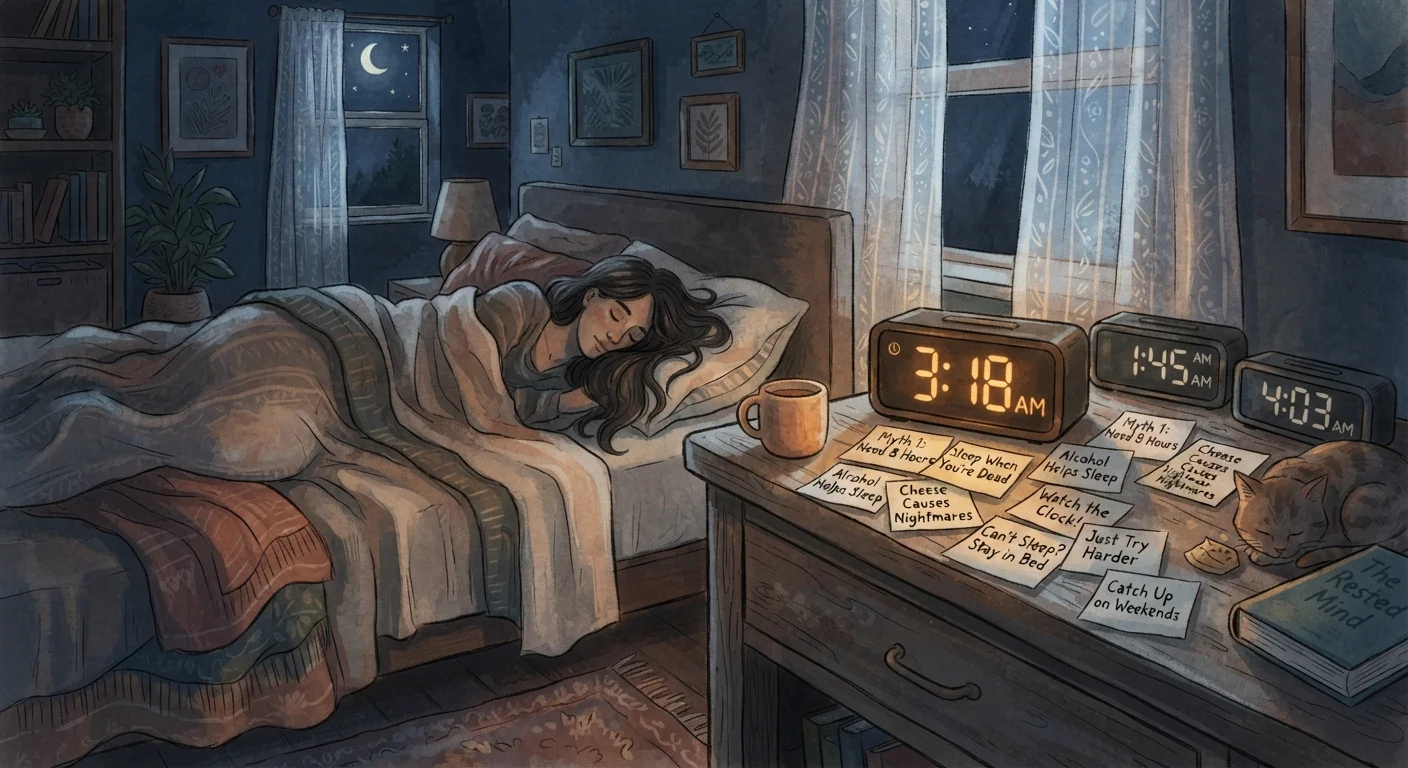
Key Takeaways
- Eight hours of sleep is a general guideline, not a universal requirement for every adult.
- Weekend sleep 'catch-up' cannot fully reverse the cognitive and metabolic effects of weekday sleep debt.
- Alcohol may help you fall asleep faster but significantly disrupts sleep quality and REM cycles.
- Your body does not fully adapt to chronic sleep restriction — performance deficits accumulate silently.
- Consistency in sleep timing matters as much as total sleep duration for overall health.
Why Sleep Myths Are So Persistent
Sleep occupies roughly a third of our lives, yet most Americans hold at least a few fundamentally incorrect beliefs about how it works. These myths aren't harmless — they shape nightly decisions that compound over weeks and years into real consequences for mood, cognition, metabolic health, and cardiovascular function.
The problem isn't a lack of information. It's that many sleep misconceptions feel intuitive. "I'll sleep in on Saturday" or "a nightcap helps me wind down" are behaviors reinforced by short-term experience, even when the underlying biology tells a different story. What follows are some of the most widespread sleep myths, corrected by what research actually supports.
For a broader look at how sleep science intersects with daily performance, the Sleep Science Basics hub offers a solid foundation.
The Myths, Corrected
Each of the following misconceptions is something a significant portion of American adults believe — and act on. Understanding why they're wrong is the first step toward building genuinely sustainable sleep habits.
Myth
Everyone needs exactly eight hours of sleep to function properly.
Fact
Sleep needs vary by individual. Most adults need between seven and nine hours, but the right amount depends on genetics, age, health status, and lifestyle.
The "eight hours" figure is a population-level median, not a prescription. The American Academy of Sleep Medicine recommends that adults aim for at least seven hours, while acknowledging that individual requirements vary. Some adults feel fully restored on six and a half hours; others genuinely need nine. Chronically sleeping fewer hours than your body requires — regardless of where your personal threshold falls — is associated with impaired cognition, weakened immune response, and metabolic disruption. For more on this, see our piece on common misconceptions about how much sleep adults actually need.
Myth
You can catch up on lost sleep over the weekend and be fully recovered by Monday.
Fact
Weekend recovery sleep helps short-term alertness but does not fully reverse the cognitive and metabolic deficits accumulated through weekday sleep restriction.
Research, including work published in Current Biology, has shown that while sleeping in on weekends can partially reduce sleepiness, it does not fully restore reaction times, attention, or metabolic markers that degrade under chronic sleep restriction. Additionally, irregular sleep timing across the week disrupts the circadian system itself — a pattern sometimes called "social jetlag" — which carries its own health associations. Our detailed article on catching up on sleep over the weekend examines the evidence in full.
Myth
Alcohol before bed helps you sleep better.
Fact
Alcohol can reduce the time it takes to fall asleep, but it suppresses REM sleep and causes sleep fragmentation in the second half of the night.
Alcohol is a sedative, which is why it produces a sense of drowsiness. However, as the body metabolizes it during the night, it triggers a rebound effect — increasing arousal, causing more frequent awakenings, and suppressing REM (rapid eye movement) sleep, which is critical for memory consolidation and emotional regulation. Habitual use also builds tolerance to the sedative effect while the sleep-disrupting effects persist. People who rely on alcohol as a sleep aid often end up with both poorer sleep quality and a dependence that becomes harder to break over time.
Myth
Your body adjusts to less sleep if you do it long enough.
Fact
People adapt to feeling less sleepy under chronic sleep restriction, but their actual cognitive performance continues to deteriorate — they simply lose the ability to accurately perceive the deficit.
Studies by sleep researcher David Dinges and colleagues at the University of Pennsylvania demonstrated that people restricted to six hours of sleep per night for two weeks showed cognitive performance equivalent to subjects who had been kept awake for 24 hours straight — yet they reported feeling only slightly sleepy. The subjective sense of adjustment is real; the objective impairment is also real. This disconnect is one of the most consequential findings in sleep science, because it means individuals operating on insufficient sleep often cannot self-assess how impaired they are.
Myth
Lying in bed with your eyes closed is almost as good as actual sleep.
Fact
Quiet rest without sleep provides some cognitive relief but does not replicate the restorative biological processes — including memory consolidation and cellular repair — that occur during sleep stages.
Sleep is an active biological state, not simply the absence of wakefulness. During sleep, the brain cycles through distinct stages including slow-wave (deep) sleep and REM sleep, each serving specific functions: hormonal regulation, immune activity, memory consolidation, and waste clearance via the glymphatic system. Passive rest in a dark room can reduce mental fatigue to a degree, but it cannot substitute for these stage-dependent processes. This distinction matters for anyone tempted to replace a short nap or earlier bedtime with extended quiet wakefulness in bed.
If you frequently wake up feeling unrefreshed despite adequate time in bed, the issue is often sleep quality rather than quantity. Our article on why a full night's sleep still leaves some people exhausted explores the most common culprits in detail.
Building Habits That Actually Work
Correcting myths is only useful if it leads to practical change. The research consistently points toward a few evidence-backed principles that most adults can implement without major disruption.
- Anchor your schedule. Going to bed and waking at consistent times — even on weekends — reinforces your circadian rhythm (your body's internal 24-hour clock). For a deeper look at this trade-off, see our comparison of consistent bedtimes versus sleeping in on weekends.
- Treat light exposure as a lever. Morning light suppresses melatonin and signals wakefulness; evening light delays sleep onset. Managing this exposure is one of the highest-leverage behavioral changes available.
- Replace alcohol wind-downs. If alcohol is part of your pre-bed routine, substituting a non-stimulating alternative — herbal tea, light reading, or breathing exercises — preserves the winding-down ritual without fragmenting sleep architecture.
- Question your sleep assumptions. If you consistently feel tired despite clocking hours in bed, the answer may not be more sleep but better sleep. Our piece on waking up groggy despite eight hours of sleep addresses the behavioral and environmental factors most commonly responsible.
Persistent Sleep Problems Warrant Professional Attention
If you consistently struggle to fall asleep, stay asleep, or feel rested despite adequate time in bed, these may be signs of an underlying sleep disorder such as insomnia or sleep apnea. These conditions are treatable, but they require proper clinical evaluation. Do not attempt to self-diagnose or self-treat based on general information alone — consult a qualified healthcare professional.
This article is for general informational purposes only and does not constitute medical advice. If you have persistent concerns about sleep quality, daytime fatigue, or suspected sleep disorders, please consult a qualified healthcare professional.