

Key Takeaways
- Sleep is a biologically active process essential for physical repair, memory consolidation, and emotional regulation.
- Two interlocking systems — circadian rhythm and sleep pressure — determine when and how deeply you sleep.
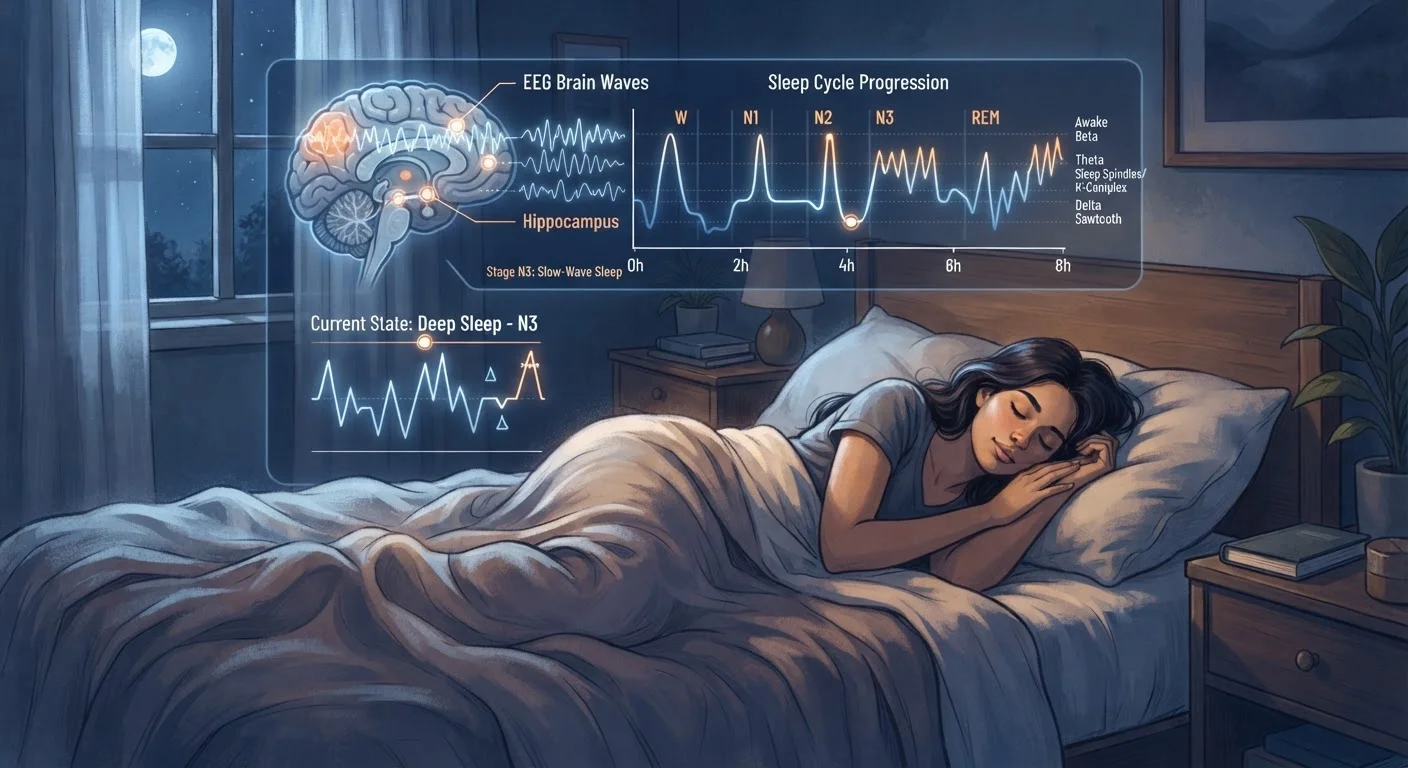
- A full night consists of multiple 90-minute cycles, each containing distinct NREM and REM stages.
- Melatonin and cortisol are the primary hormones orchestrating the timing of sleep and wakefulness.
- Light exposure, irregular schedules, and stress are the most common biological disruptors of healthy sleep.
Start here
Why Humans Need Sleep at All
Next
The Two Systems That Govern Your Sleep
Then
Sleep Stages and Cycles: The Basics
Dig deeper
Key Hormones Involved in Sleep
Apply it
What Disrupts Sleep Biology
Why Humans Need Sleep at All
Sleep is not passive downtime — it is one of the most metabolically active periods of your day. During sleep, the brain consolidates memories, the body repairs tissues, the immune system strengthens its defenses, and hormones critical for growth and appetite regulation are released. No waking activity fully substitutes for these processes.
From an evolutionary standpoint, the fact that all mammals sleep — despite the vulnerability it creates — underscores how biologically indispensable sleep is. For a foundational look at how these processes interact with daily performance, see a practical starting point for improving your sleep.
Circadian rhythm
Your body's internal 24-hour clock that regulates sleep, wakefulness, and many other biological processes based largely on light and darkness cues.
Sleep pressure
The biological drive to sleep that builds the longer you remain awake, driven by the accumulation of a chemical called adenosine in the brain.
NREM sleep
Non-rapid eye movement sleep — the category of sleep stages that includes light sleep and the deepest, most physically restorative slow-wave sleep.
REM sleep
Rapid eye movement sleep — a stage characterized by high brain activity, vivid dreaming, and processing of emotional memories.
Melatonin
A hormone released by the pineal gland in response to darkness that signals to the body it is time to prepare for sleep.
Sleep architecture
The overall structure and pattern of sleep stages across a full night, including how cycles of NREM and REM repeat and evolve in composition.
The Two Systems That Govern Your Sleep
Your sleep is regulated by two interlocking biological mechanisms working in concert.
- Circadian rhythm: An internal 24-hour clock, anchored in a brain structure called the suprachiasmatic nucleus (SCN), that aligns your sleep-wake cycle with the environment — primarily using light as its cue.
- Sleep pressure (homeostatic drive): The longer you stay awake, the more adenosine — a byproduct of neural activity — accumulates in the brain. This chemical buildup creates an increasing biological urge to sleep. Adenosine clears during sleep, restoring alertness.
When these two systems are synchronized, falling asleep and waking feel natural and effortless. When they conflict — due to shift work, jet lag, or irregular schedules — sleep quality suffers noticeably.
Sleep Stages and Cycles: The Basics
A typical night of sleep is not a uniform state. Instead, the brain cycles through distinct stages roughly every 90 minutes, with four to six complete cycles in a full night.
- NREM Stage 1 (N1)
- The lightest stage — a brief transition between wakefulness and sleep lasting a few minutes.
- NREM Stage 2 (N2)
- Body temperature drops, heart rate slows, and the brain produces sleep spindles — bursts of rhythmic activity associated with memory consolidation.
- NREM Stage 3 (N3) — Slow-Wave Sleep
- The deepest, most restorative stage. Growth hormone is released and physical repair is most active here. It is hardest to wake someone from this stage.
- REM Sleep
- Brain activity increases dramatically, resembling wakefulness. Most vivid dreaming occurs here, and emotional memory processing is a key function.
Early cycles contain more deep NREM sleep; REM periods lengthen as the night progresses. This is why a full eight hours yields meaningfully more REM than six hours. For a more detailed stage-by-stage breakdown, explore what your brain does during each sleep stage.
Key Hormones Involved in Sleep
Several hormones directly shape when and how well you sleep.
- Melatonin: Produced by the pineal gland in response to darkness, melatonin is a timing signal — it does not cause sleep directly, but cues the body that nighttime has arrived. Light suppresses its release, which is why bright evening light can delay sleep onset.
- Cortisol: Often called a stress hormone, cortisol also serves a healthy circadian purpose — levels rise naturally in the early morning hours to promote wakefulness and alertness. Chronically elevated nighttime cortisol from stress can interfere with sleep onset and quality.
- Adenosine: Though technically a neuromodulator rather than a classic hormone, adenosine accumulates throughout the day and is a primary driver of sleep pressure. Caffeine works by blocking adenosine receptors — temporarily masking tiredness rather than eliminating it.
Time Your Caffeine Wisely
Because caffeine blocks adenosine receptors — the very chemical that builds your natural sleep drive — consuming it too late in the day can make it harder to fall asleep even when you feel tired. A general guideline used by sleep researchers is to avoid caffeine within six hours of your intended bedtime. Individual sensitivity varies, so pay attention to how your own body responds.
What Disrupts Sleep Biology
Understanding the biology of sleep makes it easier to identify what undermines it. The most common biological disruptors include:
- Light at night: Blue-wavelength light from screens and overhead lighting suppresses melatonin and delays circadian timing.
- Irregular sleep schedules: Shifting bedtimes by more than an hour or two between weekdays and weekends — sometimes called social jet lag — misaligns the circadian clock.
- Caffeine timing: Because caffeine has a half-life of roughly five to six hours in most adults, afternoon consumption can still be measurably present in the body at bedtime.
- Chronic stress: Elevated cortisol and arousal states keep the nervous system in a heightened alert mode that is physiologically incompatible with deep sleep.
Building sustainable habits that work with your biology — rather than against it — is the most evidence-supported path to consistent, restorative sleep. See our complete guide to building lasting sleep habits for practical application. You can also explore the Sleep Habits & Hygiene hub for a broader collection of evidence-based routines.
This article is for general informational and educational purposes only and does not constitute medical advice. Consult a qualified healthcare professional for guidance specific to your health situation.