

Key Takeaways
- Melatonin secretion begins roughly 1–2 hours before sleep, making the last hour biologically critical.
- Blue-spectrum light from screens suppresses melatonin and delays sleep onset measurably.
- Core body temperature must drop slightly for sleep to begin — cooling your environment helps.
- Mental arousal from stressful content or intense activity prolongs the time it takes to fall asleep.
- Consistent pre-sleep habits signal the brain to anticipate sleep, reinforcing the body's internal clock.
- Poor wind-down quality affects deep slow-wave sleep, not just the time it takes to fall asleep.
Pre-Sleep Wind-Down Window
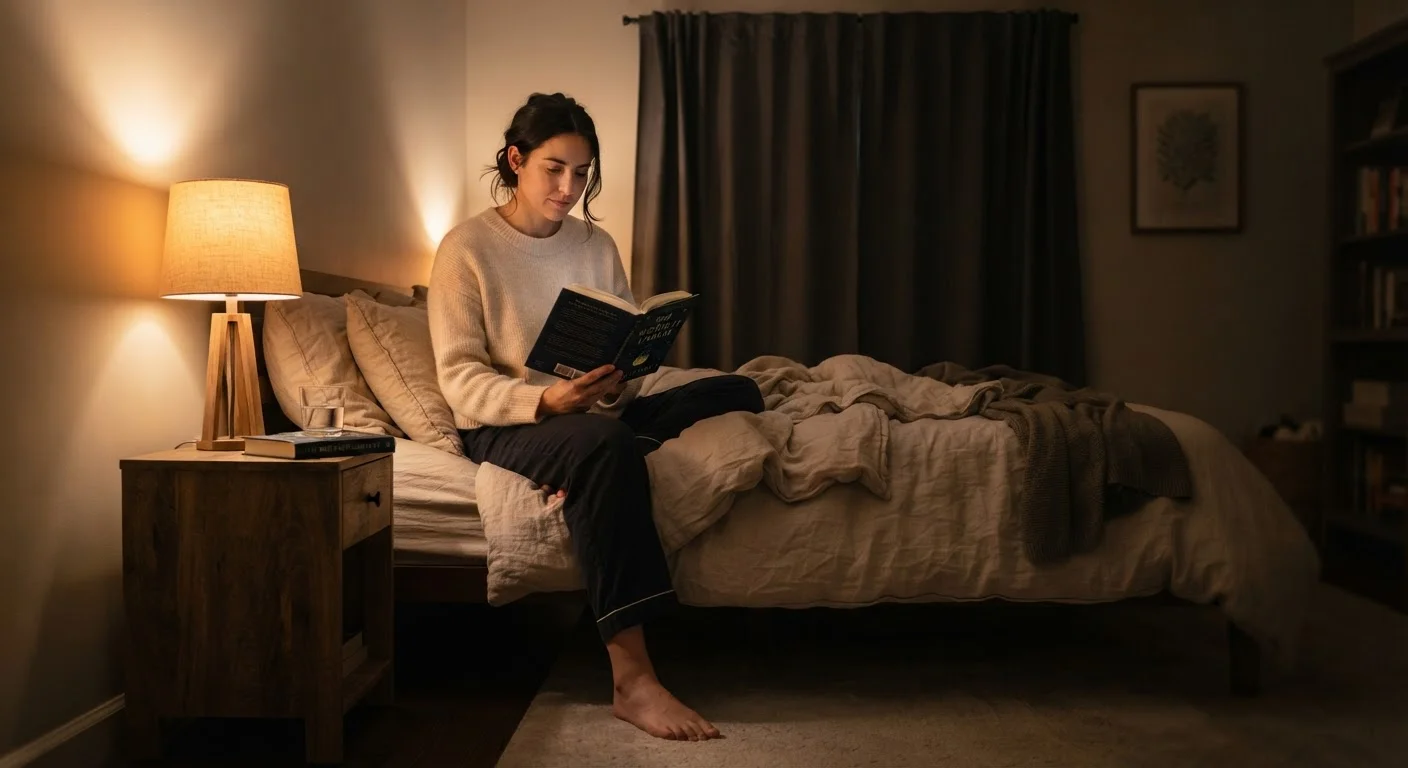
The pre-sleep wind-down window is the roughly 60-minute period before you intend to fall asleep, during which your brain and body undergo a coordinated series of biological shifts to prepare for sleep. Hormone levels, core body temperature, and neural activity all begin changing during this time. How you spend this window — the light you're exposed to, the activities you engage in, and your stress level — directly influences how easily you fall asleep and how restorative that sleep turns out to be.
This window overlaps with the ascending phase of melatonin secretion, known as Dim-Light Melatonin Onset (DLMO), which typically begins 1–2 hours before habitual sleep time and is highly sensitive to environmental light exposure.
The Biology Behind the Wind-Down Window
Sleep doesn't arrive the moment your head hits the pillow. It's the endpoint of a gradual biological process that begins well before you close your eyes — and the last 60 minutes of wakefulness are when that process accelerates most sharply.
Two overlapping mechanisms drive this transition. First, the brain's suprachiasmatic nucleus — the master circadian clock — cues the pineal gland to release melatonin as ambient light dims. This hormone doesn't cause sleep directly; rather, it communicates to virtually every organ system that darkness has arrived and rest should follow. Second, core body temperature follows a predictable nightly decline, dropping by roughly 1–2°F in preparation for sleep. Both processes are sensitive to disruption in ways that earlier evening hours simply are not.
Understanding this biology matters because it reframes the wind-down hour as a physiological event, not just a preference. The choices made during this window — light exposure, mental activity, temperature — either support or interfere with processes the body is already trying to execute. For a broader look at how your sleep environment interacts with these systems, see how temperature, light, and noise shape sleep quality.
~85%
Melatonin suppression from blue light exposure
Research has shown that evening blue-light exposure under certain intensities and durations can suppress melatonin production by up to approximately 85% compared to dim-light conditions.
1–2°F
Core body temperature drop needed for sleep onset
Sleep physiology research indicates the body must shed approximately 1–2°F of core temperature as part of the normal sleep-initiation process.
1–2 hours
Before bedtime melatonin secretion typically begins
Dim-Light Melatonin Onset (DLMO) generally occurs 1–2 hours before an individual's habitual sleep time, marking the start of the active biological wind-down phase.
Light: The Most Powerful Disruptor
Of all the inputs that affect the pre-sleep window, light — particularly short-wavelength blue light — is the most potent circadian disruptor. Photoreceptors in the retina called intrinsically photosensitive retinal ganglion cells (ipRGCs) are especially sensitive to blue-spectrum wavelengths and feed directly into the circadian clock. When these cells detect blue light in the evening, they signal the brain to suppress melatonin and maintain wakefulness.
Smartphones, tablets, LED televisions, and overhead lighting all emit meaningful blue-light content. Studies have found that evening blue-light exposure can suppress melatonin by up to 85% in some conditions and delay sleep timing significantly. Dimming lights, switching to warm-toned bulbs, and using amber or red-tinted lighting in the final hour are approaches supported by the underlying science — though individual sensitivity varies.
This also connects to the content consumed, not just the light emitted. Emotionally activating news, social media, or work emails create cognitive arousal that independently delays sleep, compounding the photoreceptor effect. The combination of bright light and mental stimulation makes the modern smartphone an especially effective sleep disruptor in the pre-bed window.
Temperature and the Sleep-Onset Signal
Core body temperature and sleep are tightly coupled. As sleep approaches, the body sheds heat through peripheral vasodilation — increased blood flow to the hands and feet — causing that characteristic warm, slightly flushed feeling some people notice when drowsy. This peripheral warming allows core temperature to fall, and that drop is a biological prerequisite for sleep initiation.
A bedroom environment that is too warm interferes with this process. Sleep research broadly supports a cool sleeping environment — typically in the low-to-mid 60s Fahrenheit for most adults — as optimal for both sleep onset and maintenance. A room that stays warm prevents the core temperature decline the body is working to achieve.
Counterintuitively, a warm bath or shower taken 60–90 minutes before bed can accelerate this process. The temporary increase in skin temperature followed by rapid heat loss when you leave the warm water mimics and amplifies the natural pre-sleep cooling cascade. This is sometimes called the "warm bath effect" in sleep research literature.
Mental Arousal and the Cognitive Wind-Down
Physical conditions aside, cognitive arousal is a major determinant of sleep latency — the time it takes to fall asleep once you're in bed. The brain's arousal systems, particularly the noradrenergic and orexin pathways, must downregulate for sleep to begin. High-stakes mental activity — problem-solving, emotionally charged conversations, or consuming anxiety-inducing content — keeps these systems active long after the activity ends.
This is why many people report lying awake with racing thoughts even when they feel physically exhausted. The body may be ready; the brain is not. Practices that reduce rumination and cognitive load during the wind-down hour — journaling, light reading, breathing exercises — work in part by allowing this neural deactivation to proceed. There is no single prescribed method; the goal is reducing mental engagement with arousing material, not following a rigid ritual.
It's worth noting that the wind-down window doesn't operate in isolation. The habits built across the full evening — not just the final hour — compound over time. For a deeper look at how the broader evening period shapes deep sleep architecture, see your evening routine's hidden effect on deep sleep. And for a comprehensive overview of every factor shaping nightly rest, every factor that influences sleep quality is a useful reference.
This article is for general informational and educational purposes only and is not a substitute for professional medical advice, diagnosis, or treatment. If you experience persistent sleep difficulties, consult a qualified healthcare provider.