

Key Takeaways
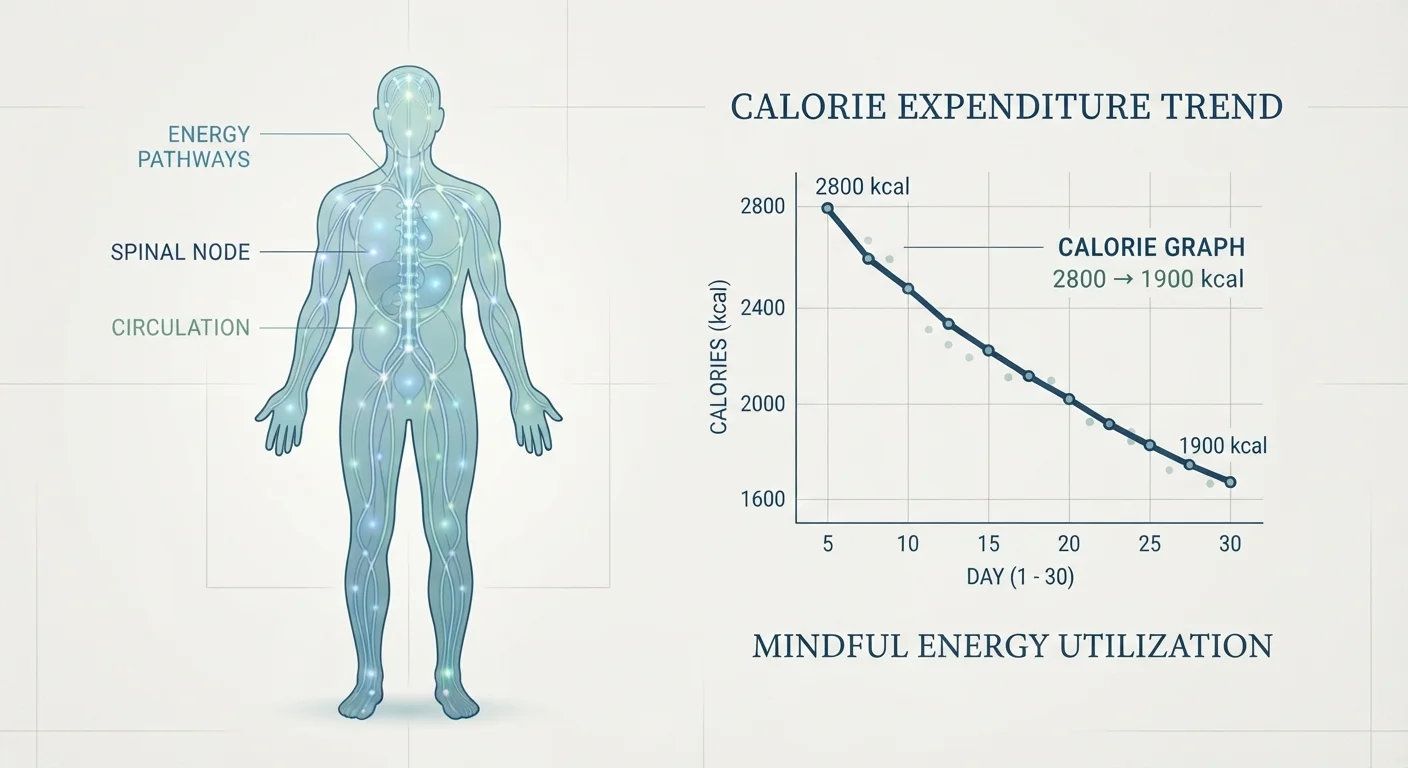
- A calorie deficit triggers metabolic adaptation, causing your body to burn fewer calories over time.
- Resting metabolic rate can drop beyond what body composition changes alone would predict.
- Non-exercise activity thermogenesis (NEAT) often decreases unconsciously during a deficit, compounding energy savings.
- Losing lean muscle mass during a deficit is a key driver of slowed metabolism.
- Resistance training and adequate protein intake help preserve muscle and moderate the metabolic slowdown.
- Metabolic adaptation is real but not permanent - it can partially reverse as eating patterns normalize.
Metabolic Adaptation
Metabolic adaptation is the process by which your body adjusts how much energy it burns in response to changes in food intake. When you eat less over a sustained period, your metabolism doesn't stay fixed - it gradually reduces the calories it expends, partly to protect against what it interprets as a potential energy shortage. This means weight loss often slows even without any change in your eating habits.
Also called adaptive thermogenesis, this response involves reductions in resting metabolic rate beyond what can be explained by changes in body mass alone - a phenomenon well-documented in clinical weight-loss research.
Your Body Treats a Calorie Deficit as a Threat
When you consistently eat fewer calories than your body burns, something counterintuitive begins to happen: your body fights back. Rather than passively burning through its energy stores, it actively recalibrates how much energy it uses. This response - known as metabolic adaptation or adaptive thermogenesis - is rooted in biology, not willpower.
Think of it as a built-in survival mechanism. Your metabolism has no way of distinguishing a deliberate diet from a famine. Faced with a sustained energy shortfall, it shifts into a more economical mode - preserving fuel wherever possible. The result is a gradual reduction in total daily energy expenditure that can make continued weight loss harder than expected.
Understanding this process doesn't mean your goals are out of reach. It means having realistic expectations and smarter strategies. For a broader look at how calorie intake and metabolic rate interact over time, see our article on how calorie deficits and metabolic rate shape weight outcomes.
The Key Components That Change
Your total daily energy expenditure is made up of several distinct components, and a calorie deficit affects nearly all of them:
- Resting Metabolic Rate (RMR): The calories your body burns just to maintain basic functions - breathing, circulation, cellular repair. RMR declines during a deficit, partly because of reduced body mass, but also because of adaptive thermogenesis that exceeds what body size alone would predict.
- Non-Exercise Activity Thermogenesis (NEAT): This is the energy spent on everyday movement - walking to your car, doing chores, shifting in your seat. Research shows NEAT often drops significantly and unconsciously during calorie restriction, sometimes accounting for hundreds of fewer calories burned per day.
- Thermic Effect of Food (TEF): Since you're eating less food, your body also spends less energy digesting it. Learn how TEF contributes to total energy expenditure - it's a smaller component, but it does shift with intake.
- Exercise Energy Expenditure: As body weight decreases, the same physical activity burns slightly fewer calories simply because there's less mass to move.
~15-20%
Potential drop in resting metabolic rate during sustained restriction
Research published in peer-reviewed metabolism journals indicates RMR can fall by this range during prolonged calorie deficits, beyond what body weight loss alone predicts.
~300 kcal/day
Average NEAT reduction observed during calorie restriction
Studies on adaptive thermogenesis have documented unconscious reductions in non-exercise movement of this magnitude in some individuals undergoing calorie restriction.
~25%
Proportion of weight loss that can be lean mass without resistance training
Exercise physiology research suggests that without strength training and adequate protein, a substantial portion of weight lost during a deficit may come from lean tissue rather than fat.
Hormonal changes amplify these shifts. Leptin - a hormone that signals fullness and supports metabolic rate - falls during sustained restriction. Hunger hormones like ghrelin tend to rise. The net effect is a body that burns less and wants more.
The Role of Muscle Mass
One of the most metabolically significant consequences of a calorie deficit is the potential loss of lean muscle tissue. Muscle is metabolically expensive - it burns more calories at rest than fat does. When the body needs fuel and protein intake or resistance training is insufficient, it can break down muscle for energy.
This creates a compounding problem: less muscle means a lower resting metabolic rate, which means the same calorie intake now represents a smaller deficit - or no deficit at all. This is a primary reason why rapid or severe calorie restriction tends to produce diminishing returns over time.
Protect Muscle to Protect Your Metabolism
During any calorie deficit, prioritize protein intake - most nutrition researchers suggest higher protein targets help preserve lean tissue. Pairing this with regular resistance training sends a strong signal to your body to hold onto muscle, moderating the metabolic slowdown that naturally accompanies reduced calorie intake.
Adequate protein intake and regular resistance training are among the most evidence-supported strategies for preserving muscle during a deficit. These approaches don't eliminate metabolic adaptation, but they can meaningfully moderate it. For a closer look at how exercise affects metabolic rate beyond calorie burn, see how physical activity influences metabolic rate.
What This Means in Practice
Metabolic adaptation helps explain several frustrating but common experiences: weight loss that stalls despite no changes in diet, feeling colder or more fatigued during a prolonged deficit, or regaining weight quickly after returning to normal eating. None of these are signs of personal failure - they're predictable biological responses.
A few practical implications worth understanding:
- Weight loss plateaus are expected, not aberrations. As metabolic rate adjusts, the energy deficit narrows automatically. This is normal physiology, not a broken metabolism.
- Extreme restriction can be counterproductive. Larger deficits don't necessarily produce faster long-term results, and they tend to trigger stronger adaptive responses and greater muscle loss.
- Recovery periods matter. Some research suggests that planned breaks from restriction - sometimes called diet breaks - may help partially reset adaptive responses, though this area of science is still developing.
Many of the myths that circulate about "boosting" your metabolism or "breaking" it are addressed in our companion piece on metabolism myths that won't die. And if you've found yourself attributing stubborn weight to a slow metabolism, this article on metabolism misreadings may offer useful perspective.
This article is for general informational and educational purposes only and is not a substitute for personalized medical or nutritional advice. Consult a qualified healthcare professional before making significant changes to your diet or exercise routine.