
Calorie Deficit vs. Metabolic Rate: Understanding the Real Engine of Weight Change

Key Takeaways
- A calorie deficit is necessary for weight loss, but it does not operate in isolation from your metabolism.
- Metabolic rate adapts in response to reduced calorie intake, a process sometimes called metabolic adaptation.
- Losing muscle mass during a deficit can lower resting metabolic rate, making sustained weight loss harder.
- Physical activity influences metabolic rate in ways that extend well beyond calories burned during exercise.
- Both levers - intake and metabolic rate - must be understood together to build a sustainable strategy.
Option A
Calorie Deficit
The energy-intake lever you can directly control.
Best for: Establishing a starting point for weight change by consistently consuming fewer calories than you expend.
Option B
Metabolic Rate
The adaptive, biological engine that responds to what you eat and do.
Best for: Understanding why weight change slows, plateaus, or reverses - and how to manage long-term energy balance.
If you want to initiate weight loss and need a clear, actionable starting point
Calorie Deficit
Creating a moderate energy deficit is the most direct and well-supported method for initiating fat loss, and it gives you a measurable variable to work with.
If you've hit a weight-loss plateau despite eating less
Metabolic Rate
Plateaus are often explained by metabolic adaptation. Understanding how your body has adjusted its energy expenditure is essential before making further dietary changes.
If you want to protect long-term results and avoid regain
Metabolic Rate
Preserving or improving metabolic rate - through resistance training, adequate protein, and gradual deficits - is the best documented strategy for keeping weight off sustainably.
If you're building a weight management plan from scratch
Calorie Deficit
Starting with a well-calibrated deficit provides structure, while monitoring signs of metabolic adaptation allows you to course-correct over time.
Two Sides of the Same Equation
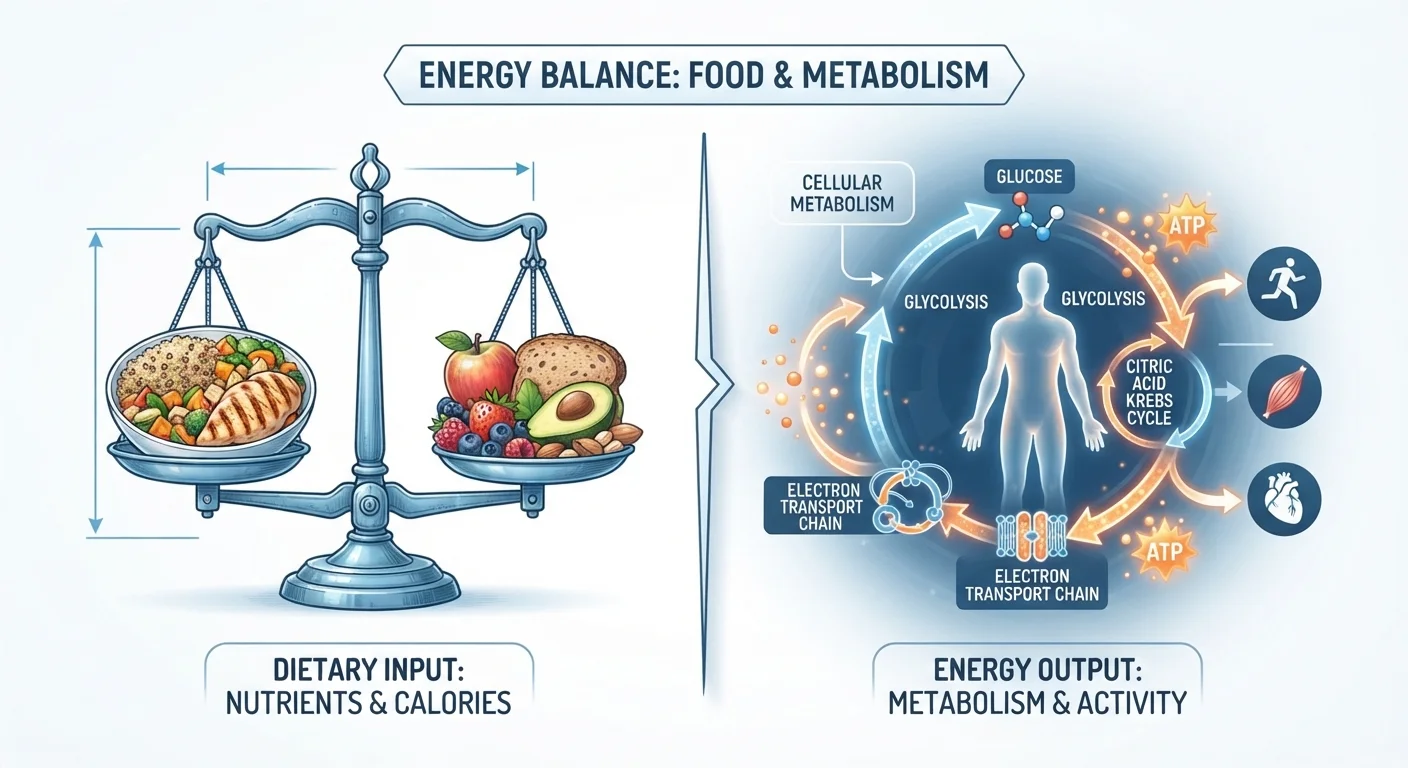
Weight change comes down to energy balance: the relationship between how many calories you take in and how many your body expends. Most people are familiar with one side of this equation - eating less, or creating a calorie deficit. Fewer appreciate how much the other side, metabolic rate, shifts in response. To understand why weight loss works the way it does - and why it sometimes stops working - you need to look at both.
A calorie deficit means consuming fewer calories than your body uses in a given period. On paper, this is straightforward: a sustained deficit leads to weight loss. But the body is not a static calculator. It responds to changes in energy availability by adjusting how much energy it burns, which is where metabolic rate enters the picture.
For a deeper foundation on what metabolism actually involves, see what metabolism actually is - because it's far more than a simple speed dial.
How a Calorie Deficit Triggers Metabolic Adaptation
When calorie intake drops significantly, the body interprets the change as a potential energy shortage and responds by becoming more efficient. This is known as metabolic adaptation - a reduction in total energy expenditure beyond what would be predicted from weight loss alone. Research published in peer-reviewed journals, including studies examining long-term dieting behavior, consistently shows that this adaptation is real and clinically meaningful.
Several mechanisms drive it. Resting metabolic rate (RMR) - the energy your body burns at complete rest - declines partly because you weigh less (less tissue to maintain), and partly due to hormonal shifts, including reductions in thyroid hormones and leptin. Non-exercise activity thermogenesis (NEAT), which covers all movement outside formal exercise, also tends to fall unconsciously as energy availability decreases.
| Criterion | Calorie Deficit | Metabolic Rate |
|---|---|---|
| What it is | Energy intake below expenditure | Total calories body burns daily |
| Directly controllable? | Yes - via food choices and portions | Partially - influenced but not fully controlled |
| Adapts over time? | Static tool; you adjust it | Yes - decreases in response to deficit |
| Key components | Food intake minus total expenditure | RMR, NEAT, thermic effect of food, exercise |
| Primary risk if mismanaged | Muscle loss, nutrient deficiency | Plateau, metabolic adaptation, regain |
| Supported by exercise? | Indirectly - exercise increases expenditure | Yes - especially resistance training |
The practical consequence: a calorie deficit that produced results in week one may produce fewer results by week twelve, even if your intake hasn't changed. What happens to your metabolism during a calorie deficit covers these adaptive mechanisms in detail.
Muscle Mass: The Metabolic Rate Wildcard
One of the most important - and underappreciated - interactions between calorie deficits and metabolic rate involves lean body mass. Muscle tissue is metabolically expensive: it burns significantly more calories at rest than fat tissue. When a calorie deficit is too aggressive or protein intake is inadequate, the body may break down muscle alongside fat for fuel.
This matters because losing muscle during a deficit directly lowers RMR. The result is a lower metabolic rate that persists even after the diet ends - a key driver of weight regain. Resistance training and sufficient dietary protein are the two most evidence-supported strategies for preserving muscle mass during a deficit, helping to protect long-term metabolic rate.
Protein's Role in Protecting Metabolic Rate
Research consistently supports higher protein intake during a calorie deficit as a strategy for preserving lean muscle mass. Dietary protein also has a higher thermic effect than carbohydrates or fat, meaning the body burns more calories digesting it. While exact targets vary by individual, the principle of prioritizing protein during weight loss is well-established in nutrition science. Discuss appropriate intake levels with a registered dietitian.
This also illustrates why the number on the scale can be misleading. Two people with identical weights can have meaningfully different metabolic rates depending on their body composition. Focusing solely on calories consumed without accounting for muscle maintenance is a common oversight in many weight-loss approaches.
Using Both Levers Together
Sustainable weight management doesn't mean choosing between managing your calorie intake and managing your metabolic rate - it means doing both deliberately. A moderate deficit (rather than an extreme one) reduces the severity of metabolic adaptation. Prioritizing protein intake supports muscle retention. And physical activity, particularly resistance training, can help preserve or even increase RMR over time.
It's also worth recognizing that metabolic rate isn't fixed destiny. Physical activity influences metabolic rate in ways that go beyond the calories burned during a workout - including effects on NEAT and long-term metabolic efficiency. Meanwhile, attributing poor results entirely to a "slow metabolism" often misses behavioral and contextual factors, as explored in metabolism misreadings.
For anyone building or refining a weight management approach, consulting a registered dietitian or qualified healthcare provider is strongly recommended. Individual factors - including medical history, medications, and starting body composition - all shape how these two levers interact for any given person.
This article is for general informational and educational purposes only and does not constitute medical advice. Always consult a qualified healthcare professional before making changes to your diet, exercise routine, or health plan.