

Key Takeaways
- Muscle growth occurs during recovery, not during the workout itself.
- Exercise creates microscopic damage to muscle fibers that triggers an inflammatory repair response.
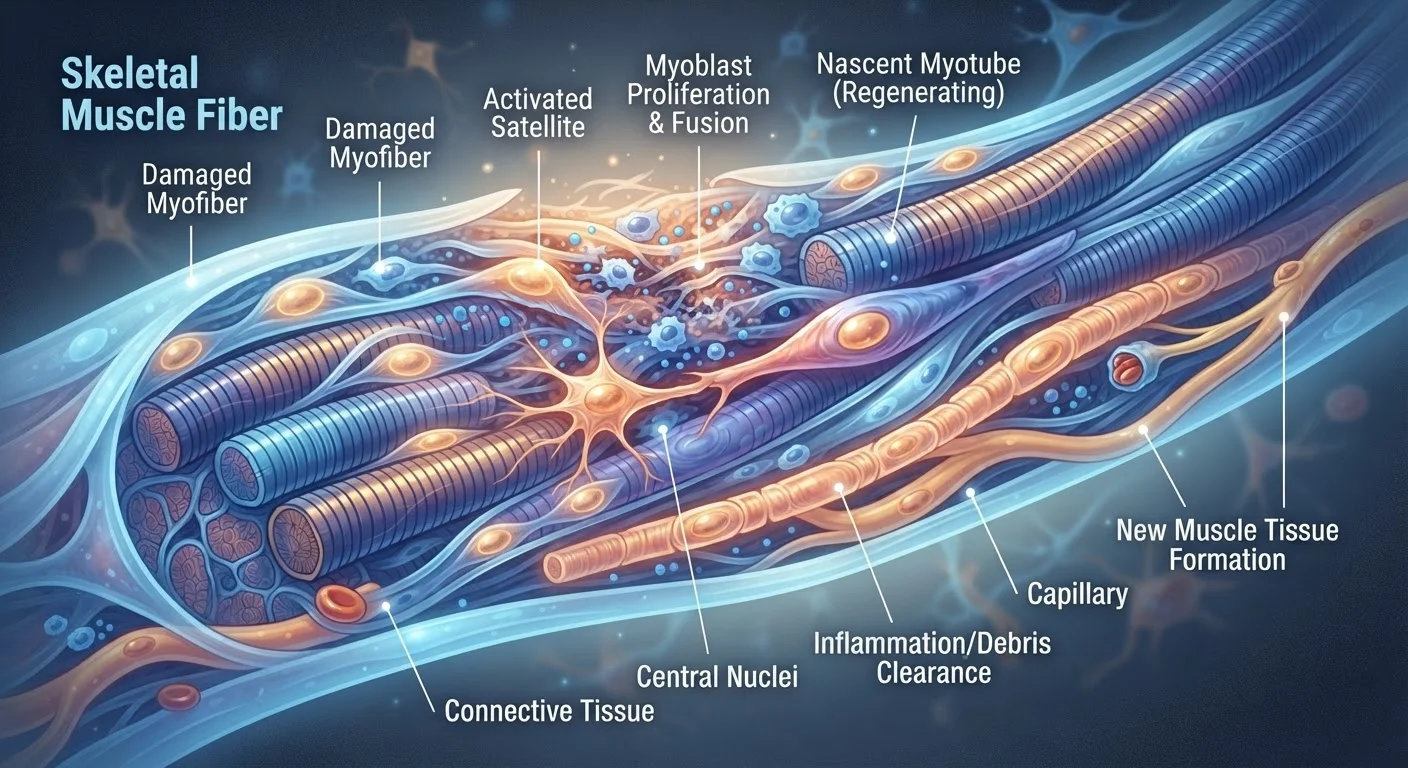
- Satellite cells fuse to damaged fibers, adding nuclei that support larger, stronger muscle tissue.
- Adequate sleep and dietary protein are foundational to effective muscle repair.
- Skipping recovery time can stall progress and increase injury risk over time.
Muscle Repair (Post-Exercise)
Muscle repair is the biological process by which your body rebuilds muscle tissue damaged during exercise. Strength and size gains don't occur during a workout — they happen in the hours and days afterward, as your body patches microtears, reduces inflammation, and builds new protein structures. Rest is not passive; it's when adaptation takes place.
This process is mediated by satellite cells (muscle stem cells), inflammatory cytokines, and the mechanistic target of rapamycin (mTOR) signaling pathway, which regulates muscle protein synthesis.
Exercise Damages Muscle — And That's the Point
When you lift weights, sprint, or push through a challenging workout, you're not building muscle in real time. You're breaking it down. Resistance and high-intensity exercise create microscopic tears — called microtrauma — in the individual fibers that make up your muscles. This sounds alarming, but it's exactly what the body is designed to handle.
These microtears trigger a carefully orchestrated inflammatory response. Immune cells rush to the site, clearing debris and releasing signaling molecules called cytokines. This phase feels familiar — it's the tenderness and stiffness known as delayed-onset muscle soreness (DOMS), typically peaking 24–48 hours after exercise.
Understanding this process reframes rest from something you earn after working hard into something your body requires to make the work count.
The Repair Cascade: What Your Body Does Next
Once inflammation signals the need for repair, the body activates satellite cells — specialized muscle stem cells that lie dormant along muscle fibers until called upon. These cells proliferate, migrate to the sites of damage, and fuse with existing fibers. In doing so, they donate nuclei to the muscle cells, expanding their capacity to produce proteins and, over time, increasing fiber size and strength.
Simultaneously, the body ramps up muscle protein synthesis (MPS) — the process of assembling new structural proteins to rebuild damaged tissue. This is where dietary protein becomes critical. Amino acids from food serve as the raw materials for MPS, and without an adequate supply, the rebuilding process is limited. Learn more about this in our article on protein's broader role in tissue repair and recovery.
48–72 hrs
Typical recovery window for heavy resistance training
Exercise physiology literature consistently supports allowing 48–72 hours before re-stressing the same muscle group with high-intensity effort.
~20–40g
Protein intake range associated with muscle protein synthesis
Research, including work published in the Journal of the International Society of Sports Nutrition, suggests protein doses in this range per meal may help optimize muscle protein synthesis in active adults.
7–9 hrs
Sleep duration linked to optimal recovery in adults
The American Academy of Sleep Medicine recommends 7–9 hours of sleep per night for adults, a range associated with better hormonal and physical recovery outcomes.
The net result — assuming sufficient recovery time and nutrition — is muscle tissue that is slightly larger and more resilient than before. This process is called supercompensation, and it's the physiological basis for progressive fitness gains.
Why Sleep Is When Repair Peaks
Deep sleep stages are among the most productive hours of the entire repair cycle. During slow-wave sleep, the pituitary gland releases growth hormone — one of the primary hormones that drives muscle protein synthesis and tissue regeneration. Cutting sleep short disrupts this hormonal cascade and meaningfully impairs recovery outcomes.
Research consistently links poor sleep quality with slower recovery, reduced muscle protein synthesis, and increased perception of effort during subsequent workouts. Our explainer on sleep as a recovery tool covers how this plays out across training cycles.
Think of sleep not as downtime, but as the primary repair window your training depends on. A detailed look at what happens stage by stage is available in what happens to your body overnight during physical recovery.
Training Before Repair Is Complete: The Hidden Cost
One of the most common mistakes in fitness is training too frequently on the same muscle groups, compounding damage before previous damage is resolved. When repair is incomplete, you're not building on a stronger foundation — you're stressing already-compromised tissue. Over time, this pattern contributes to overtraining syndrome, characterized by persistent fatigue, declining performance, and elevated injury risk.
Appropriate rest intervals aren't a sign of underperforming — they're an investment in the adaptation process. For guidance on structuring your rest strategically, see our article on active recovery vs. complete rest.
Nutrition timing also plays a supporting role. Consuming protein and carbohydrates in the hours surrounding exercise can help initiate repair and replenish glycogen stores. General principles on this are covered in pre- and post-workout nutrition guidance.
This article is for general informational purposes only and does not constitute medical advice. Consult a qualified healthcare professional before making changes to your exercise or nutrition routine, especially if you have an existing health condition or injury.