

Key Takeaways
- Compound movements engage two or more joints and multiple muscle groups in a single exercise.
- Isolation exercises focus on a single muscle group, allowing targeted development.
- Most well-rounded programs benefit from prioritizing compounds with selective isolation work added.
- Your training goal — strength, hypertrophy, rehabilitation — should guide which type you emphasize.
- Beginners typically see the greatest gains by starting with a compound-dominant approach.
- Neither type is superior; they serve different, often complementary, purposes.
Option A
Compound Movements
The multi-joint, high-efficiency foundation of most fitness programs.
Best for: Anyone looking to build overall strength, burn more calories, and train efficiently with limited time.
Option B
Isolation Exercises
The targeted, single-muscle tool for precision development and rehabilitation.
Best for: Lifters addressing muscular imbalances, working around injuries, or adding finishing volume to specific muscle groups.
If you have limited time and want maximum training efficiency
Compound Movements
Exercises like squats, deadlifts, and rows recruit many muscles at once, delivering more stimulus per minute of training time.
If you're recovering from an injury or addressing a muscle imbalance
Isolation Exercises
Targeted exercises allow you to load a specific muscle safely while avoiding stress on compromised joints or surrounding tissue.
If you're a beginner building your foundational fitness
Compound Movements
Multi-joint movements teach whole-body coordination and deliver broad strength adaptations that transfer to everyday life.
If you're an intermediate or advanced lifter refining body composition
Isolation Exercises
Once compound strength is established, isolation work helps develop lagging muscle groups and add targeted hypertrophy volume.
If you want to build a balanced, long-term training program
Compound Movements
Use compounds as the backbone of each session, then layer in isolation work strategically to round out your training.
What Sets These Two Exercise Types Apart
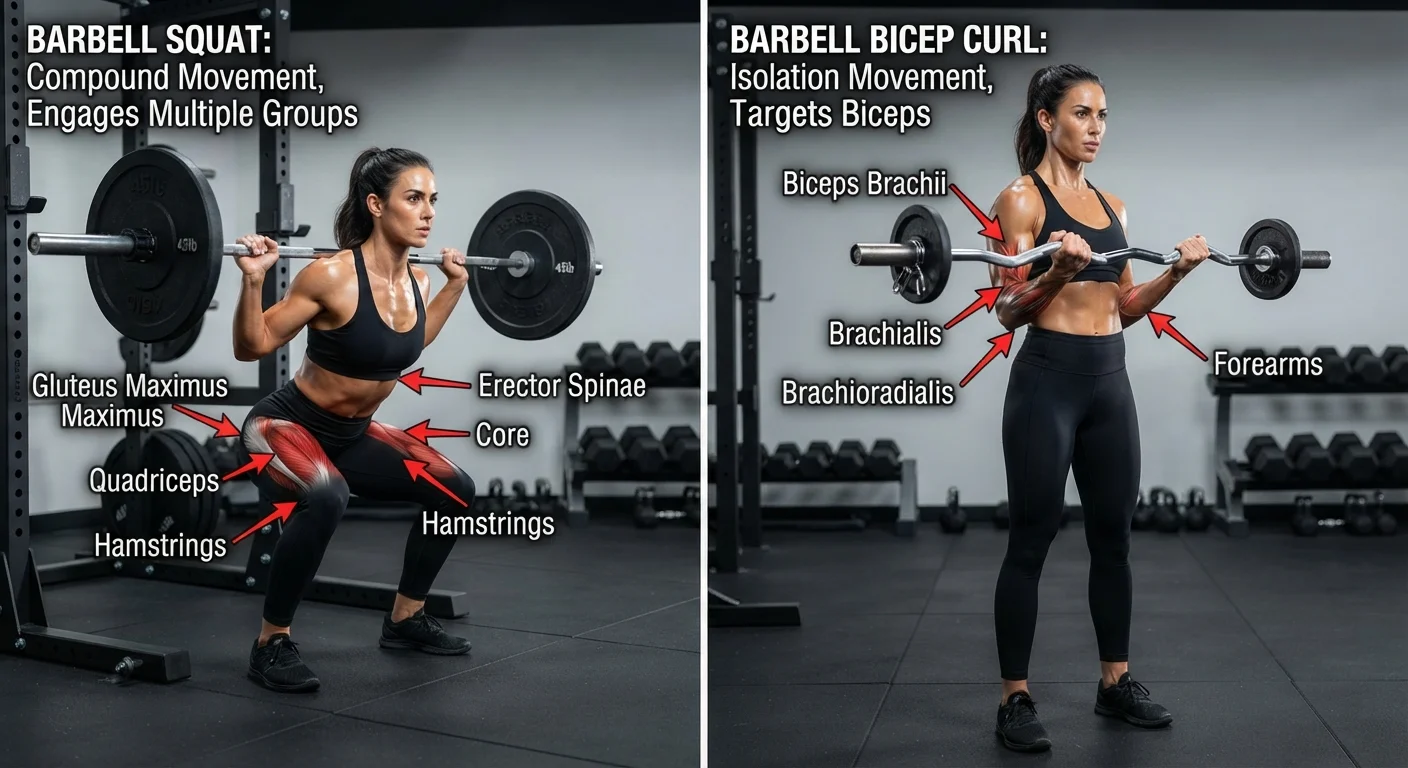
Every resistance exercise can be classified by how many joints it involves. Compound movements cross two or more joints and recruit several muscle groups simultaneously. A deadlift, for example, involves the hip, knee, and ankle joints while engaging the glutes, hamstrings, erector spinae, lats, and core all at once. Isolation exercises, by contrast, move through a single joint and focus the workload on one primary muscle — a leg extension targets the quadriceps almost exclusively.
This distinction matters because it shapes everything from how your nervous system responds to how much energy you expend. Compound lifts demand greater coordination and systemic effort; isolation work allows you to fatigue a specific muscle with precision.
| Criterion | Compound Movements | Isolation Exercises |
|---|---|---|
| Joints involved | Two or more | One |
| Muscles recruited | Multiple groups simultaneously | One primary muscle |
| Training efficiency | High — more work per set | Lower — targeted stimulus only |
| Skill and coordination demand | Higher | Lower |
| Best for beginners | Yes — builds broad base | Less critical initially |
| Rehabilitation use | Situational | Frequently preferred |
| Correcting imbalances | Limited | Well-suited |
| Examples | Squat, deadlift, pull-up, bench press | Bicep curl, leg extension, lateral raise |
The Case for Prioritizing Compound Movements
Exercise science consistently shows that multi-joint, compound exercises drive some of the most significant adaptations in strength, muscle mass, and functional capacity. When you perform a barbell squat or a pull-up, you're not just training muscles in isolation — you're training your nervous system to coordinate force production across multiple body segments simultaneously.
From a practical standpoint, compound movements are time-efficient. A single set of Romanian deadlifts challenges your hamstrings, glutes, and lower back in one movement — work that would otherwise require three separate isolation exercises. This makes compounds especially valuable for people with shorter training windows.
Compound lifts also produce a greater hormonal response during exercise, including elevations in anabolic hormones, though the long-term significance of this acute response is still debated in the research literature. What is well-supported is that compound movements build the kind of functional strength that transfers directly to real-world tasks — lifting, carrying, pushing, and pulling in everyday life.
8+
Muscle groups active in a barbell squat
Research in strength and conditioning literature identifies the squat as one of the most systemically demanding resistance exercises available.
~30%
Greater caloric expenditure vs. isolation
Multi-joint compound exercises have been shown to burn substantially more calories per set than single-joint movements due to greater muscle mass recruitment.
2–3x
More muscle groups per exercise
Compound movements engage roughly two to three times as many muscle groups per repetition compared to a matched isolation exercise.
When Isolation Exercises Earn Their Place
Isolation exercises often get dismissed as vanity work, but that's an oversimplification. They serve distinct and legitimate purposes across different training contexts.
For rehabilitation and injury prevention, isolation exercises are frequently prescribed precisely because they limit joint involvement. Strengthening the rotator cuff with external rotation exercises, for instance, allows a clinician or trainer to load the shoulder musculature without stressing the elbow or wrist. Always work with a qualified professional when using exercise for injury rehabilitation.
For intermediate and advanced lifters chasing hypertrophy (muscle growth), isolation work adds targeted volume to muscles that may not be fully fatigued by compound movements alone. Compound pressing movements build chest and tricep strength, but cable flyes or tricep pushdowns can deepen the stimulus in those areas without adding more systemic fatigue.
Isolation exercises are also useful for correcting muscular imbalances — situations where one side or one muscle group is noticeably weaker than its counterpart. Unilateral exercises like single-leg curls address side-to-side discrepancies that bilateral compound lifts can mask.
This article is for informational purposes only and is not a substitute for professional medical or fitness advice. Consult a qualified healthcare provider or certified fitness professional before beginning any new exercise program, particularly if you have an existing injury or health condition.
How to Structure a Program That Uses Both
For most people, the smartest approach isn't choosing one type over the other — it's learning to sequence them effectively within a session and across a training week.
A widely used structure places compound movements at the start of a workout, when energy and focus are highest, and adds isolation work afterward. This order makes sense: heavy squats require full-body coordination and neurological freshness, while a seated leg curl at the end of a session demands far less systemic effort.
A sample lower-body session might look like this:
- Barbell squat — compound anchor movement
- Romanian deadlift — secondary compound movement
- Leg press — compound with reduced spinal load
- Leg curl — isolation for the hamstrings
- Calf raise — isolation for the gastrocnemius and soleus
The ratio of compound to isolation work should shift based on your goals, training age, and recovery capacity. Beginners benefit most from a compound-heavy program. More experienced lifters may add greater isolation volume as their ability to recover and their knowledge of their own weak points deepens.