

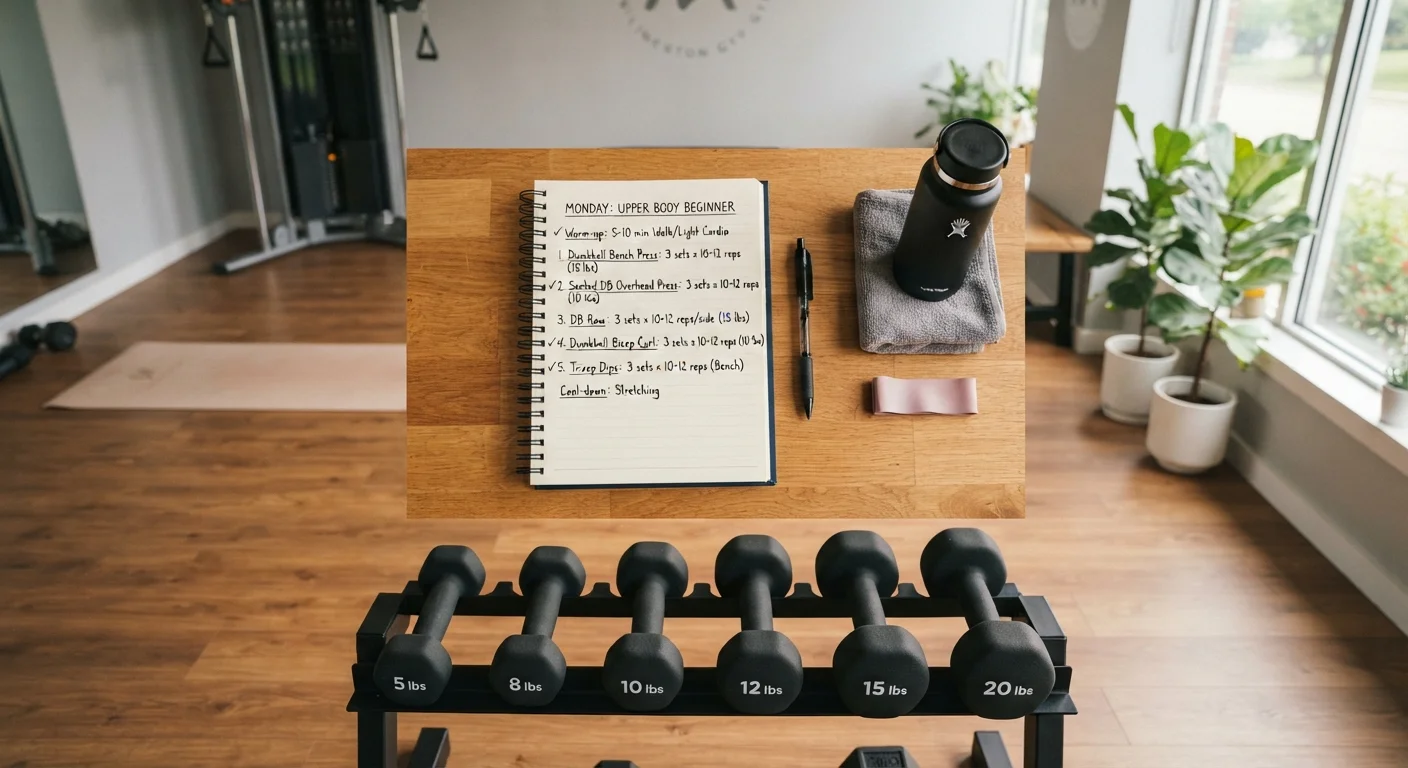
| Typical beginner sets per exercise | 2–4 sets (General exercise science guidelines) |
| Rep range for muscle endurance | 15+ reps (NSCA Essentials of Strength Training) |
| Rep range for hypertrophy (muscle building) | 6–12 reps (NSCA Essentials of Strength Training) |
| Rest period for strength/power training | 2–5 minutes (American College of Sports Medicine guidelines) |
| Rest period for hypertrophy training | 60–90 seconds (American College of Sports Medicine guidelines) |
| Rest period for endurance/circuit training | 30–60 seconds (General exercise science guidelines) |
Why Workout Terminology Matters for Beginners
Walking into a gym or opening a training app for the first time can feel like learning a new language. Instructions like "3 sets of 12 reps with 60 seconds rest" are written as if everyone already knows what they mean — but many new exercisers don't, and that gap can stall progress before it even starts.
This reference guide cuts through the jargon. Below, you'll find plain-English definitions for the core terms you'll encounter in almost every workout program, along with context for how each concept actually works in practice. If you're also new to thinking about recovery, this beginner's recovery guide pairs well with what you'll read here.
Repetition (Rep)
One complete cycle of an exercise movement from start position back to start position. The total number of reps performed consecutively before stopping forms a set.
Set
A group of consecutive repetitions performed without resting. Most programs prescribe a specific number of sets per exercise to control total training volume.
Rest Period
The recovery interval taken between sets. Rest duration is deliberately prescribed because it affects how much fatigue carries over into the next set and what physical quality the workout targets.
Training Volume
The total amount of work done in a session or week, often expressed as sets multiplied by reps multiplied by load. Progressive increases in volume drive long-term fitness adaptation.
Load
The resistance applied during an exercise, such as a dumbbell weight or bodyweight. Appropriate load selection allows completion of the target rep range with good technique.
Tempo
The controlled speed of each phase of a repetition — typically the lowering (eccentric), pause, and lifting (concentric) phases. Tempo manipulation can increase or decrease the training stimulus independently of load.
Hypertrophy
The increase in muscle cell size resulting from consistent resistance training stimulus. It is distinct from strength gains, though both can occur simultaneously.
Superset
A training technique pairing two exercises performed back-to-back before a full rest interval. Supersets are commonly used to improve workout efficiency or add metabolic challenge.
Core Terms Defined: Reps, Sets, and Rest
These three terms form the foundation of virtually every resistance training or structured workout program.
| Typical beginner sets per exercise | 2–4 sets (General exercise science guidelines) |
| Rep range for muscle endurance | 15+ reps (NSCA Essentials of Strength Training) |
| Rep range for hypertrophy (muscle building) | 6–12 reps (NSCA Essentials of Strength Training) |
| Rest period for strength/power training | 2–5 minutes (American College of Sports Medicine guidelines) |
| Rest period for hypertrophy training | 60–90 seconds (American College of Sports Medicine guidelines) |
| Rest period for endurance/circuit training | 30–60 seconds (General exercise science guidelines) |
Repetitions (Reps)
A rep is one complete execution of an exercise movement — lowering into a squat and standing back up counts as one rep. The number of reps you perform in a row before stopping shapes the training stimulus: lower rep ranges (roughly 1–5) are commonly associated with strength development, moderate ranges (6–12) with muscle building (hypertrophy), and higher ranges (15+) with muscular endurance. These are general patterns drawn from exercise science research, not rigid rules.
Sets
A set is a group of consecutive reps performed without resting. Performing 12 squats, resting, then doing 12 more squats means you've completed two sets of 12 reps. Most beginner programs recommend 2–4 sets per exercise, which provides a meaningful training dose without excessive fatigue early on.
Rest Periods
The rest period is the recovery interval between sets. Rest duration meaningfully affects your workout's outcome. Shorter rest periods (30–60 seconds) are often used in endurance- or circuit-style training. Moderate rest (60–90 seconds) suits hypertrophy-focused work. Longer rest (2–5 minutes) supports maximal strength and power efforts where full neuromuscular recovery is needed between heavy attempts.
For a deeper look at how rest fits into your broader weekly schedule, see building a weekly recovery routine.
Additional Terms You'll Encounter
Volume
Training volume refers to the total amount of work performed — typically calculated as sets × reps × load. Progressively increasing volume over time is one of the most reliable drivers of fitness adaptation.
Load
Load simply means the resistance used — whether that's a dumbbell weight, barbell plates, or bodyweight. Selecting an appropriate load is key: it should challenge you within the target rep range while still allowing good form throughout.
Tempo
Tempo describes the speed at which you move through each phase of a rep — how fast you lower, pause, and lift. A squat with a slow, 3-second lowering phase places more mechanical tension on the muscle than a fast one, even with the same load.
Superset
A superset pairs two exercises performed back-to-back with little or no rest between them before taking a full rest. This approach improves workout efficiency and can add a cardiovascular challenge.
Understanding these foundational terms also connects to how the body manages energy and body composition — concepts explored in detail in our plain-language weight management glossary.
This article is for general informational purposes only and does not constitute medical or exercise advice. Consult a qualified healthcare or fitness professional before beginning any new training program, particularly if you have existing health conditions or concerns.