

Key Takeaways
- Mindfulness is a quality of attention you can apply anytime; meditation is a dedicated practice that trains that attention.
- Both approaches have meaningful research support for reducing stress, anxiety, and emotional reactivity.
- Mindfulness requires no special time or setting — meditation typically needs a quiet block of 10–20 minutes.
- The two are complementary: regular meditation can make moment-to-moment mindfulness easier to sustain.
- Neither is a medical treatment; severe or persistent stress warrants professional support.
Option A
Mindfulness
The always-available, woven-into-daily-life approach.
Best for: People who want to lower stress throughout the day without carving out dedicated practice time.
Option B
Meditation
The structured, intentional mental training session.
Best for: People who benefit from a clear routine and want deeper, cumulative effects on stress and focus over time.
If your schedule leaves little room for structured practice
Mindfulness
Mindfulness slots into existing routines — a commute, a meal, a walk — so busy schedules aren't a barrier.
If you want a reliable daily reset that builds cumulative resilience
Meditation
A consistent 10–20 minute session trains the nervous system over time, producing benefits that extend well beyond the session itself.
If you're brand new to stress-reduction practices
Mindfulness
Starting with simple moment-to-moment awareness lowers the entry barrier and builds the foundational skill that makes meditation more effective later.
If you experience racing thoughts or rumination at night
Meditation
Structured breath-focused or body-scan meditation before bed has research support for quieting the mental chatter that disrupts sleep.
If you want the widest possible stress-relief toolkit
Mindfulness
Because mindfulness is a skill that underpins many practices — including meditation — developing it gives you the most flexible everyday resource.
Same Word, Different Meaning: Clearing Up the Confusion
If you've ever used "mindfulness" and "meditation" interchangeably, you're in good company — even wellness articles blur the line regularly. But the distinction matters, especially when you're trying to figure out what will actually help with the stress you're feeling today. For a broader look at how stress types shape your response, see how acute and chronic stress differ.
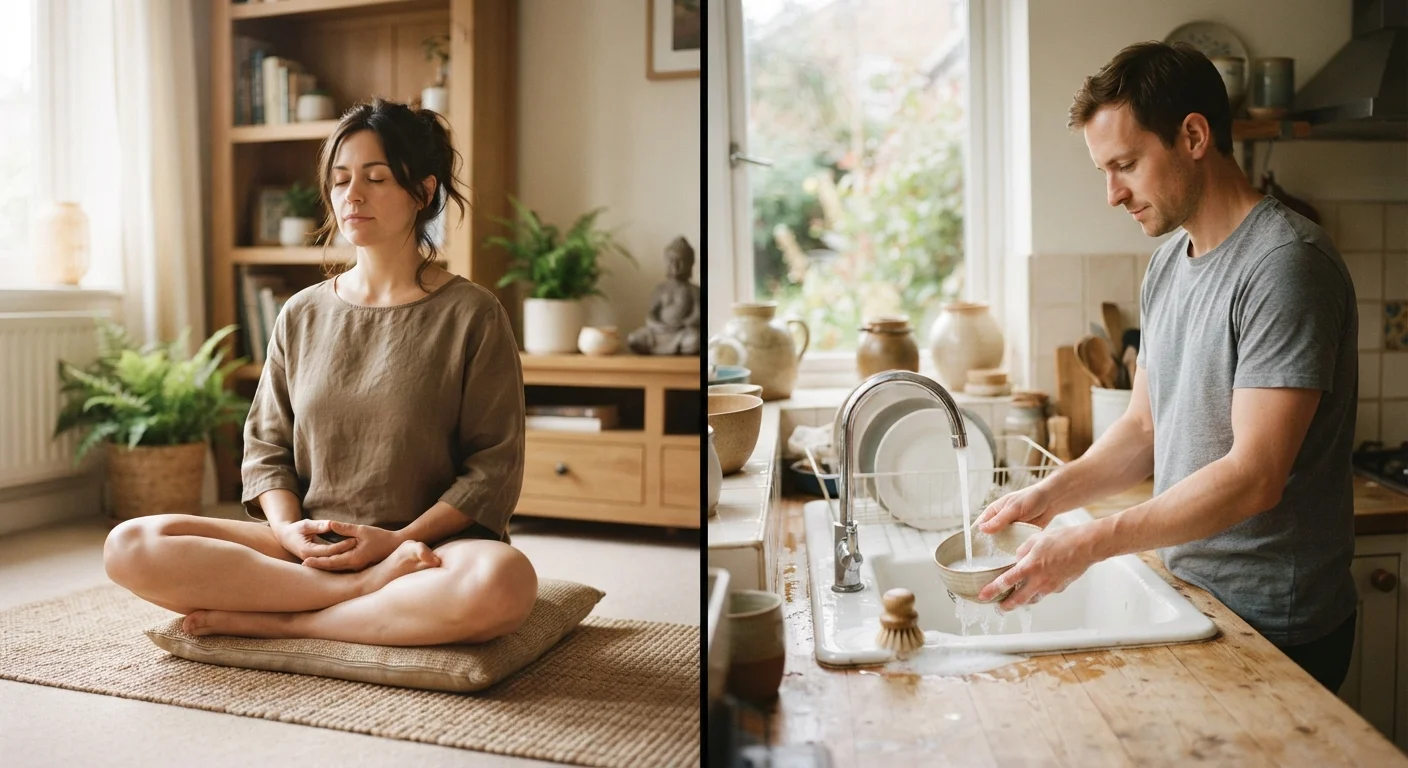
Mindfulness is a quality of attention — the practice of noticing what's happening right now, in your body, thoughts, and surroundings, without immediately judging it. You can be mindful while eating, commuting, or even having a difficult conversation. It doesn't require a special posture or a quiet room.
Meditation, by contrast, is a formal exercise — a deliberate, time-set practice in which you train your attention using a specific technique (breath focus, body scan, loving-kindness, and others). Think of it as the gym session; mindfulness is the fitness you carry with you afterward.
Crucially, most meditation uses mindfulness as its core mechanism — but mindfulness doesn't require meditation to be practiced.
What the Research Actually Shows
Both approaches have genuine evidence behind them, though the research base and effect sizes vary.
| Criterion | Mindfulness | Meditation |
|---|---|---|
| Definition | A quality of present-moment attention | A structured, timed mental practice |
| Time required | None — embedded in daily activity | Typically 10–20 minutes per session |
| Setting | Anywhere, anytime | Usually quiet, distraction-reduced space |
| Learning curve | Low — starts immediately | Moderate — technique improves with practice |
| Stress research support | Strong, especially via MBSR programs | Strong, especially for long-term practitioners |
| Primary mechanism | Decentering from reactive thoughts in the moment | Sustained attention training; nervous system regulation |
| Best entry point | Attaching to an existing daily habit | Guided audio or a structured program |
Mindfulness-based interventions — including Mindfulness-Based Stress Reduction (MBSR), an eight-week structured program developed at the University of Massachusetts — have shown consistent reductions in self-reported stress, anxiety symptoms, and measures of cortisol reactivity in multiple peer-reviewed studies. The key mechanism appears to be decentering: the ability to observe a thought without being consumed by it.
Meditation research points to structural changes in the brain over time — particularly in regions associated with emotional regulation, such as the prefrontal cortex and amygdala — though much of this work involves dedicated long-term practitioners, and results in casual users are more modest.
For everyday Americans managing ordinary stress, the honest summary is: both help, consistency matters more than which one you choose, and combining them likely produces the broadest benefit. The full breakdown of how each works for stress explores the mechanisms in more depth.
How to Make Either One Work in a Real Life
The biggest predictor of whether a stress-reduction practice sticks isn't which one you choose — it's how well it fits your actual day. Here's a practical starting point for each:
Starting with Mindfulness
- Pick one routine activity — your morning coffee, brushing your teeth, the first five minutes of your lunch break — and commit to doing it with full attention for one week.
- When your mind wanders (it will), simply notice that it wandered and return. That noticing is the practice.
- Mindful eating is a natural on-ramp: how mindful eating compares to calorie tracking shows how this skill extends beyond stress relief.
Starting with Meditation
- Begin with 5–10 minutes, not 20. Consistency at a shorter duration beats sporadic long sessions.
- A simple breath-focus technique: inhale for four counts, exhale for six. When attention drifts, gently redirect — no self-criticism required.
- Guided apps and audio programs can help establish early structure without requiring any prior experience.
- Morning tends to work well for most people, but any consistent time is the right time. See how meditation stacks up alongside journaling and breathwork as a morning practice.
When to Seek Professional Support
Mindfulness and meditation are evidence-informed self-help tools, not clinical treatments. If stress is accompanied by persistent low mood, physical symptoms, panic attacks, or is interfering significantly with work or relationships, please reach out to a licensed mental health professional. These practices can complement — but should not replace — appropriate care for more serious concerns.
If you're new to either practice and feel uncertain where to begin, this grounded starting point for stress management covers the broader landscape without the overwhelm.
This article is for informational purposes only and is not a substitute for professional medical or mental health advice. If stress is significantly affecting your daily functioning, please consult a qualified healthcare provider.