

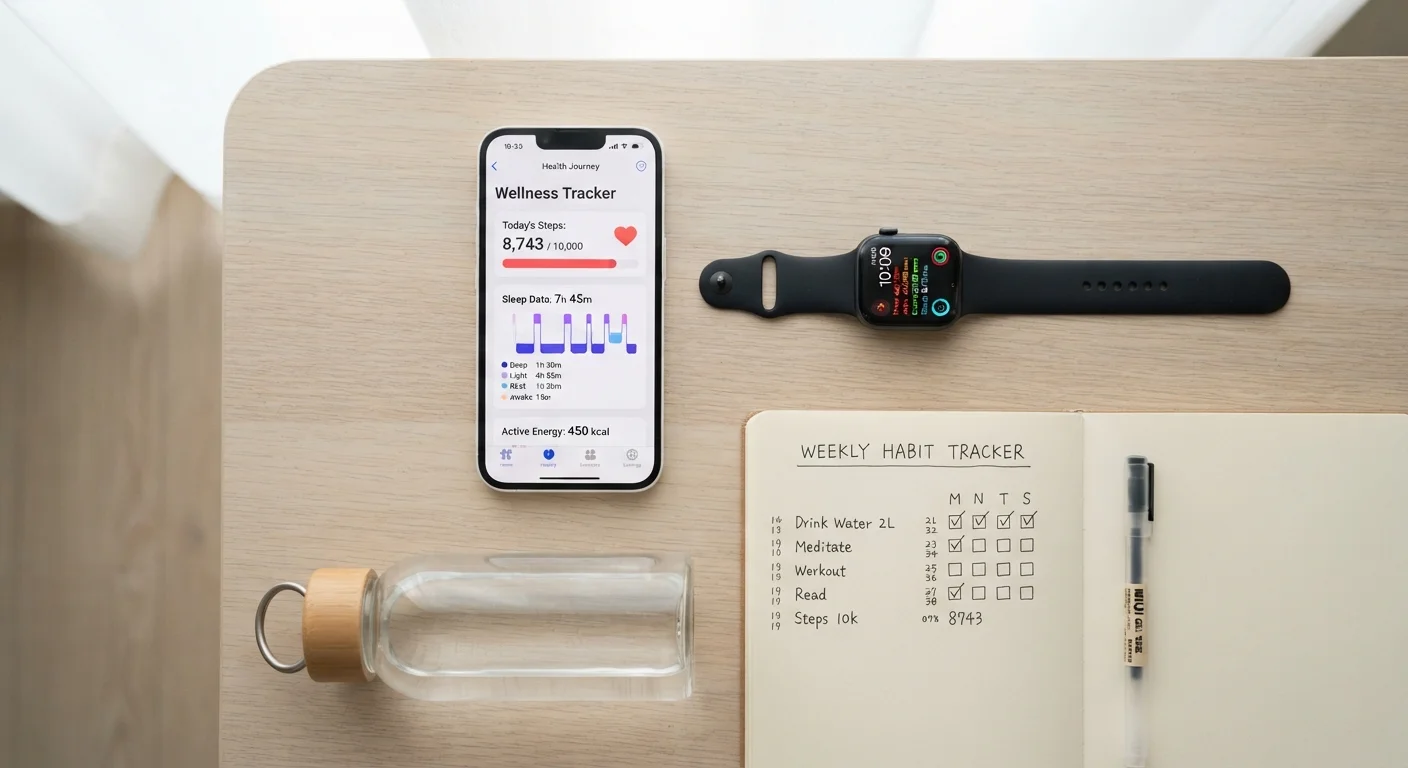
Key Takeaways
- Habit tracking can increase self-awareness and reinforce consistent healthy behaviors over time.
- Data from consumer wearables has real accuracy limitations that can mislead rather than inform.
- Obsessive tracking may trigger anxiety or unhealthy perfectionism in some individuals.
- The most effective tracking approach is one that informs without dominating your daily focus.
- Always discuss significant health data patterns with a qualified healthcare professional.
Increases awareness of baseline habits
Most people significantly overestimate how much they move and sleep. Objective data — even imperfect data — often reveals gaps between perception and reality, creating a useful starting point for change.
Reinforces consistency through visible progress
Streak-based tracking and visual logs leverage behavioral psychology principles: seeing a record of consecutive healthy days motivates people to maintain it, a phenomenon sometimes called the 'don't break the chain' effect.
Supports goal-setting with concrete feedback
Abstract goals like 'exercise more' become measurable when paired with tracking. Specific feedback — such as average daily step count — makes it easier to set realistic targets and gauge progress over weeks.
Can flag early warning patterns
Gradual trends in resting heart rate, sleep duration, or activity levels can sometimes precede illness or overtraining. While trackers cannot diagnose anything, they can prompt timely conversations with a healthcare provider.
Flexible enough for any lifestyle or budget
Effective habit tracking doesn't require expensive devices. A free app, a printed checklist, or even a simple journal can capture the behavioral data that drives change.
Consumer devices have meaningful accuracy limits
Most wearable sensors estimate metrics like sleep stages, calories burned, and blood oxygen using indirect proxies. Studies have found calorie-burn estimates from popular fitness trackers can be off by 20–40% under real-world conditions.
Can foster anxiety or obsessive behavior
For some individuals, constant data monitoring shifts focus from how they feel to what the numbers say. Clinical researchers have documented cases where fitness tracking contributed to exercise compulsion and health anxiety, particularly in people with a prior history of such tendencies.
Metric fixation can crowd out intuitive awareness
When external data becomes the primary guide, people may lose trust in internal cues like fatigue, hunger, and satisfaction — signals that are fundamental to sustainable wellness.
Data overload leads to disengagement
Tracking too many variables at once is cognitively taxing. Many users abandon habit trackers within the first few weeks, often because the system became more burdensome than motivating.
Risk of misinterpreting health signals
An unusual reading — a dip in heart rate variability or a flagged irregular rhythm — can provoke unnecessary worry or, conversely, false reassurance. Neither outcome serves health without professional context.
Our Verdict
Health habit tracking is a genuinely useful tool for building awareness and reinforcing sustainable routines — but it works best as a guide, not a scorecard. Its value depends heavily on how you engage with the data: using it to identify patterns serves your health far better than chasing perfect numbers each day.
Tracking is most beneficial for people who want structured accountability and are able to interpret data calmly, without tipping into obsession or anxiety.
Why Tracking Has Become So Popular
Over the past decade, smartphones and wearable devices have made it easier than ever to monitor daily health behaviors — steps taken, hours slept, calories consumed, heart rate variability, and more. Millions of Americans now use some form of habit tracker, whether a dedicated app, a fitness band, or simply a paper checklist.
The appeal is straightforward: visibility creates accountability. When you can see that you've moved for only 12 minutes on a given day, or slept fewer than six hours three nights running, that data becomes a prompt for change. But tracking is neither universally helpful nor harmless, and understanding both sides helps you decide how — and whether — it fits your own preventive health routine.
The Real Advantages of Monitoring Your Habits
Research consistently supports the idea that self-monitoring is one of the strongest behavioral levers for lasting habit change. Here's what the evidence and practical experience suggest tracking does well.
Increases awareness of baseline habits
Most people significantly overestimate how much they move and sleep. Objective data — even imperfect data — often reveals gaps between perception and reality, creating a useful starting point for change.
Reinforces consistency through visible progress
Streak-based tracking and visual logs leverage behavioral psychology principles: seeing a record of consecutive healthy days motivates people to maintain it, a phenomenon sometimes called the 'don't break the chain' effect.
Supports goal-setting with concrete feedback
Abstract goals like 'exercise more' become measurable when paired with tracking. Specific feedback — such as average daily step count — makes it easier to set realistic targets and gauge progress over weeks.
Can flag early warning patterns
Gradual trends in resting heart rate, sleep duration, or activity levels can sometimes precede illness or overtraining. While trackers cannot diagnose anything, they can prompt timely conversations with a healthcare provider.
Flexible enough for any lifestyle or budget
Effective habit tracking doesn't require expensive devices. A free app, a printed checklist, or even a simple journal can capture the behavioral data that drives change.
For those building a preventive health routine from scratch, pairing tracking with a structured framework can be especially effective. Our Daily Preventive Health Habit Audit covers the core pillars — sleep, movement, nutrition, stress, and social connection — and serves as a useful companion to any tracking system you choose.
The Drawbacks You Should Take Seriously
Tracking is a tool, and like any tool, it can be misused or misread. These limitations deserve equal attention.
Consumer devices have meaningful accuracy limits
Most wearable sensors estimate metrics like sleep stages, calories burned, and blood oxygen using indirect proxies. Studies have found calorie-burn estimates from popular fitness trackers can be off by 20–40% under real-world conditions.
Can foster anxiety or obsessive behavior
For some individuals, constant data monitoring shifts focus from how they feel to what the numbers say. Clinical researchers have documented cases where fitness tracking contributed to exercise compulsion and health anxiety, particularly in people with a prior history of such tendencies.
Metric fixation can crowd out intuitive awareness
When external data becomes the primary guide, people may lose trust in internal cues like fatigue, hunger, and satisfaction — signals that are fundamental to sustainable wellness.
Data overload leads to disengagement
Tracking too many variables at once is cognitively taxing. Many users abandon habit trackers within the first few weeks, often because the system became more burdensome than motivating.
Risk of misinterpreting health signals
An unusual reading — a dip in heart rate variability or a flagged irregular rhythm — can provoke unnecessary worry or, conversely, false reassurance. Neither outcome serves health without professional context.
~80%
Wearable users who disengage within months
Industry research and academic reviews consistently find that a large proportion of fitness tracker adopters significantly reduce or stop active use within the first few months.
20–40%
Calorie estimate error in popular wearables
A study published in the Journal of Personalized Medicine found energy expenditure estimates from consumer fitness trackers deviated substantially from validated indirect calorimetry measures.
Data accuracy is a particularly underappreciated concern. Consumer-grade wearables use algorithms and optical sensors that estimate rather than measure most metrics directly. Sleep tracking is a good example: devices typically infer sleep stages from movement and heart rate, which produces data that can diverge meaningfully from clinical sleep assessments. Our companion piece on sleep tracking devices offers an honest breakdown of what that data actually means.
Body composition metrics carry similar pitfalls. Inconsistent testing conditions and misread numbers can make even well-intentioned tracking misleading — a dynamic worth understanding before you act on the numbers.
How to Track in a Way That Actually Helps
The difference between beneficial and counterproductive tracking usually comes down to intent and interpretation. A few principles can keep the practice grounded.
- Choose one or two metrics that matter most to your current health goals rather than monitoring everything simultaneously.
- Look for patterns over days and weeks, not daily perfection. A single low-step day is noise; a consistent three-week decline in movement is a signal worth examining.
- Treat data as informational, not evaluative. Numbers don't judge you — and treating them as pass/fail invites the kind of perfectionism that derails progress. Our article on how good intentions undermine healthy habits explores this dynamic in depth.
- Consult a healthcare provider if tracking reveals persistent anomalies — unusually elevated resting heart rate, chronically poor sleep, or unexplained weight changes — rather than self-diagnosing from an app.
Tracking and Special Populations
People managing chronic conditions, recovering from illness, or navigating pregnancy should approach habit tracking with extra care. Metrics that are normal for one person may be misleading for another with a different health baseline. If you belong to any of these groups, consult your healthcare provider before using tracking data to guide behavioral changes.
This article is for general informational and educational purposes only and is not a substitute for professional medical advice, diagnosis, or treatment. Always consult a qualified healthcare provider with questions about your health or before making changes to your health routine.