

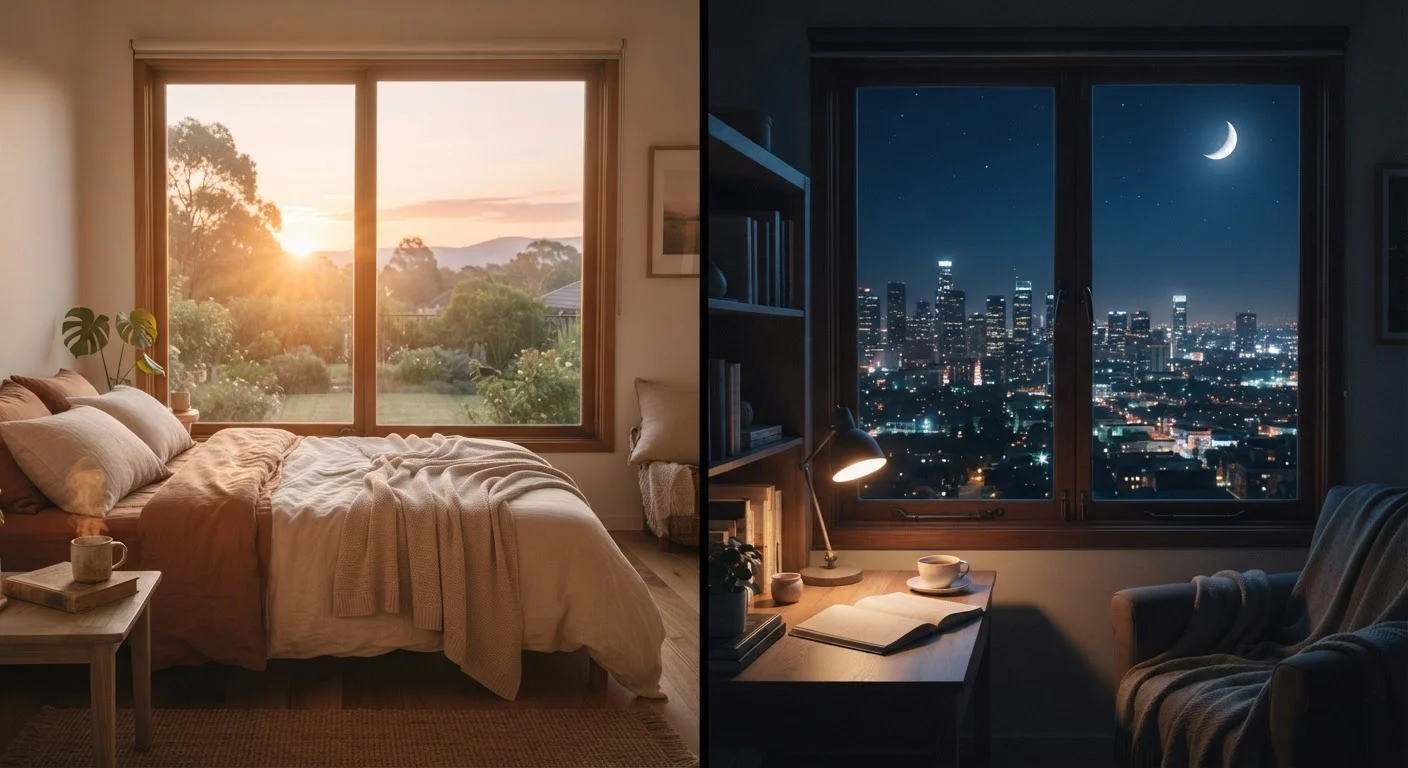
Key Takeaways
- Chronotypes are rooted in genetics and circadian biology, not simply personal preference or discipline.
- Morning and evening chronotypes differ in peak cognitive performance windows, hormone release timing, and sleep pressure patterns.
- Night owls face a structural disadvantage in societies built around early schedules, a phenomenon called social jetlag.
- Neither chronotype is healthier by default — misalignment with your natural type causes the most harm.
- Light exposure and lifestyle factors can moderately shift chronotype expression, but cannot fully override biology.
- Consult a healthcare professional if sleep timing significantly disrupts your daily functioning or mental health.
Option A
Morning Chronotype (Early Bird)
The biologically early riser primed for daytime performance.
Best for: People whose internal clock naturally aligns with conventional work and school schedules.
Option B
Evening Chronotype (Night Owl)
The biologically late riser whose peak performance comes later in the day.
Best for: People who feel most alert, creative, or focused in the afternoon and evening hours.
If your work or school schedule starts before 8 AM
Morning Chronotype (Early Bird)
Early birds naturally align with conventional schedules, reducing the sleep debt and social jetlag that night owls often accumulate on early-start days.
If you need deep creative focus or complex problem-solving time
Evening Chronotype (Night Owl)
Research suggests evening types often experience heightened creative and analytical performance later in the day, when early birds may already be fading.
If you're prioritising long-term metabolic and cardiovascular wellness
Morning Chronotype (Early Bird)
Morning chronotypes tend to have better alignment between their biological clock and social schedules, which is associated with lower metabolic risk in population studies.
If you have flexibility in your daily schedule
Evening Chronotype (Night Owl)
Night owls who can structure their day around their natural timing report fewer mood disruptions and better cognitive performance than those forced into early schedules.
What Is a Chronotype, Exactly?
A chronotype is your body's genetically influenced preference for the timing of sleep and wakefulness. It is not a habit you chose — it is a biological trait shaped by variations in clock genes, particularly those involved in regulating your circadian rhythm (your internal 24-hour biological clock). Researchers commonly group chronotypes along a spectrum from strongly morning-preferring to strongly evening-preferring, with most people falling somewhere in the middle.
The distinction matters because your chronotype influences far more than when you feel sleepy. It affects when your core body temperature peaks, when cortisol surges in the morning, when your reaction time is sharpest, and even when your muscles are primed for physical exertion. To understand the genetic and hormonal mechanisms behind these differences in depth, see what chronotypes mean biologically.
Chronotype also shifts across the lifespan. Children tend toward earlier types, adolescents shift dramatically toward eveningness, and adults gradually shift back toward morningness as they age. This is a well-documented biological pattern, not laziness or poor sleep hygiene.
Morning vs. Evening Chronotype: A Head-to-Head Comparison
The practical differences between chronotypes ripple through cognitive performance, mood, physical health risk, and social functioning. Understanding these contrasts helps explain why the same alarm time can feel effortless for one person and genuinely harmful for another.
| Criterion | Morning Chronotype | Evening Chronotype |
|---|---|---|
| Natural sleep timing | Earlier bedtime and wake time | Later bedtime and wake time |
| Peak cognitive performance | Mid-morning hours | Afternoon to evening hours |
| Cortisol awakening response | Earlier, sharper morning spike | Delayed, more gradual rise |
| Social jetlag risk | Low — aligns with standard schedules | High — misaligns with 9-to-5 norms |
| Mood regulation patterns | Generally lower reported disruption | Higher disruption when schedule misaligned |
| Metabolic risk (population data) | Lower in observational studies | Modestly elevated in observational studies |
| Genetic basis | Variants in PER and CLOCK genes | Distinct variants in same gene families |
| Shift across lifespan | Dominant in childhood and older adulthood | Most pronounced during adolescence |
One of the most consequential concepts here is social jetlag — the chronic misalignment that occurs when evening types are forced to operate on morning-centric schedules. Research published in journals including Current Biology has linked significant social jetlag to elevated markers of metabolic disruption, poorer mood, and higher rates of reported fatigue, independent of total sleep duration.
How Chronotype Shapes Mood and Mental Wellness
The relationship between chronotype and mental health is one of the more compelling areas of current sleep science. Evening chronotypes are statistically more likely to report symptoms of depression, anxiety, and emotional dysregulation — but causality here is complex and not fully established. Some researchers propose that chronic social jetlag is the mediating factor: it is the misalignment, not eveningness itself, that drives elevated mood risk.
Morning types generally benefit from a built-in alignment advantage. Their natural sleep-wake timing tends to sync with daylight hours, social schedules, and conventional work demands — meaning they accumulate less chronic sleep debt and experience fewer disruptions to their cortisol awakening response, which plays a role in daily mood regulation.
If you identify as a night owl and notice mood impacts tied to your schedule, how chronotype connects to mental health examines the research in detail. As always, persistent mood concerns warrant a conversation with a qualified healthcare professional — sleep timing is one variable among many.
This article is for general informational purposes only and does not constitute medical advice. Speak with a qualified healthcare provider about any concerns regarding your sleep, mood, or health.
Can You Change Your Chronotype — and Should You Try?
Chronotype is not immovable, but it is also not freely adjustable by willpower. Lifestyle interventions — particularly strategic light exposure — can shift sleep timing by roughly 30 to 90 minutes in most people. Morning bright light exposure suppresses melatonin and anchors your clock earlier; avoiding bright screens and artificial light in the evening reduces the delay that worsens evening chronotype expression. how light exposure shapes your sleep timing explains the mechanism in practical terms.
The more useful question, however, may not be how to override your chronotype but how to design your life around it. building a morning routine around your chronotype offers a practical framework for doing exactly that. And if you are weighing the trade-offs of forced early rising against natural wake timing, early riser vs. natural wake time directly addresses that decision.
The core principle from sleep science is clear: aligning your schedule with your chronotype — even partially — tends to produce better outcomes in sleep quality, daytime alertness, and overall well-being than fighting your biology indefinitely. For broader sleep habit guidance, the sleep habits hub covers practical routines that support any chronotype.