

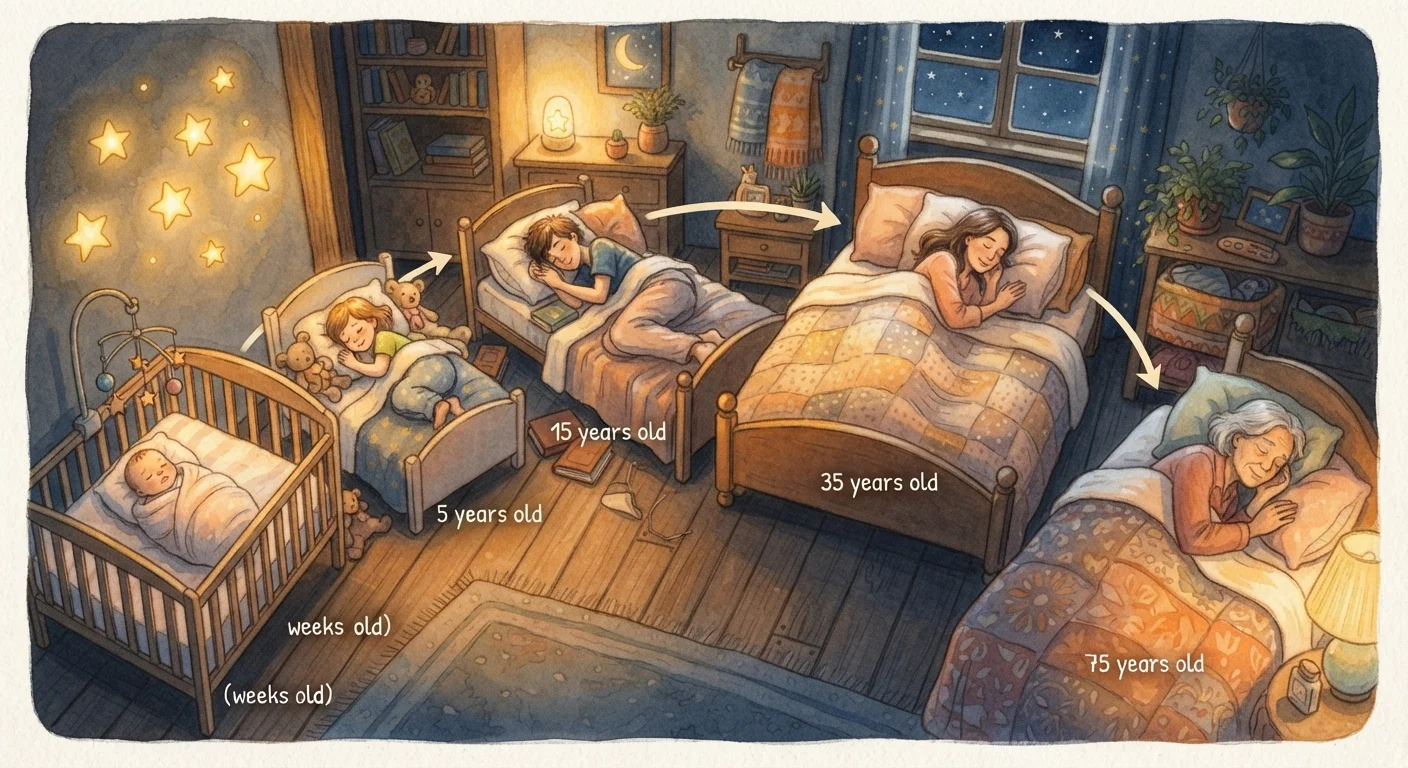
| Newborns (0–3 months) recommended sleep | 14–17 hours per day (American Academy of Sleep Medicine / National Sleep Foundation) |
| School-age children (6–12 years) recommended sleep | 9–12 hours per night (American Academy of Sleep Medicine) |
| Teenagers (13–18 years) recommended sleep | 8–10 hours per night (American Academy of Sleep Medicine) |
| Adults (18–64 years) recommended sleep | 7–9 hours per night (National Sleep Foundation) |
| Older adults (65+) recommended sleep | 7–8 hours per night (National Sleep Foundation) |
| REM sleep proportion in newborns | ~50% of total sleep (General sleep science consensus) |
Sleep by Life Stage: Recommended Hours and Key Patterns
Sleep is not one-size-fits-all. The amount and structure of sleep the body needs evolves continuously from birth through older adulthood, driven by biological development, hormonal shifts, and changes in brain activity. Understanding what is typical at each stage helps distinguish normal variation from patterns that may warrant attention.
| Newborns (0–3 months) recommended sleep | 14–17 hours per day (American Academy of Sleep Medicine / National Sleep Foundation) |
| School-age children (6–12 years) recommended sleep | 9–12 hours per night (American Academy of Sleep Medicine) |
| Teenagers (13–18 years) recommended sleep | 8–10 hours per night (American Academy of Sleep Medicine) |
| Adults (18–64 years) recommended sleep | 7–9 hours per night (National Sleep Foundation) |
| Older adults (65+) recommended sleep | 7–8 hours per night (National Sleep Foundation) |
| REM sleep proportion in newborns | ~50% of total sleep (General sleep science consensus) |
For a deeper look at the biology behind these shifts, see the overview of sleep architecture changes across life stages. For how these patterns affect adults specifically from the 20s onward, the breakdown of adult sleep needs by decade offers useful detail.
Why Sleep Needs Change: The Science Behind the Shifts
Biological development is the primary driver of age-related sleep changes. In infancy, the brain is growing at a rapid pace, and sleep — particularly REM sleep — is essential to that process. Newborns spend roughly half their sleep time in REM, compared with about 20–25% in healthy adults.
As children move through middle childhood, slow-wave sleep (deep sleep) peaks, supporting the physical growth and immune development critical to this period. By adolescence, a well-documented shift in chronotype occurs: the circadian rhythm delays, making it biologically harder for teenagers to fall asleep early and wake early — a pattern often misread as laziness.
In adulthood, slow-wave sleep gradually declines, and sleep becomes lighter and more fragmented with each decade. Older adults often experience earlier sleep timing, more nighttime awakenings, and reduced REM and deep sleep — though the need for restorative sleep does not disappear.
This Is General Information, Not Medical Advice
Sleep recommendations represent population-level guidelines, not personal prescriptions. Individual needs vary based on health status, genetics, activity, and other factors. If you have concerns about your sleep quality or duration at any life stage, consult a qualified healthcare professional.
These patterns connect directly to real-world outcomes. Adequate sleep in childhood supports attention and learning. In teenagers, insufficient sleep is linked to mood instability and reduced cognitive performance. For adults, chronic short sleep is associated with impaired judgment, metabolic changes, and reduced physical recovery. See our science-based answers to common adult sleep myths for more on what the evidence actually shows.
Key Terms for Understanding Sleep Across the Lifespan
The following definitions cover the core concepts referenced throughout sleep science literature. Understanding them makes it easier to interpret sleep recommendations, research findings, and guidance from healthcare providers.
Sleep architecture
The structured pattern of sleep stages — including light sleep, deep sleep, and REM sleep — that cycle throughout the night. This pattern changes meaningfully across the lifespan.
Circadian rhythm
The body's internal 24-hour biological clock that regulates the timing of sleep and wakefulness. It is influenced by light exposure, age, and lifestyle factors.
REM sleep
Rapid Eye Movement sleep is the stage most associated with dreaming and memory consolidation. It plays a critical role in emotional regulation and cognitive function.
Sleep latency
The amount of time it takes a person to fall asleep after lying down. Sleep latency tends to increase with age for many adults.
Slow-wave sleep
Also called deep sleep or N3 sleep, this is the most physically restorative stage, supporting immune function, tissue repair, and growth hormone release. It decreases with age.
Chronotype
An individual's natural tendency toward earlier or later sleep and wake times. Chronotype shifts across the lifespan, often becoming later during adolescence and earlier again in older adulthood.
For practical, age-appropriate routines that apply these concepts, explore the Sleep Habits & Hygiene hub or the Sleep Habits resource collection.
This article is for general informational purposes only and is not a substitute for professional medical advice. Consult a qualified healthcare provider with any questions about your sleep health or that of a child or older adult in your care.