

| Recommended Adult Sleep Duration | 7–9 hours per night (American Academy of Sleep Medicine and Sleep Research Society consensus) |
| Typical Sleep Cycle Length | Approximately 90 minutes (National Sleep Foundation) |
| REM Sleep Proportion | 20–25% of total sleep time in healthy adults (General clinical sleep medicine reference range) |
| Diagnostic Tool | Polysomnography (overnight sleep study) (American Academy of Sleep Medicine) |
| Melatonin Onset Timing | Typically 1–2 hours before habitual sleep time (Circadian biology research consensus) |
Why Sleep Vocabulary Matters
Whether you're reading a clinical sleep report, reviewing research, or simply trying to understand why you feel groggy every morning, sleep science comes with a specific vocabulary. Terms like sleep latency, circadian rhythm, and polysomnography appear frequently — and misunderstanding them can lead to confusion about your own sleep health.
This reference is designed to make those terms immediately clear. It complements broader introductory resources like Sleep Science From the Ground Up, which covers the biology behind why humans need nightly rest. Here, the focus is squarely on definitions — the building blocks that help you read, ask questions, and engage more confidently with sleep health information.
This article is for informational and educational purposes only and is not a substitute for professional medical advice.
Circadian Rhythm
The body's internal 24-hour biological clock that regulates sleep, wakefulness, hormone release, and other physiological processes. It is primarily synchronized by exposure to light and darkness.
Sleep Latency
The amount of time it takes a person to fall asleep after the lights go out and they intend to sleep. Clinically, a sleep latency of more than 30 minutes may be considered a sign of difficulty initiating sleep.
REM Sleep
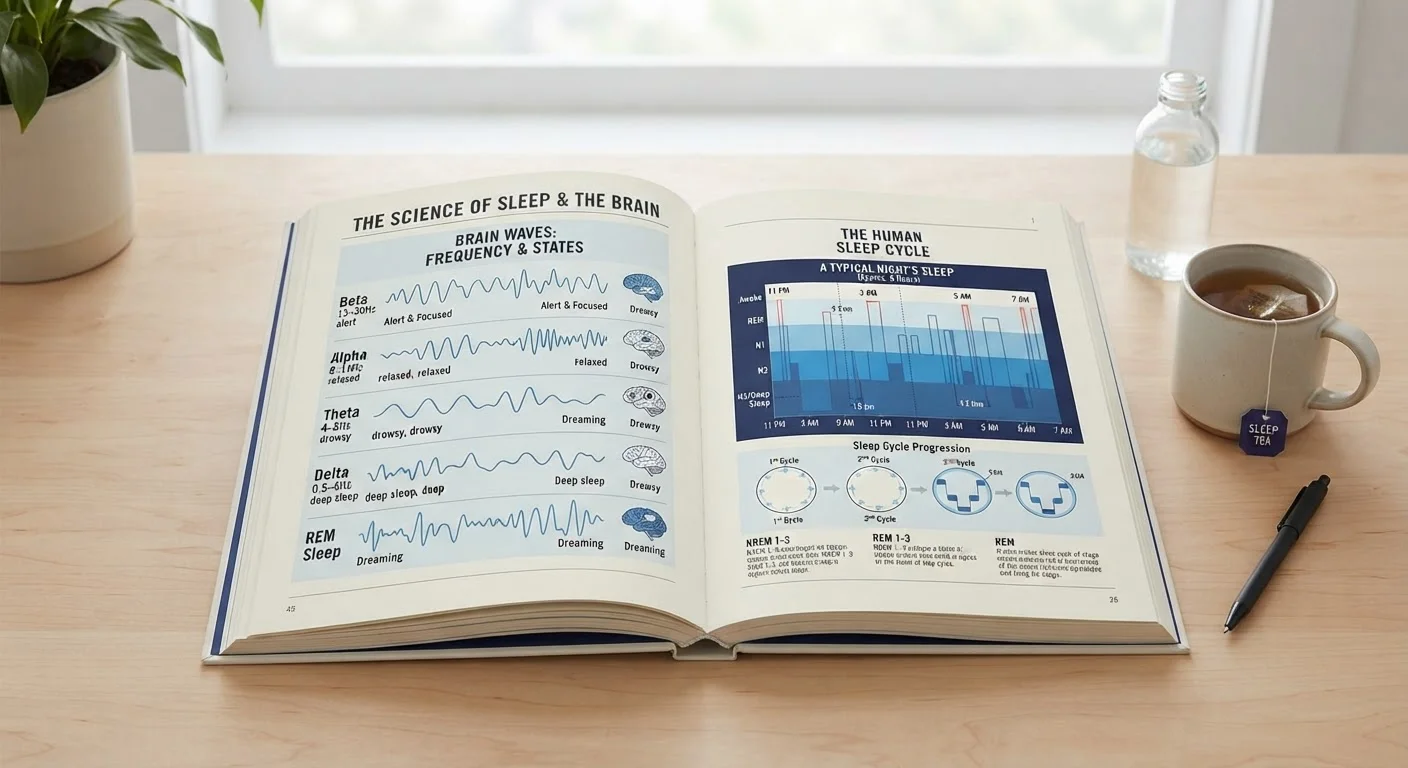
Rapid Eye Movement sleep is a distinct sleep stage characterized by vivid dreaming, temporary muscle paralysis, and high brain activity. It plays a critical role in emotional processing and memory consolidation.
NREM Sleep
Non-Rapid Eye Movement sleep encompasses three stages (N1, N2, and N3) that progress from light sleep to deep slow-wave sleep. NREM sleep is essential for physical restoration and immune function.
Slow-Wave Sleep (SWS)
The deepest stage of NREM sleep (stage N3), identified by large, slow brain waves called delta waves. This stage is considered the most restorative phase of the sleep cycle.
Polysomnography
A comprehensive sleep study conducted in a clinical setting that simultaneously records brain activity, eye movements, muscle activity, heart rate, and breathing. It is the gold-standard diagnostic tool for sleep disorders.
Sleep Architecture
The overall pattern and proportion of sleep stages across a full night of sleep. A typical healthy adult cycles through REM and NREM stages roughly every 90 minutes.
Sleep Debt
The cumulative deficit that builds when a person consistently gets less sleep than their body requires. Research suggests that chronic sleep debt is not fully recovered with a single night of extended sleep.
Homeostatic Sleep Drive
The biological pressure to sleep that increases the longer a person stays awake. It works alongside the circadian rhythm to regulate sleep timing and depth.
Chronotype
An individual's natural preference for sleep and wakefulness timing — commonly described as being a 'morning type' (early riser) or 'evening type' (night owl). Chronotype is influenced by genetics and shifts across life stages.
Sleep Fragmentation
Repeated brief awakenings that disrupt the continuity of sleep without the person necessarily remembering them. Fragmented sleep reduces the restorative quality of rest even when total sleep duration appears adequate.
Melatonin
A hormone produced by the pineal gland in response to darkness that signals the body to prepare for sleep. Melatonin does not directly cause sleep but acts as a timing cue within the circadian system.
Core Sleep Science Terms at a Glance
The glossary above defines the foundational vocabulary. Below are additional context points that help connect these terms to everyday experience.
| Recommended Adult Sleep Duration | 7–9 hours per night (American Academy of Sleep Medicine and Sleep Research Society consensus) |
| Typical Sleep Cycle Length | Approximately 90 minutes (National Sleep Foundation) |
| REM Sleep Proportion | 20–25% of total sleep time in healthy adults (General clinical sleep medicine reference range) |
| Diagnostic Tool | Polysomnography (overnight sleep study) (American Academy of Sleep Medicine) |
| Melatonin Onset Timing | Typically 1–2 hours before habitual sleep time (Circadian biology research consensus) |
Sleep architecture — the overall structure of how your sleep stages are distributed through the night — shifts across a lifetime. Children spend proportionally more time in slow-wave sleep; older adults often experience lighter, more fragmented sleep. Understanding these patterns can help contextualize what a clinician means when they review a sleep study result with you.
For readers interested in building practical habits around this knowledge, the what sleep hygiene actually means article is a logical next step. For those just starting out, Sleep for Beginners offers a grounded entry point into habits and recovery. And if you're curious how sleep vocabulary compares to terminology in other wellness domains, our weight management glossary follows the same plain-language format.
If you have concerns about your sleep quality or a possible sleep disorder, consult a qualified healthcare professional for personalized evaluation and guidance.