

Key Takeaways
- Specialized retinal cells — not standard vision cells — carry light signals to the brain's master clock.
- The suprachiasmatic nucleus (SCN) in the hypothalamus acts as the brain's primary circadian pacemaker.
- Bright morning light advances your sleep timing; bright evening light delays it.
- Blue-wavelength light suppresses melatonin most potently, but intensity and timing matter equally.
- Dim evening light and bright daytime light together create the strongest circadian signal.
Light-Sleep Signaling Pathway
The light-sleep signaling pathway is the biological process by which specialized cells in the eye detect light and send direct signals to a region of the brain that governs when you feel awake or sleepy. This pathway acts as your body's primary timekeeper, synchronizing internal rhythms to the outside world's day-night cycle. Understanding it explains why light — natural or artificial — has such a powerful influence on sleep timing.
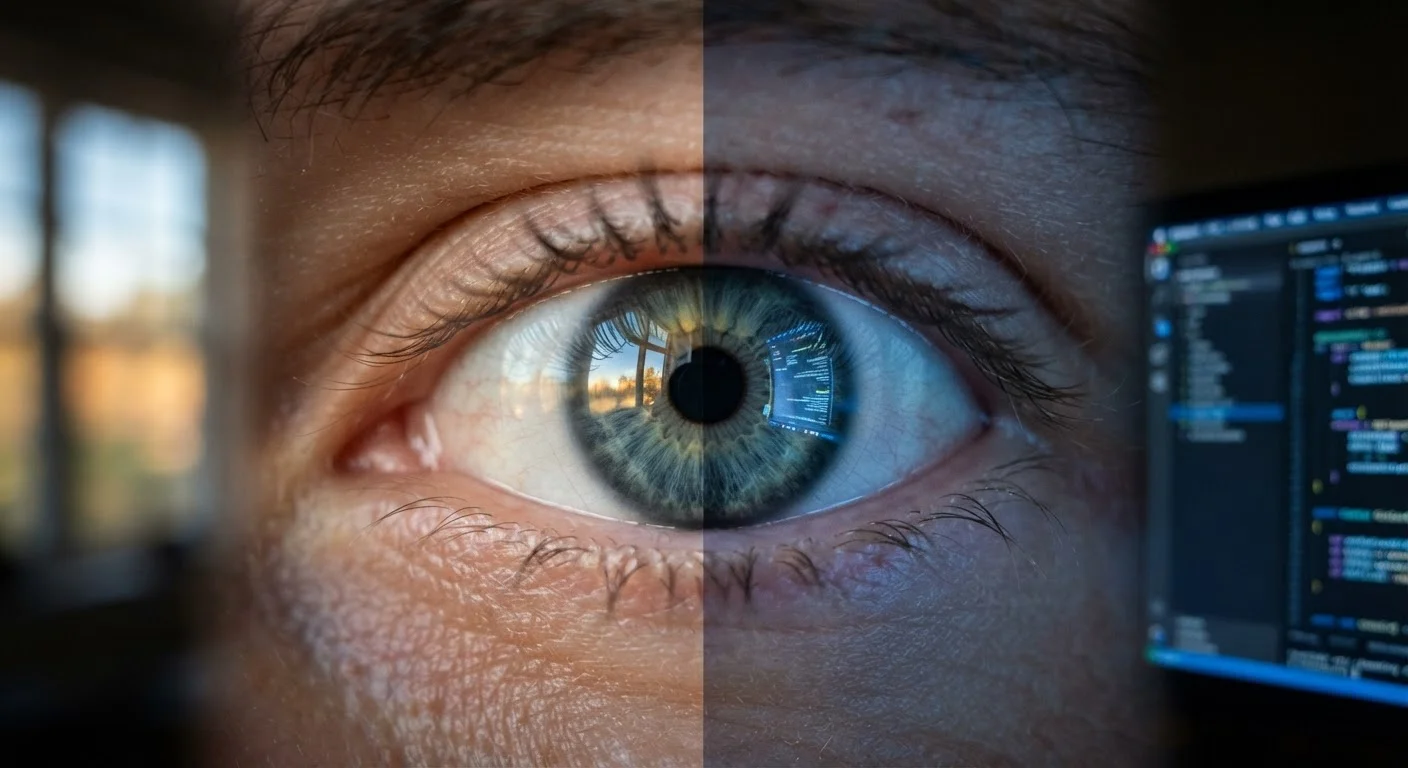
The key cells involved are intrinsically photosensitive retinal ganglion cells (ipRGCs), which contain the photopigment melanopsin and are maximally sensitive to short-wavelength (blue) light around 480 nm.
The Eye's Hidden Timekeepers
Most people understand that the eye contains rods and cones for vision. Fewer know about a third class of light-sensitive cells — intrinsically photosensitive retinal ganglion cells (ipRGCs) — that play virtually no role in forming images. Their job is entirely different: they measure ambient light levels and relay that data to the brain's internal clock.
ipRGCs contain a photopigment called melanopsin, which is most responsive to short-wavelength blue light. Unlike rods and cones, ipRGCs fire slowly and persistently, integrating light exposure over time rather than capturing fast-moving visual scenes. This makes them ideal environmental sensors rather than image processors.
Signals from ipRGCs travel along a dedicated neural highway called the retinohypothalamic tract, bypassing the visual cortex entirely and landing directly at the suprachiasmatic nucleus (SCN) in the hypothalamus. This pathway is separate from standard vision — which is why some people with significant vision loss can still have their circadian rhythms influenced by light.
The SCN: Your Brain's Master Clock
The suprachiasmatic nucleus (SCN) is a small, paired cluster of roughly 20,000 neurons sitting just above where the optic nerves cross. Despite its modest size, it acts as the master pacemaker for nearly every biological rhythm in the body — from hormone release to core body temperature to the timing of sleep and wakefulness.
When light signals arrive from the ipRGCs, the SCN adjusts its firing patterns to align internal rhythms with the external environment. In practical terms, morning light tells the SCN that the day has begun, shifting the body toward alertness. Evening darkness signals the SCN to initiate the transition toward sleep.
~480 nm
Peak wavelength activating melanopsin in ipRGCs
Research on melanopsin photosensitivity consistently identifies short-wavelength blue light near 480 nanometers as the most potent stimulus for circadian light signaling.
10,000+ lux
Typical outdoor daylight illuminance
Compared to 100–500 lux in most indoor environments, outdoor light delivers a dramatically stronger circadian signal to the SCN, even on overcast days.
~20,000
Neurons in the suprachiasmatic nucleus
Despite its small size, this paired nucleus in the hypothalamus coordinates circadian timing across virtually every organ system in the body.
The SCN also communicates downstream to the pineal gland, which produces melatonin — often called the "darkness hormone" because it rises in response to dim light, not as a direct sleep trigger, but as a circadian timing signal. Light suppresses melatonin; darkness permits it. This interplay is the core mechanism linking your light environment to your sleep schedule.
For a broader picture of how your light environment shapes rest, see how light exposure throughout the day influences sleep at night.
Timing, Intensity, and Wavelength: The Three Variables That Matter
Not all light affects sleep equally. Three interacting factors determine how powerfully a given light source shifts your circadian rhythm:
- Timing: Morning light advances your circadian phase (makes you feel sleepy earlier). Evening light delays it (pushes sleepiness later). The same light source has opposite effects depending on when it hits your eyes.
- Intensity: Brighter light produces stronger SCN responses. Outdoor daylight — even on an overcast day — typically delivers 10,000 lux or more, while most indoor environments offer 100–500 lux. This gap means indoor lighting alone rarely provides the full circadian signal the SCN expects.
- Wavelength: Blue-range light (~460–490 nm) most potently activates melanopsin in ipRGCs. Warmer, red-shifted light activates melanopsin less efficiently. This is why the color temperature of lighting matters, especially in the evening.
These variables interact: a very bright warm-white light can still suppress melatonin significantly, while a dim blue light may have a more modest effect. Focusing on any single factor in isolation — for example, obsessing only over blue light while ignoring overall brightness — oversimplifies how the system works.
Screen time before bed involves all three of these variables simultaneously, which is why the evidence around it is more nuanced than headlines often suggest.
What This Means for Your Evening and Morning Routine
Understanding the pathway from eye to SCN points to two high-leverage behavioral windows:
Evening: Reduce the Light Signal
Dimming lights and shifting toward warmer color temperatures in the hour or two before bed reduces ipRGC stimulation, allowing melatonin to rise on schedule. This doesn't require total darkness — even modest reductions in brightness can meaningfully support the transition toward sleep readiness. Bright overhead lighting is more impactful than small screens held at arm's length, though both contribute.
Morning: Strengthen the Light Signal
Bright morning light — ideally outdoor daylight — delivers a robust signal to the SCN that anchors your circadian phase. This makes evening sleepiness more predictable and consistent. Getting outdoor light before your first screen is one of the most evidence-supported morning habits for sleep health.
Two Simple Habits That Support the Pathway
Step outside within an hour of waking — even five to ten minutes of natural daylight gives the SCN a strong anchoring signal. Then, about 90 minutes before bed, dim your indoor lights and switch to warmer-toned lamps. These two bookends create the light-dark contrast your circadian system is built to respond to.
The broader relationship between light, circadian health, and cognitive function is explored in the Mind & Sleep hub, which covers how sleep quality shapes mental clarity and daily performance.
This article is for general informational and educational purposes only and does not constitute medical advice. If you have concerns about sleep disorders or chronic sleep disruption, please consult a qualified healthcare professional.