

Key Takeaways
- Non-REM sleep dominates the first half of the night; REM sleep lengthens in the second half.
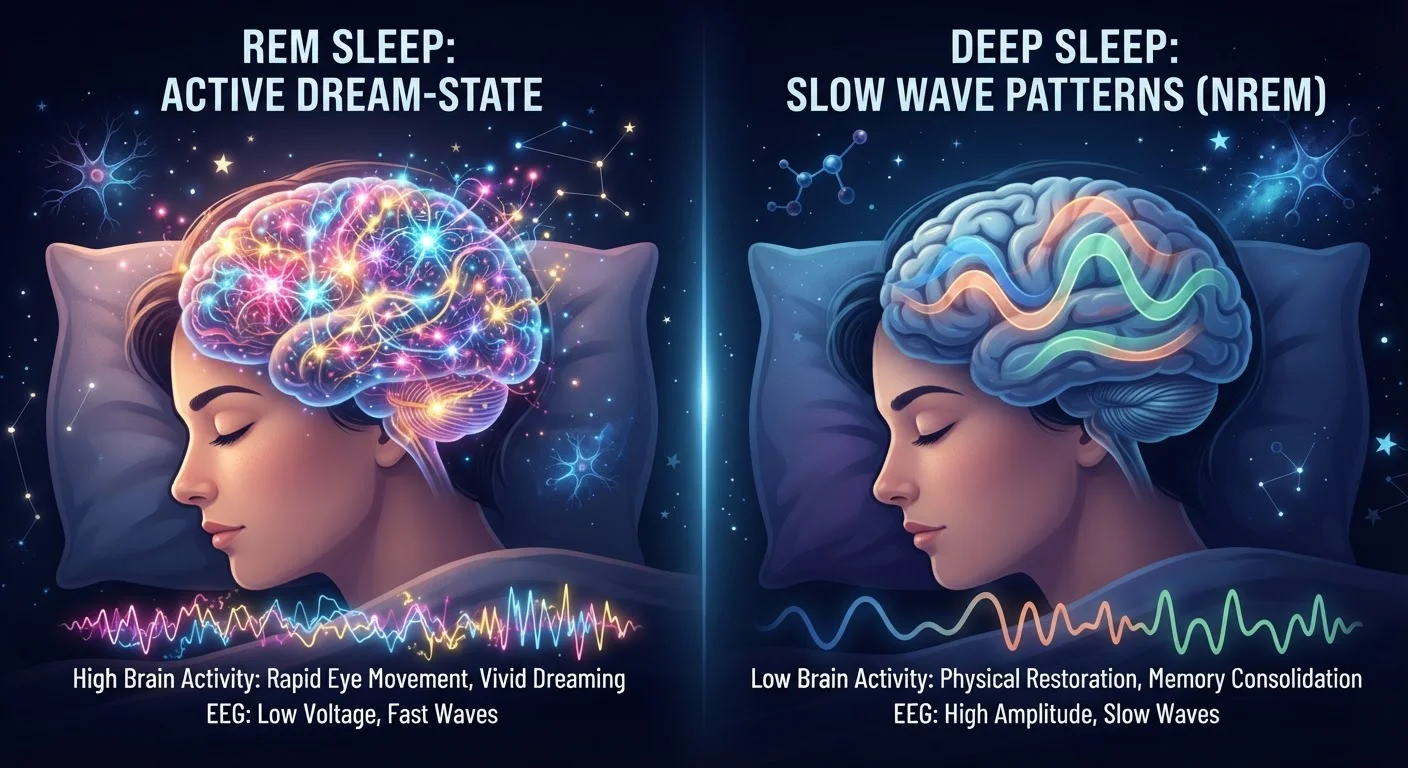
- REM sleep is characterized by rapid eye movements, vivid dreaming, and near-complete muscle paralysis.
- Non-REM deep sleep (slow-wave sleep) is when the body does its most significant physical repair work.
- Both sleep types are required for full cognitive and physical recovery — neither can fully substitute for the other.
- A single night of poor sleep can measurably disrupt the balance between REM and non-REM stages.
Option A
REM Sleep
The brain's active, dream-rich recovery phase.
Best for: Emotional processing, memory consolidation, and creative thinking during the later cycles of the night.
Option B
Non-REM Sleep
The body's deep, restorative quiet phase.
Best for: Physical repair, immune strengthening, and the deepest cognitive restoration, especially in the first half of the night.
If you want to understand why you feel emotionally depleted after poor sleep
REM Sleep
REM sleep plays a central role in emotional regulation and memory integration. Losing REM — common when sleep is cut short — is closely linked to mood instability and reduced stress resilience.
If you're recovering from illness or intense physical exertion
Non-REM Sleep
Deep non-REM (slow-wave) sleep is when growth hormone release peaks and tissue repair is most active, making it critical for physical recovery.
If you're studying the relationship between sleep and overall health
Non-REM Sleep
Non-REM sleep, particularly stages 3 and 4, is associated with immune function, metabolic regulation, and the foundational rest that precedes REM cycles.
If you want to improve learning and memory retention
REM Sleep
Research consistently links REM sleep to the consolidation of procedural and emotional memories, making it especially relevant for learning-heavy periods.
What the Science Says About Each State
Sleep is not a single, uniform state. Every night, your brain cycles through two fundamentally different modes — REM (Rapid Eye Movement) and Non-REM (NREM) sleep — each with its own biology, purpose, and measurable characteristics.
NREM sleep itself has three stages. Stages 1 and 2 are lighter sleep, featuring slowing brain waves and reduced muscle activity. Stage 3 — often called slow-wave sleep or deep sleep — produces the large, synchronized delta waves that mark the deepest, most restorative phase of NREM. During this stage, breathing slows, heart rate drops, and the body prioritizes cellular repair and immune support.
REM sleep, by contrast, looks surprisingly like wakefulness on an EEG (electroencephalogram). Brain activity is fast and desynchronized, similar to alert waking. The defining markers: rapid eye movements under closed lids, vivid dreaming, and atonia — a near-total paralysis of voluntary muscles that prevents people from physically acting out their dreams.
For a deeper look at how these stages fit into a full night's architecture, see our guide to sleep architecture.
| Criterion | REM Sleep | Non-REM Sleep |
|---|---|---|
| Brain activity | Fast, wake-like EEG patterns | Slower waves; delta waves in deep stage |
| Eye movement | Rapid, darting movements | Slow or absent |
| Muscle tone | Near-complete paralysis (atonia) | Reduced but not paralyzed |
| Dreaming | Vivid, narrative dreams common | Rare; brief mental imagery in stage 2 |
| Primary function | Emotional regulation, memory consolidation | Physical repair, immune support, waste clearance |
| When it peaks | Later cycles (second half of night) | Early cycles (first half of night) |
| Heart rate & breathing | Variable, can spike during dreams | Slow and steady |
Timing, Cycles, and Why Both Are Non-Negotiable
A typical adult completes four to six sleep cycles per night, each roughly 90 minutes long. The distribution of REM and NREM shifts dramatically across those cycles. Early in the night, NREM stage 3 dominates — this is when slow-wave, physically restorative sleep is most concentrated. As the night progresses, each cycle allocates more time to REM, which is why the longest, most vivid dreams tend to occur in the early morning hours just before waking.
This timing matters practically: cutting sleep short by even an hour or two disproportionately reduces REM sleep, since most REM is packed into the final cycles. That's one reason sleep duration and sleep quality are both important, not interchangeable. Research on short versus long sleep underscores that duration alone doesn't capture the full picture of sleep health.
The functions of each state are also distinct enough that losing one cannot be compensated by more of the other. NREM deep sleep is when the glymphatic system — the brain's waste-clearance network — is most active, flushing metabolic byproducts. REM sleep is when emotional memories are processed and procedural skills are consolidated. Your habits before bed shape both. Evening routines have a measurable influence on how much slow-wave and REM sleep you actually get.
For a plain-language breakdown of all four stages and what happens in each, our sleep stages explainer covers the full picture in accessible detail.
This article is for general informational and educational purposes only and is not a substitute for professional medical advice. If you have concerns about your sleep quality or health, consult a qualified healthcare provider.