

Key Takeaways
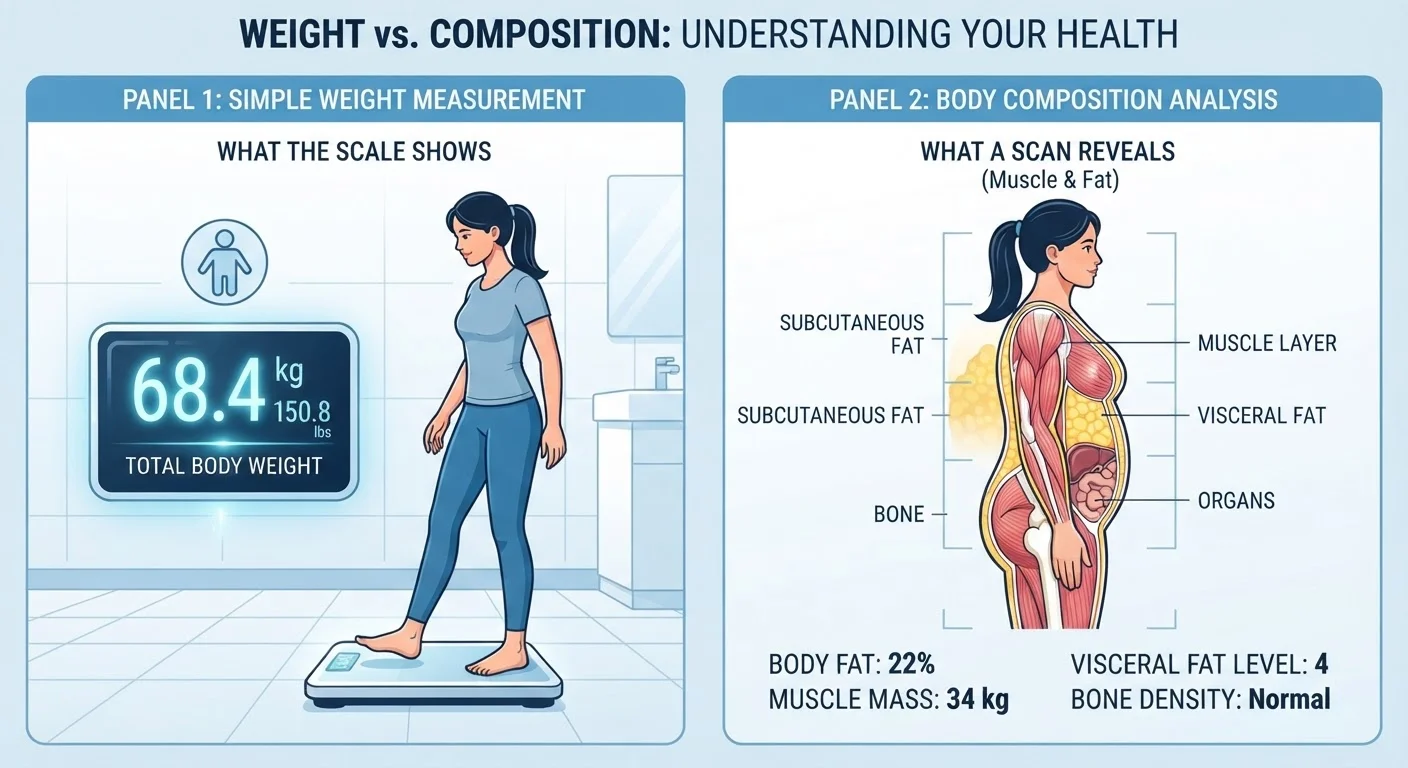
- Scale weight alone cannot distinguish between fat mass, muscle mass, water, and bone.
- Two people can weigh the same yet have dramatically different health risks based on body composition.
- Muscle tissue is metabolically active; higher lean mass is generally linked to better metabolic health.
- Where fat is stored - especially visceral fat around organs - matters as much as how much fat you carry.
- Body composition metrics are useful tools but have real limitations; context always matters.
- Improving body composition typically involves both resistance training and nutrition changes, not just weight loss.
Body Composition
Body composition refers to the proportion of different tissues that make up your total body weight - primarily fat mass and lean mass (which includes muscle, bone, organs, and water). Unlike scale weight, which is a single number, body composition breaks down what your body is actually made of. Understanding this distinction helps explain why two people of identical height and weight can have very different health profiles.
Clinically, body composition is often expressed as body fat percentage and lean body mass. Advanced methods such as dual-energy X-ray absorptiometry (DEXA) can also differentiate visceral fat from subcutaneous fat - a distinction with significant metabolic implications.
What Body Composition Actually Measures
When most people think about their physical health, they think about a number on a scale. But that number is a sum - it adds together muscle, fat, bone, organs, connective tissue, and water without distinguishing between any of them. Body composition peels back that single figure to reveal the underlying breakdown.
The two most commonly discussed components are fat mass and lean mass. Fat mass includes both essential fat (needed for hormone regulation, organ protection, and neurological function) and storage fat. Lean mass covers everything else - skeletal muscle, bone mineral density, organ tissue, and body water.
For a plain-language reference on how these categories translate into measurable metrics, see our body fat percentage and lean mass reference guide.
~30%
Body fat threshold linked to elevated metabolic risk in men
Research published in clinical nutrition journals identifies approximately 25-30% body fat in men as a range where metabolic risk markers tend to increase, independent of BMI classification.
1-2%
Annual muscle mass decline after age 30 without intervention
Exercise physiology literature estimates that adults lose roughly 1-2% of muscle mass per year beginning in their 30s, accelerating after 60, in the absence of resistance training.
~3x
Greater metabolic activity of muscle vs. fat tissue
Skeletal muscle burns significantly more calories at rest than an equivalent mass of adipose (fat) tissue, contributing to differences in resting metabolic rate across individuals.
Why Scale Weight Is an Incomplete Health Signal
Consider two adults who both weigh 175 pounds. One is a recreational weight lifter with 20% body fat and substantial muscle mass. The other is sedentary with 35% body fat and limited lean tissue. Standard BMI would treat them nearly identically - yet their metabolic health profiles, functional capacity, and chronic disease risk can differ substantially.
This is not a hypothetical edge case. Research has shown that visceral fat - the fat stored around internal organs in the abdominal cavity - is independently associated with insulin resistance, elevated blood lipids, and cardiovascular risk, even when total body weight is unremarkable. Someone can have a normal BMI while still carrying metabolically problematic fat distribution.
The concept of "normal-weight obesity" illustrates this well: individuals within a "healthy" BMI range but with elevated body fat percentages may carry similar health risks to those classified as overweight. For a deeper look at what healthy weight benchmarks actually measure, see our article on what healthy weight really means.
The Role of Muscle Mass in Health
Skeletal muscle is far more than a tool for physical performance. It is metabolically active tissue that plays a central role in glucose regulation - muscle cells are one of the primary sites where the body clears blood sugar after meals. Higher lean mass is associated with improved insulin sensitivity, better resting metabolic rate, and greater functional independence as people age.
Sarcopenia - the gradual loss of muscle mass and strength that occurs with aging - is increasingly recognized as a significant health concern independent of obesity status. Maintaining or building lean mass through resistance training is one of the most evidence-supported strategies for long-term metabolic and physical health.
The relationship between lean mass, fat distribution, and metabolic markers is explored further in our piece on body composition and metabolic health. It's also worth noting that macronutrient intake - particularly protein - plays a direct role in preserving and building lean tissue.
How Body Composition Is Assessed
Several methods exist for measuring body composition, each with different levels of accuracy, cost, and accessibility:
- DEXA scan: Considered a clinical gold standard; uses low-dose X-ray to differentiate bone, lean tissue, and fat with high precision.
- Hydrostatic weighing: Measures body density by underwater weighing; accurate but requires specialized equipment.
- Bioelectrical impedance analysis (BIA): Common in consumer scales and gym devices; sends a small electrical current through the body to estimate fat versus lean tissue. Convenient but sensitive to hydration levels.
- Skinfold calipers: A trained technician measures fat at specific body sites; accuracy depends heavily on technique.
No method is perfect for every person or context. Hydration status, recent exercise, and measurement timing can all affect results. For a balanced look at what body composition data can and cannot reliably tell you, see our guide to interpreting body composition data.
This article is for general informational and educational purposes only and is not a substitute for professional medical advice. Always consult a qualified healthcare provider before making changes to your health or fitness regimen.