

Key Takeaways
- Muscle mass peaks in early adulthood and gradually declines after age 30 without resistance training.
- Hormonal shifts - including puberty, pregnancy, and menopause - are major drivers of fat redistribution.
- Sarcopenia, or age-related muscle loss, accelerates after 60 but can be meaningfully slowed with exercise and adequate protein.
- Fat distribution patterns shift from subcutaneous to visceral with age, which carries distinct metabolic implications.
- Lifestyle factors like physical activity and diet interact with biology to determine how composition changes unfold.
Why Body Composition Doesn't Stay Still
Body composition - the ratio of muscle, fat, bone, and water in the body - is far from a fixed number. It responds continuously to biological programming, hormonal fluctuations, nutrition, activity levels, and the simple passage of time. Understanding how and why these shifts happen empowers people to make more informed decisions about their health across every decade of life.
It's worth clarifying that changes in body composition are not the same as changes in body weight. Someone's scale number can remain identical while their muscle-to-fat ratio changes significantly - a distinction with real consequences for metabolic health. Below are the key life-stage shifts researchers have documented most consistently.
Childhood and adolescence: rapid gains in lean mass
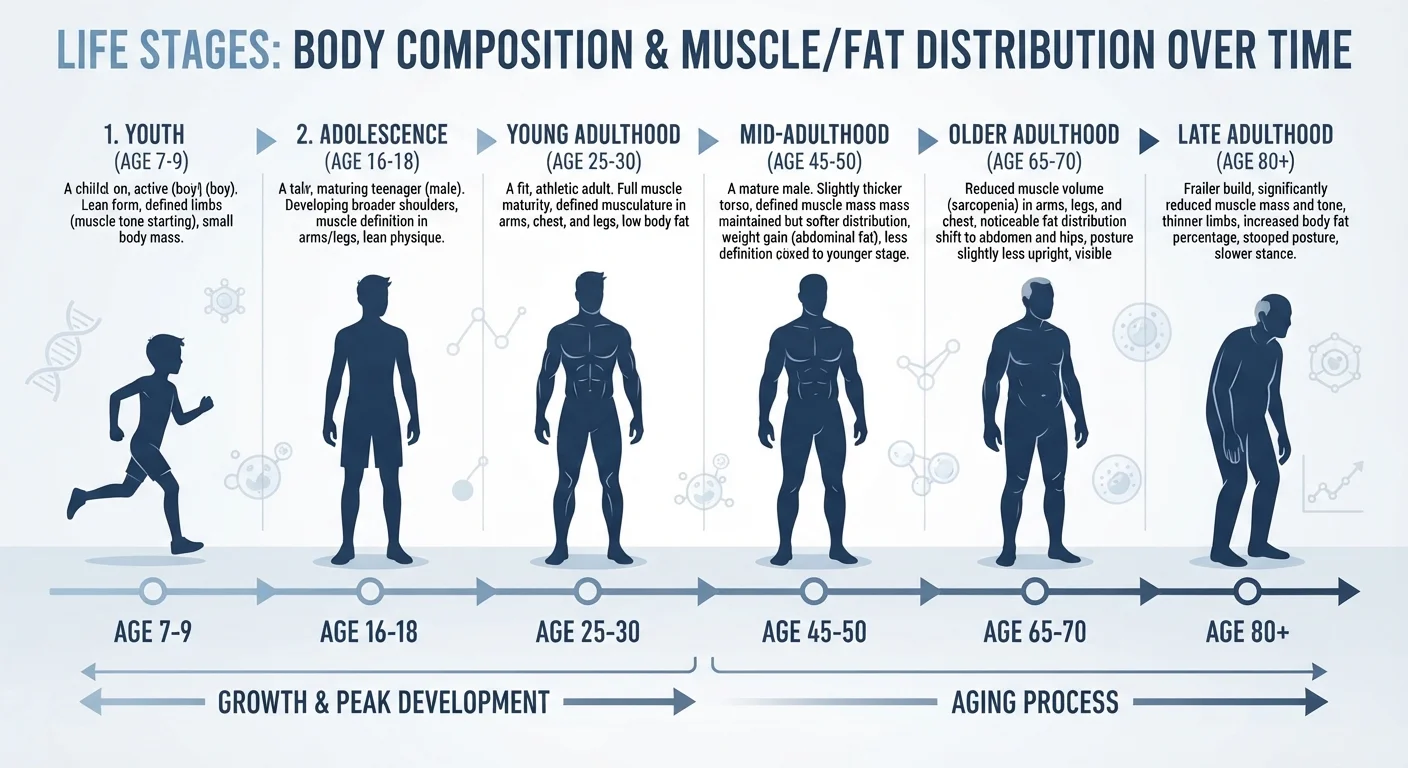
During childhood, the body builds foundational lean mass - primarily bone and muscle - at a steady rate. Adolescence accelerates this dramatically. Puberty triggers surges in sex hormones: testosterone drives pronounced muscle growth and lower body fat percentages in males, while estrogen promotes fat deposition in the hips, thighs, and breasts in females. These are normal, hormonally programmed changes rather than health problems.
By the end of adolescence, most individuals have established their basic body composition blueprint. Physical activity during these years - particularly weight-bearing exercise - plays a meaningful role in building peak bone density, which serves as a reserve drawn upon throughout adulthood.
Puberty sets the hormonal blueprint that shapes body composition well into adulthood.
Early adulthood (20s-30s): peak muscle mass and emerging fat creep
Most people reach peak skeletal muscle mass somewhere in their mid-to-late 20s. Physical performance benchmarks - strength, speed, cardiovascular capacity - tend to peak around this window. However, this is also when lifestyle habits begin to exert compounding influence. Sedentary work, disrupted sleep, and dietary shifts can trigger gradual fat accumulation even when body weight appears stable.
Research suggests that without deliberate resistance training, adults begin losing roughly 3-8% of muscle mass per decade starting around age 30. This makes early adulthood a critical window for establishing habits rather than a period when body composition can be taken for granted.
Muscle mass peaks in the late 20s - after that, inactivity quietly accelerates its decline.
Midlife (40s-50s): hormonal transitions and fat redistribution
Midlife brings some of the most noticeable body composition changes, largely driven by hormonal decline. In women, the perimenopause and menopause transition - typically occurring between the mid-40s and early 50s - involves falling estrogen levels that shift fat storage from the hips and thighs toward the abdomen. This visceral fat accumulation is metabolically distinct from subcutaneous fat and is associated with a higher risk of cardiovascular and metabolic conditions.
In men, testosterone levels decline gradually from around age 30 onward, contributing to slower muscle protein synthesis and increased fat mass over time. Neither trajectory is inevitable at a fixed rate - resistance training and adequate nutrition can meaningfully offset these changes. This is also an important time to discuss hormone-related health changes with a physician.
Hormonal decline in midlife shifts fat toward the abdomen - a change with real metabolic stakes.
Older adulthood (60s and beyond): sarcopenia and bone density loss
After age 60, muscle loss accelerates in a process called sarcopenia (from the Greek for "loss of flesh"). Without intervention, adults may lose as much as 1-2% of muscle mass per year during this period. Simultaneously, bone mineral density continues to decline, increasing fracture risk - particularly in postmenopausal women.
Fat mass often increases even when total body weight stays the same, meaning traditional weight-centric health assessments can miss important changes in older adults. Evidence consistently supports resistance training as the most effective tool for preserving muscle in this life stage. Practical weight management strategies for older adults must account for these realities rather than defaulting to calorie restriction alone.
Sarcopenia accelerates after 60, but consistent resistance training remains one of the most effective countermeasures.
Pregnancy and postpartum: a distinct composition trajectory
Pregnancy involves deliberate, hormonally directed changes in body composition: increased fat stores (particularly in early pregnancy), expanded blood volume, and growth of uterine and breast tissue. These are physiologically necessary adaptations, not departures from health. Postpartum, the body undergoes its own recomposition process, influenced by breastfeeding, sleep deprivation, activity level, and individual hormonal recovery timelines.
It's important to recognize that postpartum body composition changes are highly individual and that unrealistic expectations - including pressure for rapid "return" to pre-pregnancy composition - can be harmful. Anyone with questions about body composition during or after pregnancy should speak with an obstetrician or registered dietitian who specializes in perinatal care.
Pregnancy-driven fat gain is hormonally directed and physiologically necessary - not a health failure.
What You Can Take Forward
Body composition shifts are inevitable, but their trajectory is not entirely out of your control. The research is consistent: regular resistance training, sufficient protein intake, and staying physically active across the lifespan are among the most effective tools for maintaining favorable muscle-to-fat ratios at every age.
Because biological sex influences how fat and muscle are distributed, individual baselines vary - what matters most is tracking meaningful change over time rather than comparing against universal norms. For those navigating specific life transitions, weight management strategies adapt meaningfully across life stages and should reflect those biological realities. As always, consult a qualified healthcare provider before making significant changes to your diet or exercise routine, especially during major life transitions or if you have an existing health condition.
Track trends, not single snapshots
Body composition fluctuates day to day based on hydration, sleep, and food intake. A single measurement tells you very little. If you're tracking muscle-to-fat ratios over time, compare readings taken under consistent conditions - same time of day, same hydration state, same method. Meaningful trends emerge over months, not days.
This article is for informational purposes only and is not a substitute for professional medical advice, diagnosis, or treatment.