

Key Takeaways
- Females typically carry a higher percentage of body fat than males at equivalent fitness levels.
- Testosterone promotes greater muscle mass and bone density in males on average.
- Fat distribution differs by sex: females tend toward gluteal-femoral storage, males toward abdominal storage.
- Visceral fat - the more metabolically harmful type - accumulates more readily in males before midlife.
- Health benchmarks for body fat percentage are sex-specific and should be interpreted accordingly.
- Hormonal shifts across life stages, including menopause, substantially reshape body composition in females.
Body Composition Across Genders
Body composition refers to the proportion of fat mass versus lean mass (muscle, bone, and organs) in the body. Biological sex significantly influences these proportions, the distribution of fat across the body, and how muscle is built and maintained. Understanding these differences helps contextualize health benchmarks that vary between males and females.
These differences are largely driven by sex hormones - primarily estrogen and testosterone - which regulate fat storage patterns, lean mass accretion, and bone density throughout the lifespan.
Why Biological Sex Shapes Body Composition
Body composition - the ratio of fat to lean tissue - is not a single universal standard. Biological sex introduces meaningful physiological variation in how fat and muscle are deposited, maintained, and metabolized. These differences emerge during puberty and continue evolving across the lifespan, driven primarily by sex hormones.
Testosterone, predominant in males, promotes the development of skeletal muscle and denser bone tissue. Estrogen, predominant in females, encourages fat storage in specific depots - particularly the hips, thighs, and breasts - and plays a key role in regulating where fat is laid down. The result is that adult females typically carry a higher percentage of body fat than adult males of comparable age and fitness levels, and this is biologically normal rather than a health concern in itself.
Understanding this context matters because many body composition metrics are misapplied when the same standards are used across sexes without adjustment. Several common myths about fat and muscle stem partly from ignoring these sex-based physiological differences.
Fat Distribution: Where the Body Stores It Matters
Beyond the total amount of body fat, its anatomical location carries significant health implications. Males and females follow distinct distribution patterns driven by hormonal influences.
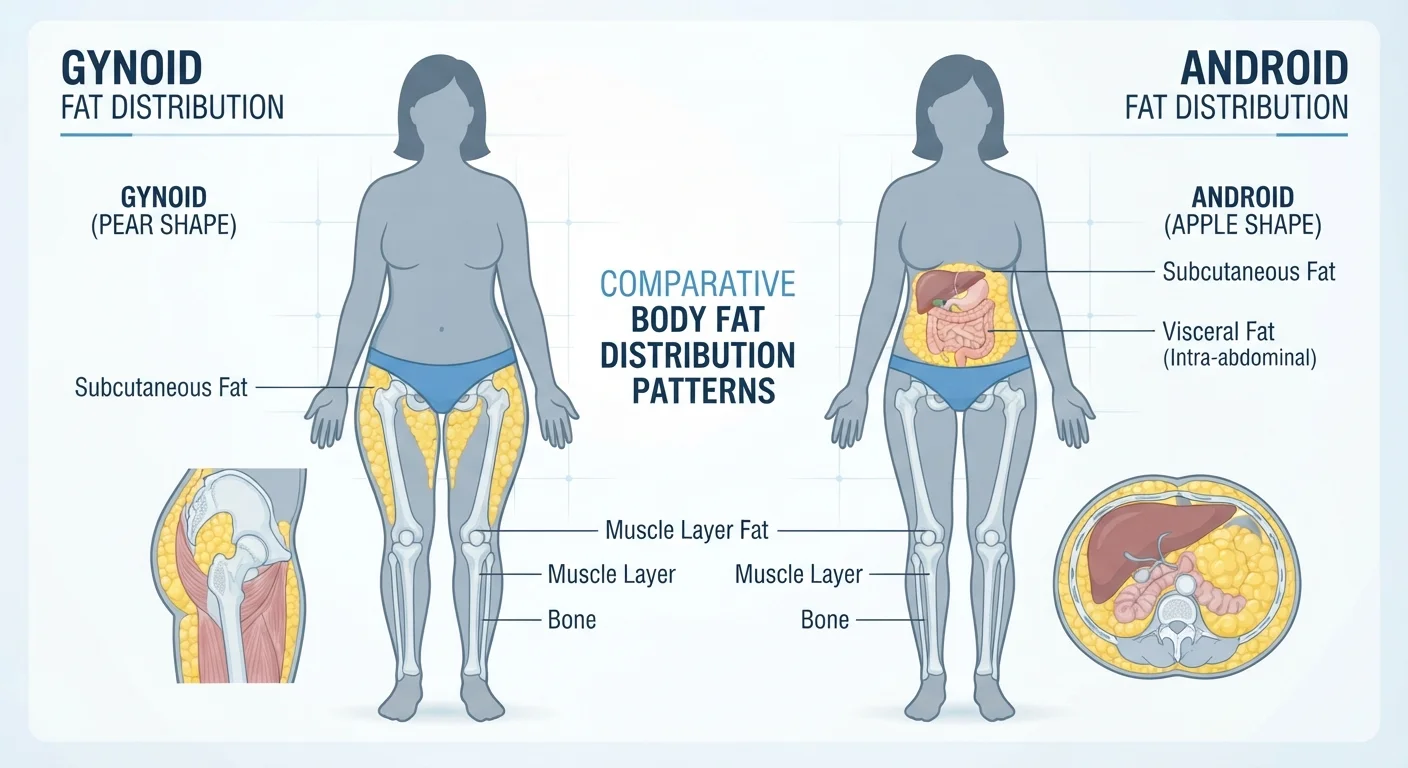
Females predominantly store fat in a gynoid pattern - concentrated in the hips, buttocks, and thighs. This subcutaneous fat is less metabolically active and generally associated with lower cardiovascular risk than abdominal fat. Males more commonly exhibit an android pattern, with fat accumulating around the abdomen, including visceral deposits that surround internal organs.
Visceral fat is metabolically active in ways that raise health risk - it's linked to insulin resistance, elevated triglycerides, and systemic inflammation. As detailed in our overview of visceral versus subcutaneous fat, location can matter as much as total fat mass when assessing metabolic health.
After menopause, estrogen decline causes a shift in female fat distribution toward the abdominal region, increasing visceral fat burden and narrowing the cardiovascular risk gap between sexes.
~6-11%
Typical body fat difference between sexes
Research consistently finds adult females carry roughly 6-11 percentage points more body fat than males of similar age and fitness level, reflecting normal hormonal physiology.
~40%
Greater muscle mass in males on average
Studies in exercise physiology estimate males have approximately 40% more skeletal muscle mass than females on average, largely attributable to testosterone's anabolic effects.
Post-50
Age when female visceral fat rises sharply
Menopause-related estrogen decline causes a marked increase in visceral fat accumulation in females, substantially raising metabolic risk after approximately age 50.
Lean Mass, Muscle, and Hormonal Drivers
Males generally carry greater absolute lean mass - muscle and bone - than females, largely due to higher circulating testosterone. Testosterone enhances protein synthesis in muscle tissue and increases bone mineral density. This is why, on average, males have larger muscle cross-sections and higher baseline strength.
This difference does not mean females cannot build meaningful muscle. Research consistently shows that both sexes experience significant strength and lean mass gains from resistance training. Women typically gain strength proportionally comparable to men; the absolute size of muscle achieved simply differs due to hormonal environment. The relationship between lean mass and health is important for both sexes - muscle and fat tissue function very differently in terms of metabolic activity and long-term health outcomes.
With aging, both sexes lose lean muscle mass - a process called sarcopenia - but the rate and hormonal drivers differ. Males experience a more gradual decline tied to slowly falling testosterone. Females often see accelerated muscle loss around menopause. Body composition changes across life stages are substantial and worth understanding for both preventive and clinical health planning.
Interpreting Health Benchmarks Correctly
Health and fitness assessments that use body fat percentage, waist circumference, or lean mass ratios must be interpreted with sex-specific reference ranges. Applying male benchmarks to females - or vice versa - produces misleading results and can lead to unnecessary concern or missed health signals.
For example, a body fat percentage considered high for an adult male may fall squarely within the healthy range for an adult female. Similarly, waist circumference cutoffs used to screen for metabolic risk differ by sex. These distinctions are reflected in clinical guidelines from organizations such as the National Institutes of Health and the American Heart Association.
Body composition metrics also interact with metabolic health in complex ways. The connection between body composition and metabolic health involves more than just total fat - it encompasses fat distribution, muscle mass, and hormonal status, all of which differ by biological sex.
This article provides general health education and is not a substitute for personalized medical advice. Consult a qualified healthcare provider to interpret any body composition measurements in the context of your individual health history.