

Key Takeaways
- Visceral fat surrounds internal organs and is far more metabolically harmful than subcutaneous fat.
- Subcutaneous fat sits just beneath the skin and plays important roles in energy storage and hormone regulation.
- A person's fat distribution - not just total body fat percentage - is a critical indicator of metabolic health risk.
- Waist circumference is a practical proxy for estimating visceral fat accumulation.
- Lifestyle changes including aerobic exercise and dietary improvements can meaningfully reduce visceral fat.
- Consult a qualified healthcare provider for personalized guidance on body composition and health risk assessment.
Option A
Visceral Fat
The metabolically active fat that surrounds internal organs.
Best for: Understanding health risk: visceral fat is the type most closely linked to cardiometabolic disease, insulin resistance, and systemic inflammation.
Option B
Subcutaneous Fat
The accessible, visible fat stored just beneath the skin.
Best for: Understanding body composition broadly: subcutaneous fat serves important protective and hormonal functions and is far less dangerous than visceral fat in most contexts.
If you want to understand which type of fat poses the greatest disease risk
Visceral Fat
Visceral fat is the primary driver of insulin resistance, cardiovascular risk, and chronic inflammation - making it the more clinically significant concern to address first.
If you're assessing overall body composition and appearance
Subcutaneous Fat
Subcutaneous fat is what most people observe visually and measure via body fat percentage tools; while excess amounts carry some risk, it is far less harmful than visceral fat.
If you're evaluating risk without a scale or body fat scan
Visceral Fat
Waist circumference and waist-to-hip ratio are low-cost, accessible indicators that reflect visceral fat more accurately than weight or BMI alone.
If you're looking at how lifestyle changes affect fat loss
Visceral Fat
Research consistently shows visceral fat responds more rapidly to aerobic exercise and dietary changes than subcutaneous fat, making it a meaningful early target.
Two Types of Fat, Very Different Consequences
Most conversations about body fat focus on how much of it a person carries. But research in metabolic medicine has made one thing increasingly clear: where fat is stored matters as much as how much is stored. The distinction between visceral and subcutaneous fat is not merely anatomical - it has direct implications for disease risk, hormonal health, and long-term wellness.
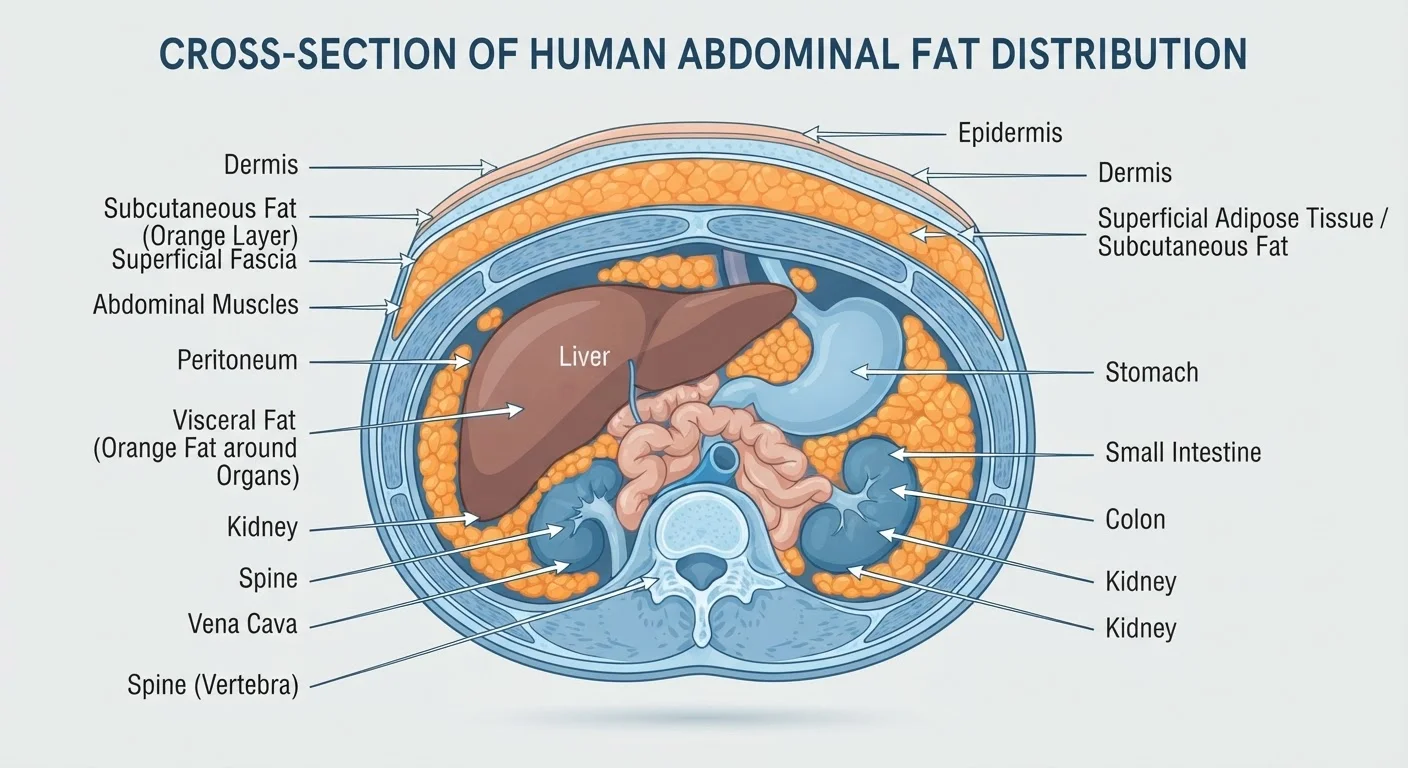
Subcutaneous fat is the layer stored just below the skin. You can pinch it. It accumulates on the thighs, hips, arms, and abdomen surface. Visceral fat, by contrast, is stored deep within the abdominal cavity, wrapping around organs including the liver, pancreas, and intestines. Because visceral fat is metabolically active - releasing fatty acids, hormones, and inflammatory compounds directly into the portal circulation that supplies the liver - its effects on the body are substantially more disruptive.
To understand how each fat type fits into overall body composition, see our explainer on muscle and fat tissue.
| Criterion | Visceral Fat | Subcutaneous Fat |
|---|---|---|
| Location | Deep inside abdominal cavity, around organs | Just beneath the skin surface |
| Visibility | Not visible or pinchable | Visible; can be pinched |
| Metabolic Activity | Highly active; releases cytokines and fatty acids | Less metabolically active |
| Disease Risk | Strongly linked to insulin resistance, CVD, type 2 diabetes | Moderate risk at excess levels; lower-body fat may be protective |
| Response to Exercise | Responds well to aerobic exercise | Slower to reduce with exercise |
| Measurement | Estimated via waist circumference or imaging | Estimated via skinfold calipers or DEXA |
| Biological Function | Limited protective function; excess is harmful | Insulation, energy storage, hormone production |
Why Visceral Fat Is Metabolically Dangerous
Visceral fat is not inert storage - it functions like an endocrine organ. It secretes pro-inflammatory cytokines (signaling proteins such as TNF-alpha and IL-6) and releases free fatty acids directly into the liver via the portal vein. This contributes to insulin resistance, elevated triglycerides, non-alcoholic fatty liver disease, and a chronic low-grade inflammatory state that underlies many cardiometabolic conditions.
Elevated visceral fat is associated with increased risk for type 2 diabetes, cardiovascular disease, and certain cancers - even in individuals whose overall body weight falls within a normal range. This makes body weight or BMI alone an incomplete picture of health risk. Two people with identical BMI values can have dramatically different visceral fat loads and, consequently, very different metabolic profiles.
~10%
Visceral fat as share of total body fat
Research estimates visceral fat typically accounts for roughly 10% of total body fat, yet it disproportionately drives metabolic disease risk.
3x
Higher liver fat risk with elevated visceral fat
Studies published in journals such as Hepatology have found individuals with high visceral fat are significantly more likely to develop non-alcoholic fatty liver disease.
~40%
Visceral fat reduction with aerobic exercise
A meta-analysis in Obesity Reviews found aerobic exercise programs produced meaningful visceral fat reductions independent of significant changes in total body weight.
Chronic stress also plays a role: cortisol, the body's primary stress hormone, promotes preferential deposition of fat in the visceral region. For more on how ongoing stress affects the body physiologically, see our article on acute vs. chronic stress.
The Role of Subcutaneous Fat: Not the Villain
Subcutaneous fat is often lumped together with visceral fat in public health messaging, but it serves distinct and important biological functions. It acts as an insulating layer, protects underlying muscles and bones from impact, and stores energy that the body can draw on during caloric deficits. It also plays a role in hormone production, including leptin - a hormone involved in appetite regulation.
Some subcutaneous fat depots, particularly in the lower body (hips and thighs), may actually be metabolically protective. Research has suggested that gluteofemoral fat - fat stored in the hips and thighs - may help sequester excess fatty acids, reducing the amount that would otherwise accumulate viscerally or in the liver. This partially explains why individuals with a "pear-shaped" body distribution (more lower-body subcutaneous fat) tend to have lower cardiometabolic risk than those with a central or "apple-shaped" distribution.
Fat distribution patterns vary significantly by biological sex and age - a topic explored further in our article on body composition differences across genders.
Measuring and Reducing Visceral Fat
Visceral fat cannot be directly measured without imaging techniques such as MRI or CT scans, which are impractical in everyday clinical settings. However, waist circumference is a validated and widely used proxy. General clinical thresholds - greater than 35 inches for women and greater than 40 inches for men - are commonly cited as indicators of elevated visceral fat risk, though these are population-level guides, not diagnostic cutoffs. Waist-to-hip ratio is another practical tool that factors in lower-body fat distribution.
The encouraging finding from research is that visceral fat is often more responsive to lifestyle interventions than subcutaneous fat. Regular aerobic exercise - activities like brisk walking, cycling, or swimming performed consistently - has been shown to reduce visceral fat even when overall body weight changes modestly. Dietary patterns that limit refined carbohydrates, added sugars, and ultra-processed foods also demonstrate meaningful effects on visceral fat reduction. Adequate sleep and stress management are additional levers, given cortisol's role in visceral fat accumulation.
For a deeper look at how fat and muscle distribution interact with metabolic health markers, visit our guide on body composition and metabolic health.
This article is for general informational purposes only and does not constitute medical advice. Consult a qualified healthcare provider for personalized assessment and guidance on body composition, fat distribution, and related health concerns.