

Key Takeaways
- Muscle tissue burns more calories at rest than fat tissue, influencing your basal metabolic rate.
- Fat tissue is not inert - it actively secretes hormones and supports vital functions like vitamin storage.
- Where fat is stored in the body (distribution) matters as much as total fat amount for health risk.
- Losing muscle mass while gaining fat - even at the same body weight - can quietly worsen metabolic health.
- Body composition, not scale weight, is the more reliable lens for assessing long-term health.
Muscle and Fat Tissue
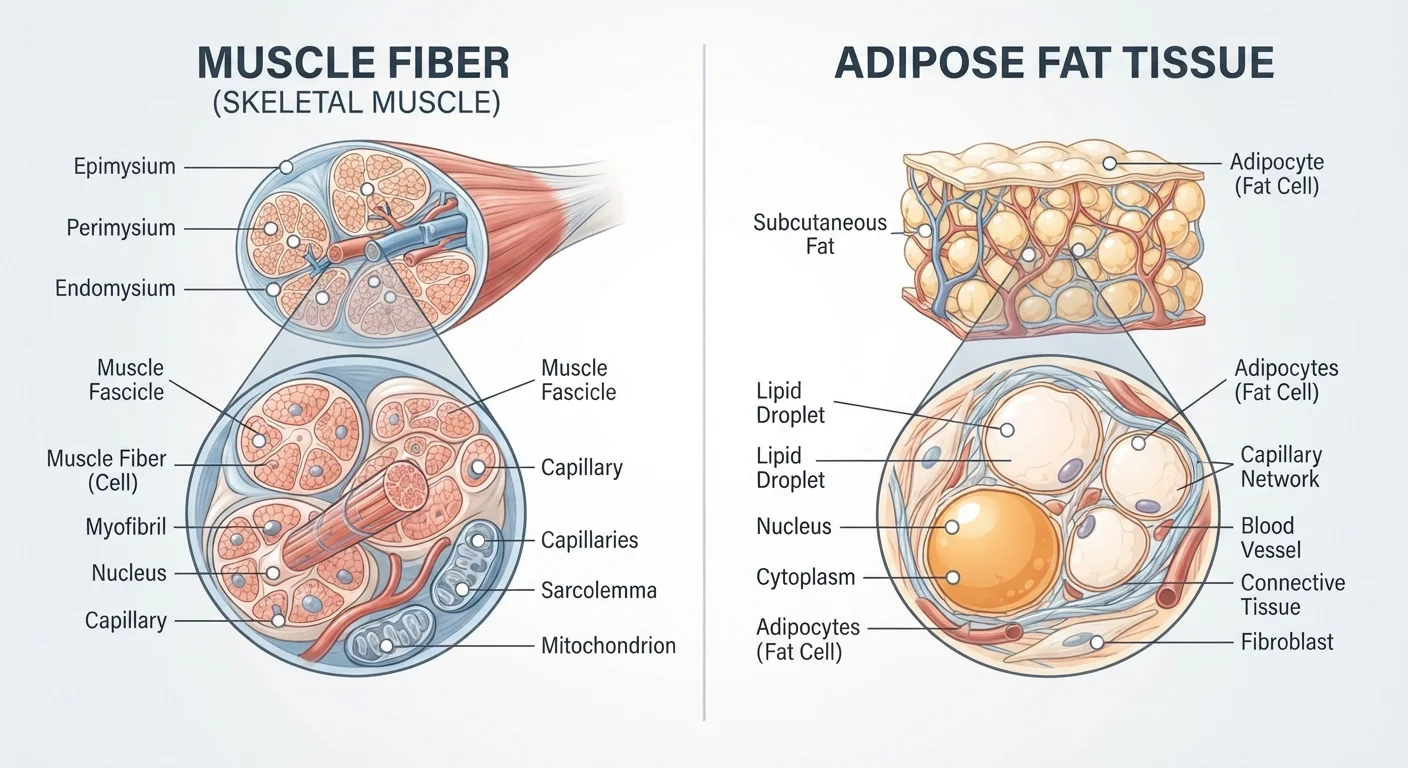
Muscle tissue (skeletal muscle) is a metabolically active type of body tissue made primarily of protein fibers that generate movement and burn energy at rest. Fat tissue (adipose tissue) stores energy, insulates the body, and secretes hormones. Together, the proportion of each - your body composition - is a more meaningful health indicator than body weight alone.
Skeletal muscle is classified as highly metabolically active tissue, consuming significantly more energy per kilogram at rest than adipose tissue, which contributes to differences in basal metabolic rate (BMR) across individuals.
What Muscle Tissue Actually Does
Skeletal muscle makes up the bulk of your lean body mass and serves functions that go far beyond movement. Muscle tissue is one of the body's primary sites for glucose uptake - when you eat carbohydrates, muscle acts as a major storage depot for glycogen, the stored form of sugar. This is a central reason why greater muscle mass is consistently associated with better insulin sensitivity in research.
Muscle is also metabolically expensive to maintain. Because it requires energy just to sustain itself, people with more lean muscle mass generally have a higher basal metabolic rate - the number of calories the body burns at complete rest. This doesn't mean muscle is a magic weight-loss lever, but it does mean body composition changes can influence your metabolism over the long term. For a fuller picture of how metabolism works, see our metabolism basics hub.
Perhaps less appreciated is muscle's role as an endocrine organ. Skeletal muscle secretes signaling proteins called myokines during contraction, which have anti-inflammatory effects and support brain health, immune function, and bone density. Exercise, in this sense, is not just a calorie-burning tool - it is a biochemical event with whole-body consequences.
What Fat Tissue Actually Does
Body fat - or adipose tissue - has long been mischaracterized as passive, inert storage. In reality, it is a dynamic endocrine organ. Adipose tissue secretes hormones including leptin (which signals fullness to the brain), adiponectin (which supports insulin sensitivity), and others that regulate inflammation and metabolism. Adequate body fat is not optional - it is essential for reproductive health, immune regulation, and the absorption of fat-soluble vitamins A, D, E, and K.
~600
Named skeletal muscles in the human body
Skeletal muscle collectively accounts for approximately 30-40% of total body mass in a healthy adult, according to standard anatomical references.
3-5%
Minimum essential fat for men
The American College of Sports Medicine identifies essential fat minimums as approximately 3-5% for men and 10-13% for women, needed for basic physiological function.
10-13%
Minimum essential fat for women
Women carry a higher baseline of essential fat due to sex-specific physiological needs, including hormonal and reproductive function.
~1-2%
Annual muscle mass loss after age 30
Research published in journals of gerontology consistently shows skeletal muscle mass begins declining in the third decade, accelerating after age 60 without intervention.
Not all fat behaves the same, however. The location of fat storage matters enormously for health risk. Visceral fat - stored deep within the abdominal cavity around internal organs - is metabolically distinct from subcutaneous fat stored just beneath the skin. Visceral fat is more metabolically active in a harmful way: it releases fatty acids and inflammatory cytokines directly into the portal circulation, which feeds the liver. This pattern is associated with increased risk for type 2 diabetes, cardiovascular disease, and metabolic syndrome. For a detailed breakdown, see our article on visceral fat vs. subcutaneous fat.
Why the Muscle-to-Fat Ratio Matters
Understanding each tissue type in isolation only goes so far. What researchers and clinicians increasingly focus on is the ratio between lean mass and fat mass - what is broadly called body composition. Two people can weigh exactly the same and have dramatically different health profiles depending on how much of that weight is muscle versus fat.
This is why the scale alone is a limited tool. As explained in our body composition explainer, someone who loses muscle during a calorie-restrictive diet may show a lower number on the scale while their metabolic health actually worsens. Conversely, someone who gains muscle through resistance training may see the scale stay flat or rise while their risk for chronic disease falls.
“Skeletal muscle is the largest metabolic organ in the body. Its mass, quality, and function are central determinants of metabolic health across the entire lifespan.”
— Stuart Phillips, Professor of Kinesiology, McMaster University, and researcher in muscle protein metabolism
Muscle loss with age - a process called sarcopenia - illustrates this clearly. As lean mass declines and fat mass often increases even at similar caloric intake levels, older adults face heightened risk for insulin resistance, functional decline, and poor health outcomes. This underscores why building and maintaining muscle is a public health priority across the lifespan, not just an aesthetic goal. For more on how these tissue dynamics connect to metabolic disease risk, see our companion piece on body composition and metabolic health.
This article is for general informational and educational purposes only and is not a substitute for professional medical advice, diagnosis, or treatment. Consult a qualified healthcare provider for guidance specific to your health situation.