

Key Takeaways
- The actual calorie difference between a 'fast' and 'slow' metabolism in similarly sized people is smaller than popular belief suggests.
- Body size, muscle mass, age, and genetics all influence resting metabolic rate - no single factor dominates.
- Most people who believe they have a slow metabolism are influenced by factors like activity levels and diet composition, not metabolic rate alone.
- Clinically significant metabolic disorders (like hypothyroidism) are distinct from everyday metabolic variation and require medical evaluation.
- Lifestyle factors such as resistance training and adequate sleep can modestly influence metabolic rate over time.
Option A
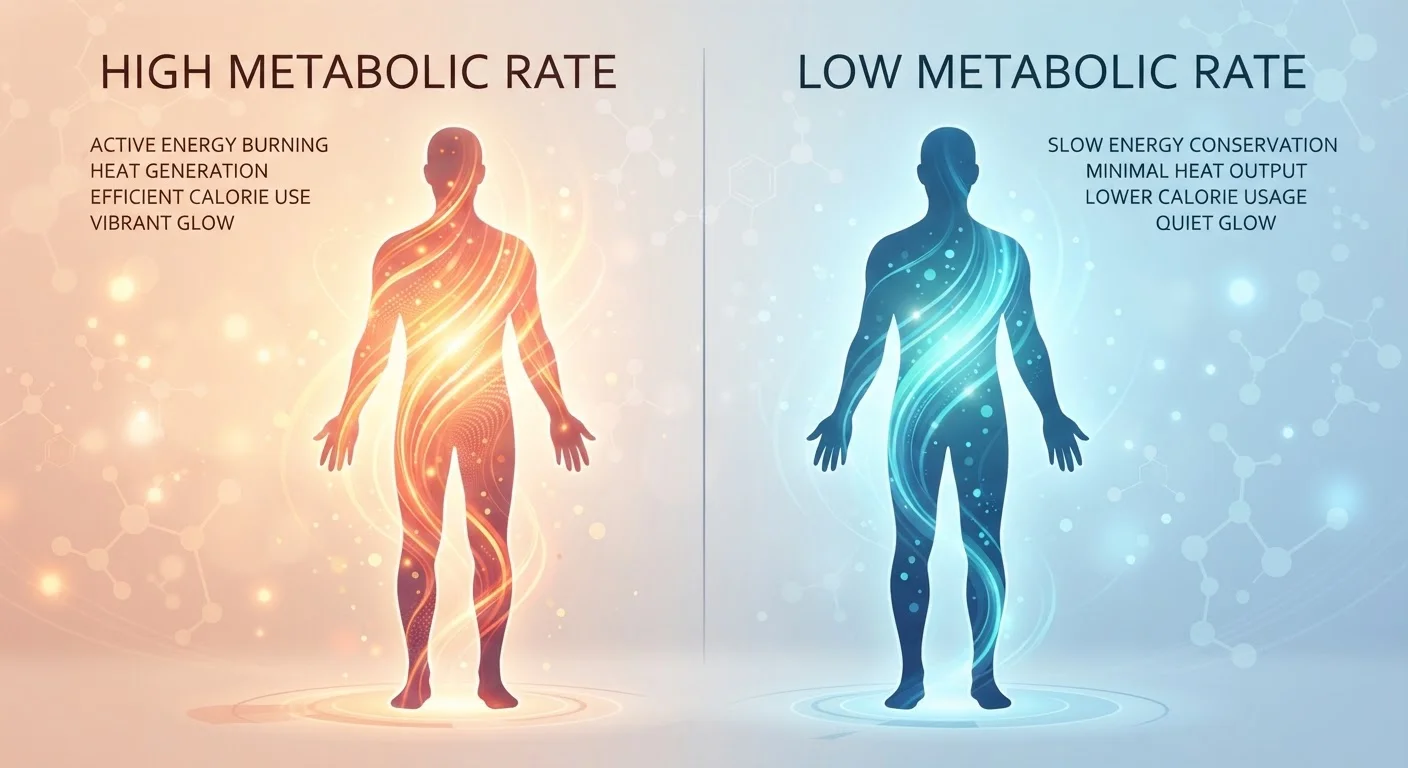
Fast Metabolism
The enviable engine that seems to burn everything off.
Best for: Understanding why some people appear to eat freely without gaining weight - and what actually drives that.
Option B
Slow Metabolism
The commonly blamed culprit behind stubborn weight gain.
Best for: Exploring whether metabolic rate truly explains why weight loss feels harder for some people than others.
If you're convinced your metabolism is why you can't lose weight
Slow Metabolism (with caveats)
Metabolic rate does vary between individuals, but the gap is rarely large enough to fully explain weight struggles. Evaluating activity levels, eating patterns, and sleep quality often reveals more actionable factors.
If you want to understand why a friend seems to eat anything without gaining weight
Fast Metabolism
Genetic and body-composition differences in metabolic rate are real, but differences in unconscious movement (NEAT) and appetite regulation likely explain much of the visible gap.
If you've experienced sudden, unexplained changes in weight or energy
Neither - see a clinician
Sudden metabolic shifts can signal thyroid disorders or other medical conditions that require diagnosis and treatment, not lifestyle adjustments.
What 'Fast' and 'Slow' Actually Mean
When people say someone has a fast or slow metabolism, they're usually referring to resting metabolic rate (RMR) - the number of calories your body burns at rest just to keep vital systems running. RMR accounts for roughly 60-70% of total daily energy expenditure for most people, making it a genuinely important variable.
But here's the part that often gets lost: for two adults of similar height, weight, and age, the difference in RMR is typically modest - research suggests it falls within a range of roughly 200-300 calories per day between the lower and upper ends of normal variation. That's meaningful, but it's not the dramatic gap that phrases like 'my metabolism is broken' imply.
For a deeper foundation on how metabolic rate is actually calculated and what influences it, see our complete metabolism overview.
| Criterion | Fast Metabolism | Slow Metabolism |
|---|---|---|
| Resting calorie burn | Higher end of individual range | Lower end of individual range |
| Typical RMR gap between extremes | ~200-300 kcal/day above average | ~200-300 kcal/day below average |
| Primary biological driver | More lean muscle mass, genetics | Less muscle mass, age, hormones |
| Role of NEAT | Often higher unconscious movement | Often lower unconscious movement |
| Thyroid involvement | Hyperthyroidism (pathological) | Hypothyroidism (pathological) |
| Modifiable with lifestyle? | Partially - via muscle building | Partially - via exercise, sleep |
| Explains weight differences fully? | No - NEAT and diet also key | No - behavior factors often larger |
The Real Drivers Behind Metabolic Differences
Genetics play a role in metabolic rate, but they work mostly by shaping body composition - particularly lean muscle mass, which is more metabolically active than fat tissue. Two people who weigh the same but have different muscle-to-fat ratios will have meaningfully different RMRs, with the more muscular individual burning more calories at rest.
Age is another factor. Metabolic rate tends to decline gradually with age, though research has clarified that this isn't purely a biological clock - muscle loss and reduced physical activity account for a substantial portion of the slowdown. Why metabolism slows with age explores this interaction in detail.
Hormonal status also matters. Thyroid hormones are the primary regulators of metabolic rate, and conditions like hypothyroidism genuinely slow metabolism in a clinically measurable way - this is distinct from the day-to-day variation most people experience.
~60-70%
Of daily energy use from resting metabolism
Resting metabolic rate accounts for the largest single share of total daily calorie expenditure for most adults.
~200-300 kcal
Typical RMR range between individuals of similar size
Research on metabolic rate variation suggests the real-world gap between 'fast' and 'slow' metabolisms in comparable individuals is relatively modest.
Up to 2,000 kcal
Possible daily variation in NEAT between individuals
Studies have found that non-exercise activity thermogenesis varies enormously between people at the same body weight, often more than RMR differences.
The Variable Nobody Talks About: NEAT
When researchers study people who seem to resist weight gain despite eating freely, one of the most consistent findings isn't that their RMR is dramatically higher - it's that they move more throughout the day without realizing it. This is called non-exercise activity thermogenesis (NEAT): the calories burned through fidgeting, standing, walking, and all the unconscious physical activity that never gets logged in a fitness app.
NEAT can vary by as much as 2,000 calories per day between individuals at the same body weight - a far larger range than RMR differences. Someone perceived as having a 'fast metabolism' may simply have habits and a nervous system disposition that keep them in near-constant low-level motion.
This also explains why blaming metabolism alone can be misleading - the full picture of energy expenditure is much broader than RMR.
Can You Change Your Metabolic Rate?
The honest answer is: somewhat. Resistance training that builds lean muscle mass is the most evidence-supported way to modestly raise RMR over time - not through any single workout, but through consistent training that shifts body composition. Adequate sleep and managing chronic stress also matter, since both sleep deprivation and elevated cortisol can suppress metabolic efficiency.
Many popular 'metabolism-boosting' strategies - green tea, cold water, spicy foods - produce effects that are real but small, unlikely to make a meaningful difference on their own. What the research actually shows on common metabolism boosters is worth reviewing before making changes based on popular advice.
It's also worth reading common metabolism myths - many widely held beliefs, from the idea that eating small frequent meals stokes your metabolic fire to certain supplement claims, don't hold up under scrutiny.
This article is for general informational purposes only and does not constitute medical advice. If you have concerns about unexplained weight changes or metabolic health, consult a qualified healthcare professional.