

Key Takeaways
- Metabolism does slow with age, but the cause is mostly muscle loss and reduced activity - not aging itself.
- Muscle tissue burns significantly more calories at rest than fat tissue does.
- Hormonal changes, particularly in testosterone and estrogen, contribute to shifts in body composition.
- Physical activity level is one of the most modifiable factors influencing metabolic rate at any age.
- Strength training is among the most evidence-supported tools for counteracting age-related metabolic decline.
Age-Related Metabolic Slowdown
Age-related metabolic slowdown refers to the gradual decline in the number of calories your body burns at rest as you get older. It's a real phenomenon, but it's not simply a function of years passing - it's driven by measurable changes in body composition, hormone levels, and physical activity. Understanding these underlying drivers helps explain why the slowdown varies so much from person to person.
Resting metabolic rate (RMR) accounts for the largest share of daily energy expenditure, so even modest declines compound meaningfully over years. Research suggests the most significant age-related RMR drop occurs gradually between roughly ages 20 and 60, with an accelerated decline after that.
The Myth of Automatic Metabolic Decline
Many people accept that metabolism simply winds down like a clock as they age - an unavoidable biological tax. The reality is more nuanced and, frankly, more empowering. While metabolic rate does tend to decline over the adult lifespan, the primary drivers aren't mysterious age-related processes running in the background. They're specific, measurable changes - most of which interact with how we live, not just how old we are.
Understanding this distinction matters because it shifts the question from "why is this happening to me?" to "which factors can I actually influence?" For a fuller picture of what shapes metabolic rate beyond age, see our look at the factors that genuinely influence your metabolic rate.
Muscle Loss: The Central Driver
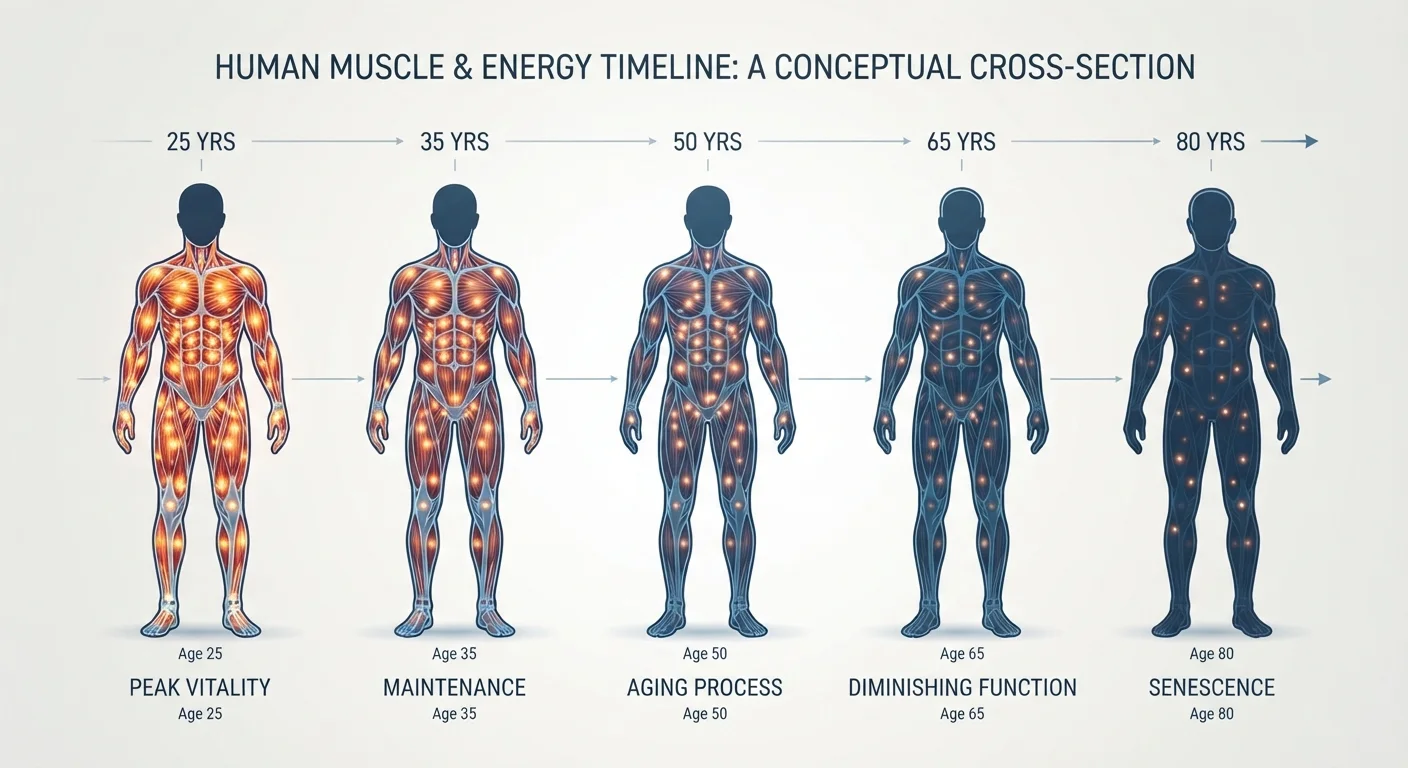
Skeletal muscle is metabolically expensive tissue. Pound for pound, it burns significantly more calories at rest than fat tissue does. Starting roughly in the mid-30s, most adults begin losing muscle mass at a rate of roughly 3-8% per decade - a process called sarcopenia - accelerating after age 60 if not actively countered.
This shift is the single largest contributor to age-related resting metabolic rate decline. As muscle is replaced - partly by fat, partly by nothing at all - the body's baseline calorie requirement quietly drops. The cumulative effect over decades is substantial.
3-8%
Muscle mass lost per decade after mid-30s
Estimates from exercise physiology research; decline accelerates significantly after age 60 in sedentary individuals.
~20%
Potential resting metabolic rate decline from age 20-80
Research on longitudinal metabolic changes suggests this range, with most decline attributable to shifts in body composition rather than aging per se.
Up to 50%
More calories burned at rest by muscle vs. fat
Exercise physiology estimates consistently show skeletal muscle is among the most metabolically active tissues in the body.
Resistance training is the most evidence-supported intervention for preserving or rebuilding muscle at any adult age. Studies consistently show that older adults who engage in regular strength training maintain higher resting metabolic rates than sedentary peers of the same age. For a broader look at how body composition changes across life stages, see how body composition shifts throughout life.
Hormonal Shifts and Their Metabolic Role
Several hormones that influence body composition and energy regulation change with age. Testosterone declines gradually in men from around age 30 onward. Estrogen drops sharply during and after menopause in women. Both hormones play roles in supporting lean muscle mass, and their decline contributes - indirectly - to the muscle loss described above.
Thyroid hormone, which directly regulates resting metabolic rate, can also become less efficient with age in some individuals, though this is not universal. It's worth distinguishing between normal age-related hormonal changes and clinically significant conditions - factors that are often conflated in popular health discussions. See how thyroid function actually connects to metabolism for a more grounded look at that relationship.
The Invisible Role of Daily Movement
Beyond structured exercise, the total volume of movement throughout the day - sometimes called non-exercise activity thermogenesis (NEAT) - tends to decrease with age. Work becomes more sedentary; recovery takes longer; small habitual movements accumulate differently. These reductions in spontaneous activity can account for a meaningful portion of the calorie-burn gap that many people attribute entirely to a "slower metabolism."
“The decline in resting metabolic rate with age is largely explained by changes in body composition - specifically the loss of fat-free mass. When you account for that, much of what we call 'aging metabolism' becomes a story about muscle.”
— Claude Bouchard, Professor and researcher in exercise genomics, Pennington Biomedical Research Center
This also helps explain why two people of the same age can have meaningfully different metabolic rates. Differences in daily activity, muscle mass, and lifestyle habits account for far more variation than age alone - a point explored in depth in our piece on fast versus slow metabolism.
The practical implication: preserving daily movement habits - not just formal exercise - is a meaningful part of metabolic maintenance across adult life. Strategies that support this alongside weight management are discussed in our guide to weight management across different life stages.
This article is for general informational and educational purposes only and is not a substitute for professional medical advice. Consult a qualified healthcare provider before making changes to your diet, exercise routine, or health practices.