
Sitting vs. Standing Throughout the Day: What the Difference Means for Your Body

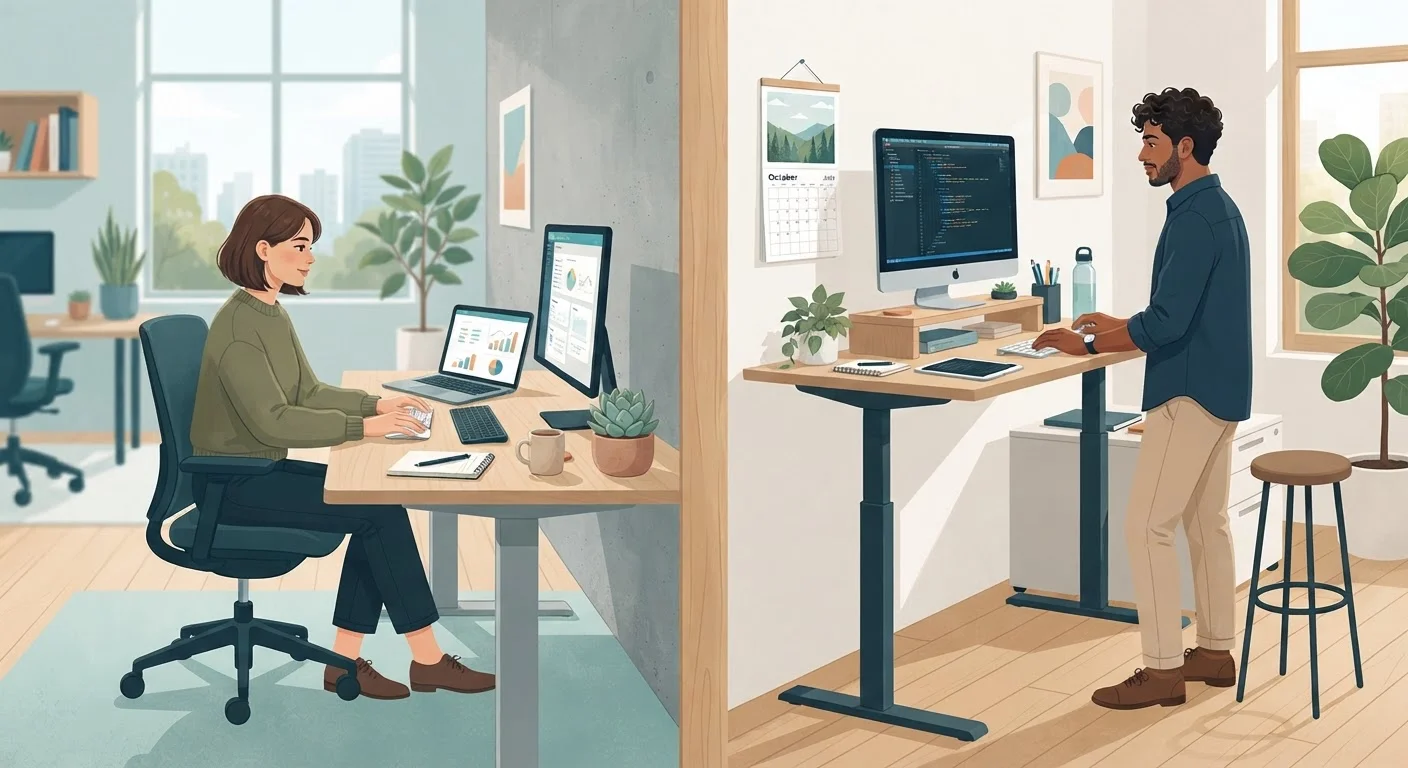
Key Takeaways
- Sitting for hours continuously is linked to metabolic and cardiovascular risks independent of gym exercise.
- Standing all day is not a healthy substitute - it brings its own musculoskeletal downsides.
- Alternating between sitting, standing, and brief movement breaks is what research most consistently supports.
- Non-gym movement throughout the workday accumulates meaningful health benefits over time.
- Small postural changes compound - consistency matters more than any single prolonged posture.
Option A
Prolonged Sitting
The default posture of modern desk work.
Best for: Tasks requiring sustained focus, fine motor control, or long periods of concentrated cognitive effort.
Option B
Prolonged Standing
The well-intentioned alternative that also has limits.
Best for: Breaking up sedentary time and supporting light activity during low-intensity tasks.
If you work at a desk and rarely leave your chair
Prolonged Standing (with movement breaks)
Introducing regular standing intervals and short walks helps interrupt the continuous sedentary time that is most strongly linked to health risks.
If you already stand for most of your shift
Prolonged Sitting (in balance)
Occupational standing without rest periods raises risk of lower-limb discomfort and fatigue; planned seated recovery time can restore balance.
If you want the most evidence-backed daily approach
Prolonged Sitting
Structured alternation - roughly 20-30 minutes sitting, 8-10 minutes standing, followed by brief walking - reflects current expert guidance for desk workers.
Why Your Default Posture Matters More Than You Might Think
Most Americans spend the majority of their waking hours seated - at desks, in cars, on sofas. Research has consistently identified prolonged, uninterrupted sitting as a distinct health concern, separate from whether someone exercises regularly. In other words, going to the gym after work does not fully cancel out eight or more hours of continuous chair time.
The risks associated with extended sitting include disrupted blood sugar regulation, reduced circulation in the lower limbs, and associations with higher cardiovascular risk over time. These effects appear to be driven by muscular inactivity itself - particularly in the large muscle groups of the legs - rather than simply by a lack of formal exercise. To understand this distinction in more depth, see how sedentary behavior and physical inactivity differ.
Standing entered the conversation as a natural counterpoint - and while it does offer advantages, treating it as a straightforward solution oversimplifies what the body actually needs throughout a workday.
| Criterion | Prolonged Sitting | Prolonged Standing |
|---|---|---|
| Primary risk | Metabolic & cardiovascular disruption | Musculoskeletal fatigue & discomfort |
| Effect on blood sugar | Raises post-meal glucose levels | Modest improvement over sitting |
| Calorie expenditure | Very low | Slightly higher, but minimal |
| Lower-limb circulation | Reduced with prolonged duration | Can cause pooling and swelling |
| Cognitive performance | Sustained well for focused tasks | May decline with prolonged standing |
| Joint and back stress | Lumbar compression over time | Knee, hip, and foot fatigue |
| Ideal duration | Up to 20-30 min per interval | Up to 8-10 min per interval |
The Real Costs of Standing Too Long
Standing desks surged in popularity on the premise that upright posture was inherently healthier. But static standing carries its own physiological costs. Occupational health research points to increased lower-limb discomfort, varicose vein risk, fatigue, and even reduced cognitive performance when standing is sustained without breaks or movement.
The key variable is static posture - whether sitting or standing, holding any single position for extended periods limits circulation and places repetitive strain on specific muscle groups and joints. The body is designed for postural variety, not duration in any fixed stance.
For a detailed look at what standing desks genuinely help with - and where their limits are - see what standing desks actually do and don't do.
6-8 hrs
Average daily sitting time for U.S. adults
Research published in the American Journal of Epidemiology found that U.S. adults average between six and eight hours of sedentary time per day.
~80 cal/day
Extra calories burned standing vs. sitting
A systematic review in the European Journal of Preventive Cardiology estimated standing burns only modestly more calories than sitting - roughly 80 extra per eight-hour day.
2+ hrs
Recommended standing/light activity at work
Public Health England guidance suggests desk-based workers aim for at least two hours of standing and light activity during the workday as an initial target.
Building a Smarter Movement Pattern Into Your Day
The most well-supported approach for desk workers is intentional alternation: cycling through sitting, standing, and brief bouts of walking or light movement. Expert bodies such as Public Health England have suggested a general target of accumulating at least two hours of standing and light activity during the workday, working up from there over time - though individuals should calibrate to their own comfort and any relevant health conditions.
Brief movement breaks - even two to three minutes of walking every 30 minutes - have been shown in controlled studies to blunt blood sugar spikes and improve circulation compared to unbroken sitting. These moments do not need to be formal exercise. Refilling a water bottle, taking the long route to a meeting, or standing during a phone call all count.
This is precisely the premise behind building small movements into a desk job - non-gym movement accumulates real benefit when it becomes a consistent pattern rather than an occasional event. For a deeper comparison of movement breaks versus structured workouts, the science of incidental activity is worth exploring.
This article is for general informational purposes only and does not constitute medical advice. If you have a health condition that affects your posture, mobility, or tolerance for standing or sitting, consult a qualified healthcare professional before making changes to your routine.