

Key Takeaways
- Bodyweight training effectively builds functional strength, endurance, and mobility with zero equipment.
- Progressive overload is possible without weights, but becomes harder to sustain at advanced fitness levels.
- It excels for beginners and those returning from injury, but has real limits for building maximum muscle mass.
- Combining bodyweight work with other training methods often produces the most balanced fitness outcomes.
No equipment or gym membership required
All you need is enough floor space to lie down. This removes one of the most common barriers to starting a consistent exercise habit — cost and access.
Develops functional, real-world movement patterns
Exercises like squats, push-ups, and hinges mirror everyday activities. Training these patterns improves how your body moves in daily life, not just in a gym setting.
Lower injury risk for beginners
Working with body weight reduces the chance of technique-related injuries common when beginners add external load before mastering movement fundamentals.
Supports mobility and joint health
Many bodyweight movements — deep squats, hip hinges, shoulder circles — naturally move joints through a full range of motion, supporting long-term flexibility and joint integrity.
Highly adaptable for all fitness levels
Most exercises have easier and harder variations. A push-up can be done on the knees or elevated surface for beginners, and progressed to archer or one-arm versions for advanced trainees.
Limited scalability for advanced muscle growth
Once relative body strength improves significantly, adding meaningful overload without equipment becomes increasingly difficult. This creates a ceiling for hypertrophy (muscle size) gains.
Lower-body loading is harder to achieve
Upper-body pushing and pulling can be heavily loaded through leverage and angle changes, but legs — which are stronger and benefit from heavier loads — are harder to challenge with body weight alone.
Progress can be harder to track and quantify
Unlike adding pounds to a barbell, progressing through movement variations is less linear and can feel ambiguous, which makes structured programming more complex.
Not ideal for sport-specific strength development
Athletes in power or strength sports typically need external loading to replicate the demands of competition. Bodyweight training alone is unlikely to meet those performance requirements.
Our Verdict
Bodyweight training is a genuinely effective, accessible approach to building foundational strength, movement quality, and cardiovascular fitness. It delivers real results — especially for beginners and intermediate exercisers — but hits a ceiling when maximum muscle hypertrophy or heavy loading is the goal. Used strategically, or as one part of a broader routine, it holds up well against most alternatives.
Ideal for beginners building a movement base, travelers without gym access, anyone returning from minor injury, or intermediate exercisers seeking variety and mobility work.
What Bodyweight Training Actually Is
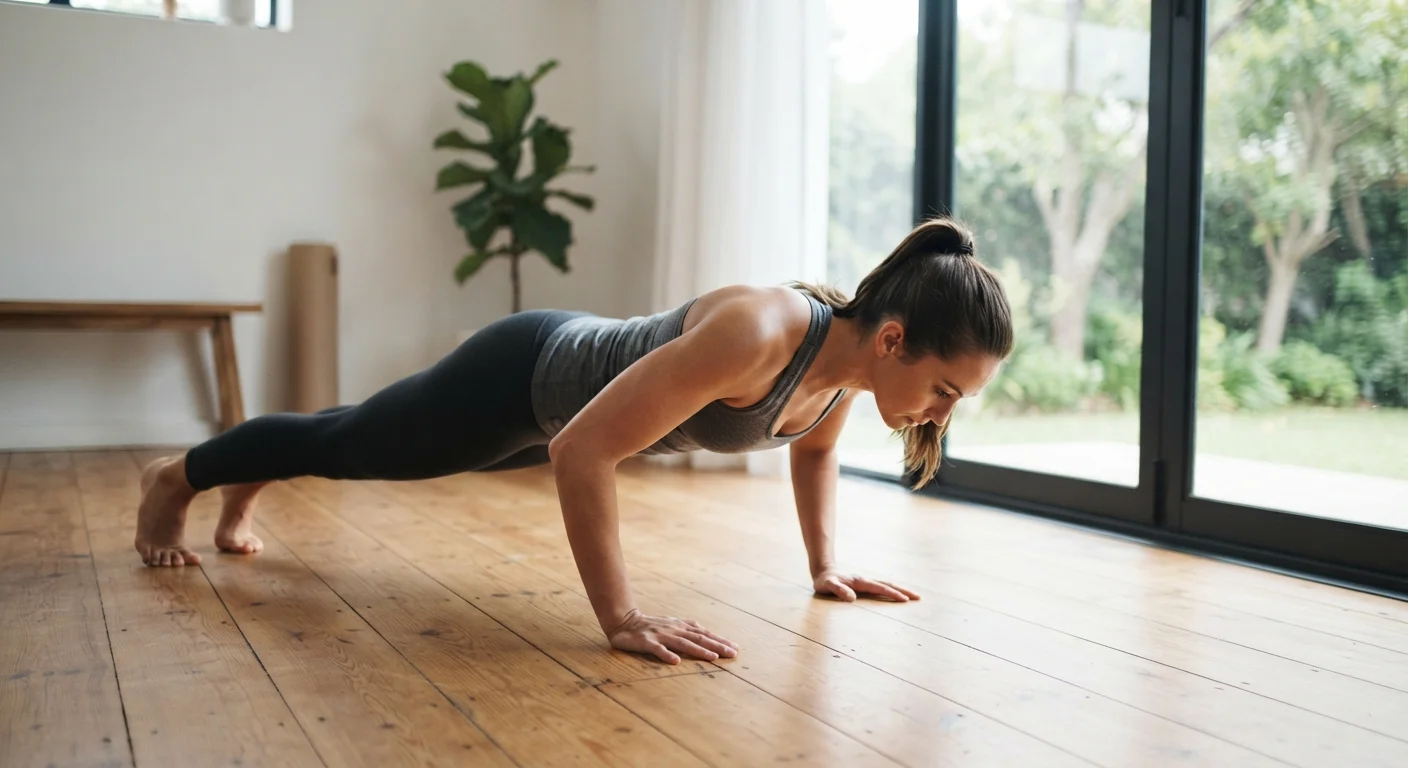
Bodyweight training uses your own body as the primary source of resistance — no barbells, dumbbells, or machines required. Push-ups, squats, lunges, pull-ups, planks, and burpees are among the most common examples. The category also includes more advanced skills like pistol squats, handstands, and muscle-ups, which demand significant strength and coordination.
This style of training falls under the broader umbrella of resistance exercise. Because it uses gravity and body mass to create load, it stimulates muscle and strength adaptations similar to — though not always identical to — those produced by weighted training. Understanding that distinction matters before drawing conclusions about what it can and cannot do for you.
If you're curious how strength training of any kind affects body composition, our article on how resistance training affects body composition provides useful background.
What Bodyweight Training Does Well
The advantages here are real and well-supported by exercise science research.
No equipment or gym membership required
All you need is enough floor space to lie down. This removes one of the most common barriers to starting a consistent exercise habit — cost and access.
Develops functional, real-world movement patterns
Exercises like squats, push-ups, and hinges mirror everyday activities. Training these patterns improves how your body moves in daily life, not just in a gym setting.
Lower injury risk for beginners
Working with body weight reduces the chance of technique-related injuries common when beginners add external load before mastering movement fundamentals.
Supports mobility and joint health
Many bodyweight movements — deep squats, hip hinges, shoulder circles — naturally move joints through a full range of motion, supporting long-term flexibility and joint integrity.
Highly adaptable for all fitness levels
Most exercises have easier and harder variations. A push-up can be done on the knees or elevated surface for beginners, and progressed to archer or one-arm versions for advanced trainees.
For beginners especially, bodyweight exercise provides an excellent on-ramp to consistent movement. The motor patterns learned — hip hinging, pushing, pulling, bracing the core — transfer directly to weighted training if you choose to add it later. And because you're working with manageable load from day one, the injury risk is relatively low compared to jumping straight into heavy lifting without a foundation.
It's also worth noting that bodyweight training develops what coaches call relative strength — the ability to move your own body efficiently through space. This has meaningful real-world payoffs: better posture, easier daily movement, and reduced risk of falls as you age.
Where Bodyweight Training Has Real Limits
No training method is without trade-offs. Here's where bodyweight exercise genuinely falls short.
Limited scalability for advanced muscle growth
Once relative body strength improves significantly, adding meaningful overload without equipment becomes increasingly difficult. This creates a ceiling for hypertrophy (muscle size) gains.
Lower-body loading is harder to achieve
Upper-body pushing and pulling can be heavily loaded through leverage and angle changes, but legs — which are stronger and benefit from heavier loads — are harder to challenge with body weight alone.
Progress can be harder to track and quantify
Unlike adding pounds to a barbell, progressing through movement variations is less linear and can feel ambiguous, which makes structured programming more complex.
Not ideal for sport-specific strength development
Athletes in power or strength sports typically need external loading to replicate the demands of competition. Bodyweight training alone is unlikely to meet those performance requirements.
The core challenge is progressive overload — the principle that muscles must face incrementally greater demands to keep adapting. With free weights, adding 5 pounds to a barbell is straightforward. With bodyweight, you must change leverage, add repetitions, slow the tempo, or learn a harder movement variation. That works up to a point, but for experienced lifters seeking maximum hypertrophy (muscle size), research consistently shows that external load provides a more reliable and scalable stimulus.
This doesn't make bodyweight training ineffective — it means knowing when to supplement it. For a fuller picture of how muscle and fat interact with overall health, see our piece on why body composition matters beyond the scale.
Bodyweight Training and Older Adults
For older adults, bodyweight training can be especially valuable for improving balance, functional mobility, and fall prevention. However, research also suggests that older adults may benefit particularly from progressive resistance training with external load to counter age-related muscle loss (sarcopenia). If you are over 60 or managing a chronic condition, consult a healthcare provider or certified fitness professional before designing your program.
Building a Smart Bodyweight Practice
Getting the most from bodyweight training means applying the same principles that make any resistance program effective: consistency, progressive challenge, adequate recovery, and variety across movement patterns.
A well-rounded session should include at least one pushing movement (push-up variations), one pulling movement (rows or pull-ups), a lower-body pattern (squats or lunges), and core stability work (planks, hollow holds). Rotating between these ensures balanced development rather than overtraining one area.
Common misconceptions can also get in the way of progress. Our guide on fitness myths that hold beginners back addresses several beliefs that apply directly to bodyweight exercisers — including the idea that you must feel soreness for a workout to count.
This article is for general informational purposes only and does not constitute medical or personal fitness advice. Consult a qualified healthcare or fitness professional before starting a new exercise program, particularly if you have any existing health conditions or injuries.