

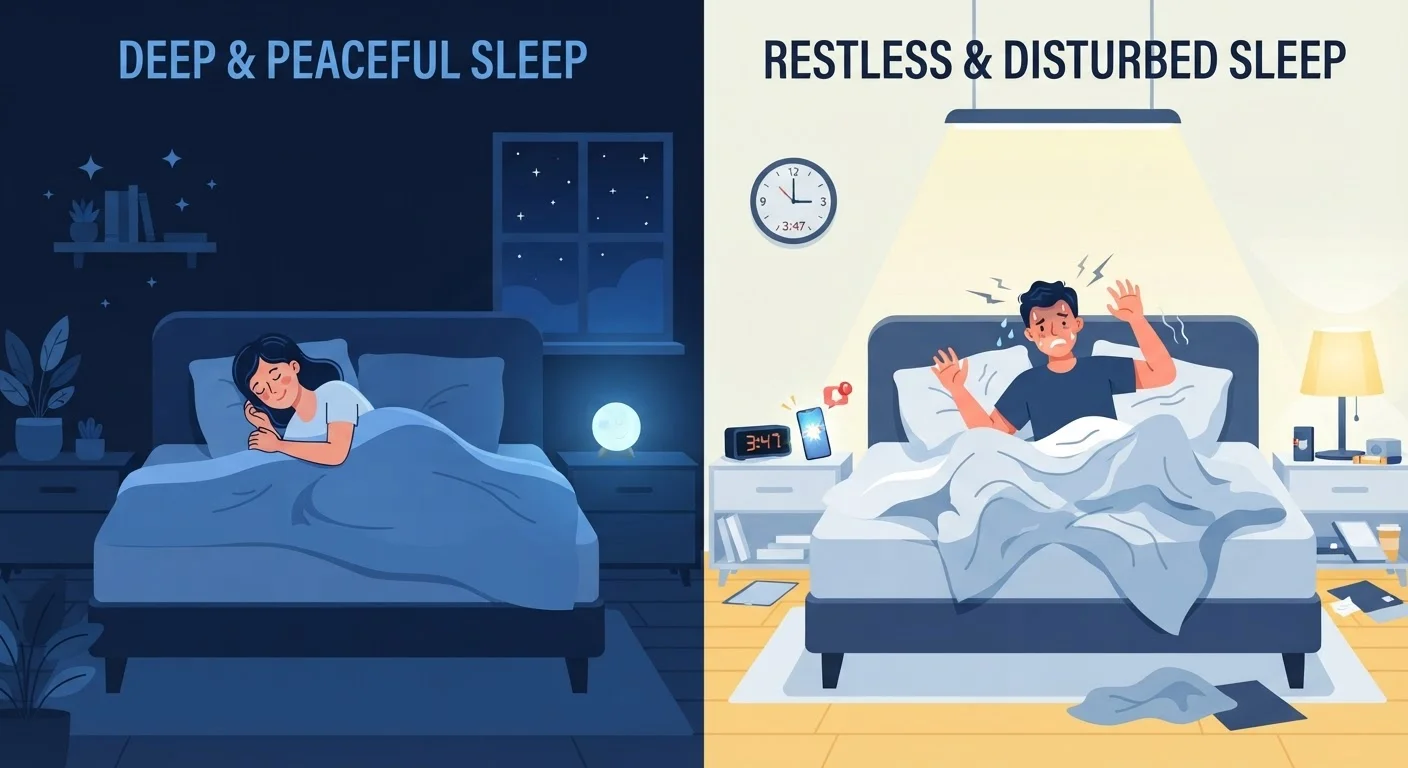
Key Takeaways
- Sleep quality — how restorative your sleep cycles are — often has a stronger immediate impact on mood and cognition than total hours alone.
- Duration still matters: consistently sleeping fewer than seven hours is associated with measurable impairment across multiple performance domains.
- Fragmented sleep, even when lengthy, can leave the brain deprived of critical slow-wave and REM stages essential for memory and recovery.
- The ideal scenario combines adequate duration with good quality; sacrificing either consistently carries real performance costs.
- Persistent sleep problems — whether quantity or quality — warrant evaluation by a qualified healthcare professional.
Our Verdict
Sleep quality and duration are interdependent, not competing variables. Current evidence suggests that for most adults, quality has the edge in determining how sharp and functional you feel day-to-day — but quantity sets the floor. Consistently short sleep, regardless of quality, accumulates a deficit that performance cannot overcome.
| Best for | Recommended |
|---|---|
| Those prioritizing cognitive sharpness and mood on a fixed schedule | Optimize sleep quality first |
| Those recovering from sleep deprivation or high physical demand | Prioritize duration alongside quality |
| Those waking unrefreshed despite sufficient hours | Investigate sleep quality and architecture |
| Those with persistent sleep difficulties regardless of cause | Consult a qualified healthcare professional |
Defining the Terms: Quality vs. Duration
Sleep duration refers simply to how many hours you spend asleep in a given night. Sleep quality describes how effectively that time is used — whether you cycle properly through the stages of non-REM (NREM) and REM sleep, stay asleep consistently, and wake feeling genuinely restored.
The distinction matters because a person can log eight hours in bed and still perform poorly if their sleep is repeatedly interrupted, if they spend little time in slow-wave or REM stages, or if their sleep timing is misaligned with their natural circadian rhythm. Conversely, a concentrated block of highly efficient sleep may leave someone feeling sharper than a longer but fragmented night. To understand why, it helps to know what actually happens in your brain overnight — specifically, how different sleep stages serve different restorative functions.
What the Evidence Says About Each Factor
Research consistently links both dimensions to real-world outcomes, but they do not influence performance in identical ways.
The Case for Duration
Most major sleep research organizations, including the American Academy of Sleep Medicine, recommend that adults aim for seven to nine hours per night. Studies have found that sleeping fewer than seven hours — even briefly — is associated with slower reaction times, reduced working memory, impaired emotional regulation, and weakened immune response. Crucially, people tend to underestimate their own performance deficits when sleep-deprived, making objective measurement more reliable than self-report alone. For a broader look at outcomes at both extremes, see our article on short sleep vs. long sleep outcomes.
The Case for Quality
Duration without quality is a poor substitute. Slow-wave sleep (deep NREM) is essential for physical recovery and memory consolidation, while REM sleep supports emotional processing and creative problem-solving. When sleep is fragmented — by noise, apnea, stress, or environmental disruption — these stages are shortened or skipped, even if total time in bed looks adequate. This is why a full night's sleep still leaves some people exhausted: the hours were there, but the architecture was compromised.
| Sleep Quality | Sleep Duration | |
|---|---|---|
| Primary driver of feeling restored | High — depends on sleep stage cycling | Moderate — needs minimum threshold |
| Impact on cognitive sharpness | Strong — REM and slow-wave critical | Strong below 7 hours; diminishing above 9 |
| Mood and emotional regulation | Impaired quickly by fragmentation | Impaired with chronic short sleep |
| Physical recovery and immunity | Depends on slow-wave stage access | Sufficient duration needed for cycles |
| Measurability at home | Harder — requires pattern observation | Easy — total hours in bed |
| Most common cause of deficit | Disruptions, apnea, irregular timing | Lifestyle constraints, poor habits |
| Recovery timeline after single bad night | Faster if duration is adequate | Slower — deficit accumulates over days |
How Each Affects Mood, Productivity, and Physical Wellness
When quality is poor, the brain's prefrontal cortex — responsible for decision-making and emotional control — is among the first areas to show impaired function. This translates into irritability, difficulty concentrating, and reduced motivation, effects that emerge even after a single disrupted night. Research on consistent bedtimes and cognitive performance further suggests that timing regularity amplifies these effects: irregular sleep schedules compound quality deficits regardless of total duration.
Physical wellness is similarly affected by both variables. Athletic recovery, immune function, and hormonal regulation — including cortisol and growth hormone release — depend on achieving sufficient slow-wave sleep, which typically requires both adequate duration and uninterrupted cycles. Shortchanging either dimension can undermine physical adaptation and leave the body in a low-grade stressed state. If you suspect your sleep habits may already be affecting your output, review the signs your sleep habits may be undermining your productivity.
Practical Guidance: Improving Both Simultaneously
The good news is that the behavioral habits that improve sleep quality also tend to support healthy duration. Consider the following evidence-informed approaches as general health information — not a personal prescription.
- Consistent sleep and wake times: Anchoring your schedule to a fixed wake time, even on weekends, reinforces the circadian rhythm and improves both sleep onset and continuity.
- Managing light exposure: Bright morning light advances the circadian clock; limiting blue-spectrum light in the evening helps delay arousal signals at bedtime.
- Keeping the sleep environment cool, dark, and quiet: Environmental disruptions are a leading driver of fragmented sleep, reducing time in slow-wave and REM stages.
- Alcohol and caffeine awareness: Both substances alter sleep architecture — caffeine delays sleep onset, while alcohol suppresses REM sleep even when it initially aids drowsiness.
For those managing daytime fatigue, strategic napping can serve as a supplemental tool, though its effectiveness depends heavily on timing and your existing sleep patterns.
If sleep difficulties persist — whether characterized by poor quality, inadequate duration, or both — they may reflect underlying conditions such as insomnia or sleep-disordered breathing. Understanding the difference between sleep deprivation and chronic insomnia can clarify which type of support is appropriate. A qualified healthcare provider is the right resource for persistent or severe concerns.
This article is for general informational and educational purposes only and does not constitute medical advice. Always consult a qualified healthcare professional regarding personal sleep concerns, symptoms, or treatment decisions.