

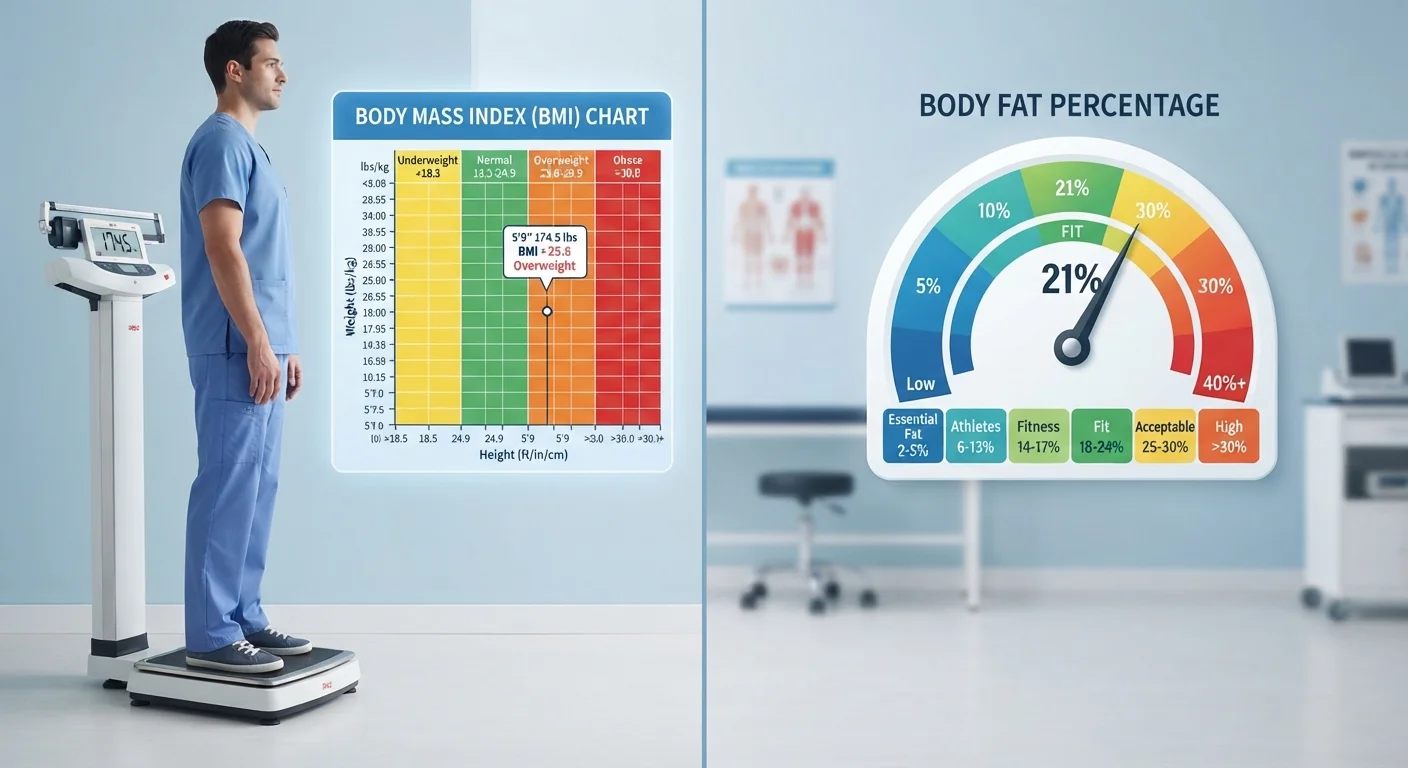
Key Takeaways
- BMI is calculated from height and weight alone - it does not distinguish muscle from fat.
- Body fat percentage directly measures how much of your body mass is fat tissue.
- A person can have a normal BMI yet carry an unhealthy level of body fat, and vice versa.
- Accurate body fat measurement requires specialized tools such as DEXA or hydrostatic weighing.
- Both metrics have documented limitations; neither should be used as a standalone health verdict.
- Consulting a healthcare provider helps determine which metric is most relevant to your health goals.
Option A
BMI (Body Mass Index)
The population-level screening tool.
Best for: Quick, low-cost health screenings and large-scale epidemiological research where individual body composition detail is not required.
Option B
Body Fat Percentage
The direct measure of body composition.
Best for: Individuals and clinicians who need a more precise picture of fat versus lean mass to guide fitness or health decisions.
If you want a fast, no-cost initial health screen
BMI (Body Mass Index)
BMI requires nothing more than a scale and a measuring tape, making it practical for routine checkups and general population tracking.
If you're tracking changes in body composition during a fitness program
Body Fat Percentage
Body fat percentage can detect meaningful shifts in fat and lean mass that BMI completely misses, giving a truer picture of progress.
If you're an athlete or have significant muscle mass
Body Fat Percentage
BMI routinely misclassifies muscular individuals as overweight or obese because it cannot differentiate muscle from fat tissue.
If your clinician needs a population-level risk reference
BMI (Body Mass Index)
Decades of epidemiological data are indexed to BMI categories, making it a useful reference point for discussing broad disease-risk patterns.
How Each Measurement Is Calculated
BMI is derived from a simple formula: weight in kilograms divided by height in meters squared (kg/m²). The result places a person into one of four standard categories - underweight, normal weight, overweight, or obese. Because the calculation needs only two inputs, BMI can be computed instantly, at no cost, in any clinical or community setting.
Body fat percentage works differently. It estimates what fraction of total body mass is composed of adipose (fat) tissue, with the remainder attributed to lean mass - muscle, bone, water, and organs. Measuring it accurately requires specialized methods. Common approaches include DEXA scanning, hydrostatic (underwater) weighing, air displacement plethysmography (the Bod Pod), and skinfold caliper assessments. Consumer-grade bioelectrical impedance scales offer a rough estimate but are sensitive to hydration, meal timing, and electrode placement, which can introduce meaningful error.
For a deeper look at why these distinctions matter, see why the scale doesn't tell the whole story in our body composition overview.
What BMI Gets Right - and Where It Falls Short
BMI's enduring appeal is its practicality. Across large populations, higher BMI correlates meaningfully with elevated risk for type 2 diabetes, cardiovascular disease, and certain cancers. That statistical relationship makes it a useful epidemiological shorthand.
Its limitations, however, are well-documented. BMI cannot distinguish muscle mass from fat mass. A competitive strength athlete and a sedentary individual with the same height and weight will receive identical BMI scores despite dramatically different health profiles. Conversely, older adults who have lost significant muscle mass through a process called sarcopenia may register a "normal" BMI while carrying a disproportionately high fat load - a condition sometimes called "normal-weight obesity."
Ethnicity also matters. Research suggests that the metabolic risks associated with a given BMI value differ across racial and ethnic groups, prompting ongoing debate about whether universal cutoff thresholds are appropriate. Several health organizations have proposed adjusted thresholds for certain populations, though no single standard has been universally adopted.
| Criterion | BMI | Body Fat Percentage |
|---|---|---|
| What it measures | Weight relative to height | Fat tissue as % of total body mass |
| Distinguishes muscle from fat | No | Yes |
| Cost to measure | Free (scale + tape) | Low to high (method-dependent) |
| Accessibility | Universal - no equipment needed | Requires tools or clinical access |
| Accuracy for individuals | Moderate - population-level proxy | High (DEXA/hydrostatic); moderate (BIA) |
| Useful for athletes | Limited - often misclassifies | Yes - reflects actual composition |
| Tracks body composition changes | Poorly | Effectively |
| Used in population research | Extensively | Less common due to cost |
What Body Fat Percentage Adds to the Picture
Because body fat percentage directly quantifies fat tissue, it can reveal health risks that BMI obscures. Research published in clinical nutrition and exercise physiology literature consistently shows that excess body fat - particularly visceral fat stored around abdominal organs - is more directly linked to metabolic dysfunction than body weight alone. How muscle and fat tissue differ metabolically shapes why this distinction is clinically relevant.
Generally accepted reference ranges for body fat percentage vary by sex and age. For adult men, values roughly between 10-20% are considered healthy; for adult women, ranges around 20-30% are typically cited - though these figures come from different sources and should be interpreted in consultation with a healthcare provider rather than used as rigid personal targets.
The tradeoff for greater precision is cost and access. DEXA scans, considered a gold-standard method, require specialized equipment and a clinical setting. This limits routine use for most people, unlike the immediate availability of a BMI calculation.
Understanding how body composition intersects with broader metabolic markers is explored further in body composition and metabolic health.
This article is for general informational purposes only and does not constitute medical advice. Consult a qualified healthcare professional before making decisions about health monitoring or body composition assessment.