

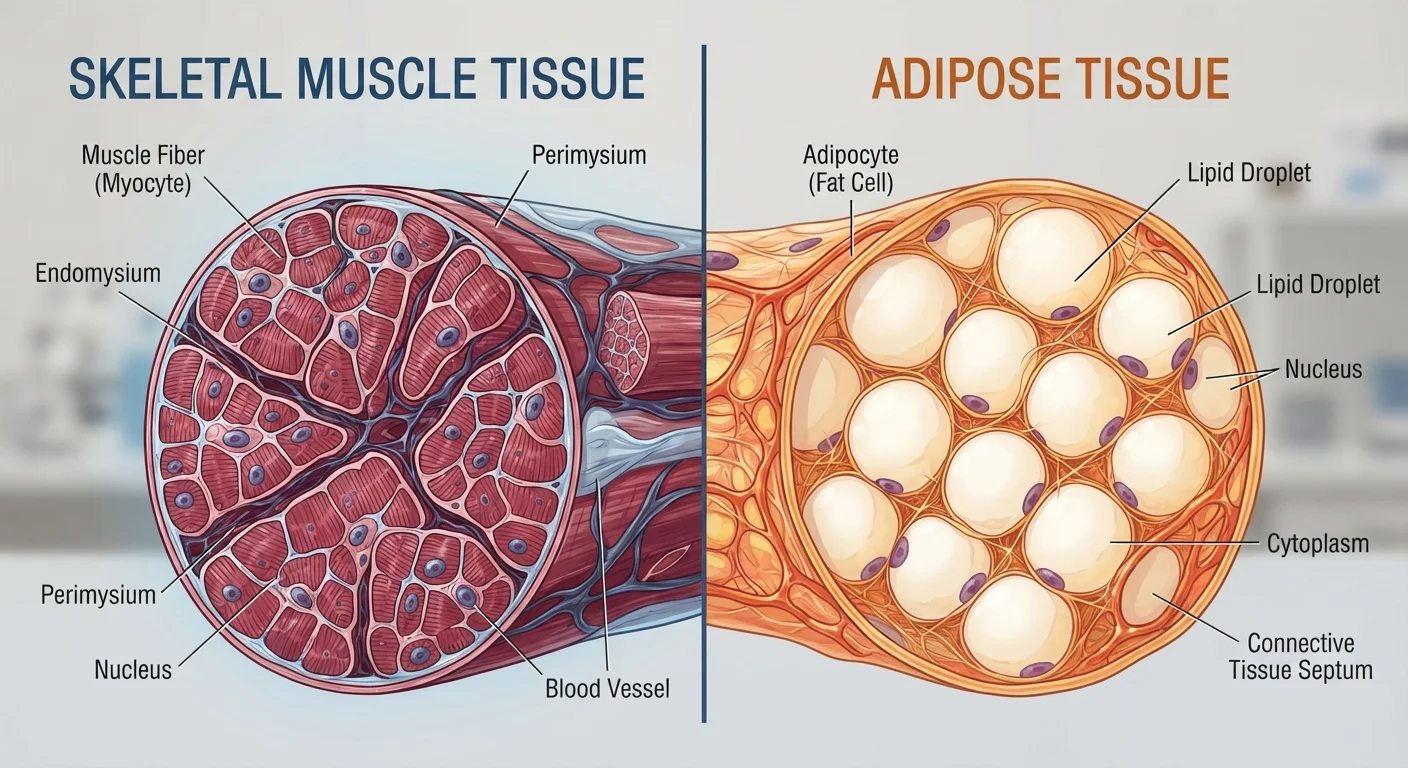
Key Takeaways
- Skeletal muscle burns roughly 6 calories per pound per day at rest; fat burns about 2 calories per pound.
- The calorie difference per pound is real but modest - dramatic metabolism boosts from muscle gain are often overstated.
- Total muscle mass matters more than per-pound rates; larger bodies with more muscle burn meaningfully more calories overall.
- Resistance training supports muscle retention, which helps offset the metabolic slowdown that can accompany aging.
- No single tissue type determines your metabolism - organ mass, hormones, and activity level all play major roles.
Option A
Skeletal Muscle
The metabolically active tissue that powers movement.
Best for: People aiming to support a higher resting metabolic rate and improve long-term body composition.
Option B
Body Fat
Essential energy storage with a more modest metabolic footprint.
Best for: Understanding baseline energy needs - fat still burns calories, just at a slower rate than muscle.
If you want to support a higher resting metabolism long-term
Skeletal Muscle
Building and preserving muscle mass through resistance training is the most evidence-supported strategy for raising basal metabolic rate over time.
If you're trying to understand why weight loss slows over time
Skeletal Muscle
As body mass decreases - including muscle - total resting calorie burn drops, which is a key reason metabolic adaptation occurs during prolonged calorie deficits.
If you believe fat tissue is entirely metabolically inert
Body Fat
Fat tissue does burn calories at rest and plays active roles in hormone regulation; understanding this corrects a common and misleading oversimplification.
The Core Claim - and Why It Needs Context
"Muscle burns more calories than fat" is one of the most repeated claims in fitness culture - and it's technically true. But the magnitude of that difference is frequently exaggerated in ways that lead people to unrealistic expectations about resistance training and weight management.
Both tissues are metabolically active at rest. Research estimates that skeletal muscle burns approximately 6 calories per pound per day at rest, while fat tissue burns closer to 2 calories per pound per day. That's a meaningful difference per pound - but it's far smaller than popular messaging tends to suggest.
To put it in practical terms: if someone added 5 pounds of muscle through months of dedicated training, the resting calorie increase would be roughly 20 extra calories per day. That's not nothing, but it won't dramatically transform your metabolism on its own. For a fuller picture of how these two tissue types function beyond calorie burning, see how each tissue affects your health.
| Criterion | Skeletal Muscle | Body Fat |
|---|---|---|
| Resting calorie burn (per lb/day) | ~6 calories | ~2 calories |
| Metabolic activity | High - requires constant energy | Low - modest but not zero |
| Hormonal role | Releases myokines during exercise | Produces leptin, adiponectin |
| Changes with age | Decreases without resistance training | Tends to increase with age |
| Impact on RMR | Meaningful contributor | Minor contributor |
| Health risk factor | Low; higher mass generally protective | Depends on type and location |
Why Total Mass - Not Per-Pound Rate - Is What Matters Most
The per-pound figures above can be misleading in isolation. What actually drives resting metabolic rate (RMR) is the total amount of metabolically active tissue in your body - not just the type.
A person with a naturally high muscle mass may burn several hundred more calories per day at rest than someone with significantly less - not because of a magical metabolic rate, but simply because they're carrying more active tissue in absolute terms. This is why RMR tends to be higher in taller, larger-framed individuals and why it declines with age as muscle mass naturally decreases.
Importantly, organs - including the liver, brain, heart, and kidneys - account for the largest share of resting energy expenditure, roughly 60-70% of RMR despite making up a small fraction of total body weight. Muscle contributes meaningfully, but it's one part of a complex metabolic picture.
This complexity is one reason that common body composition myths persist - single-variable thinking rarely captures how metabolism actually works.
~6 cal/lb
Resting calorie burn rate of muscle
Research estimates skeletal muscle burns roughly 6 calories per pound per day at rest, compared to about 2 for fat tissue.
60-70%
Share of RMR from organ metabolism
Organs such as the liver, brain, and kidneys account for the majority of resting energy expenditure despite their relatively small mass.
~20 cal/day
Estimated resting burn from 5 lbs of new muscle
Based on per-pound estimates, adding 5 pounds of muscle would increase resting calorie expenditure by approximately 20 calories daily.
What This Means for Real-World Fitness Decisions
Understanding the true muscle-vs-fat calorie story has practical implications for how you approach exercise and body composition goals.
Resistance training is still worth it - just not primarily for a metabolic boost. Building muscle supports functional strength, bone density, insulin sensitivity, and long-term mobility. Any resting metabolic benefit is a bonus, not the headline.
Preserving muscle during weight loss matters. When calorie intake is reduced, the body can break down muscle alongside fat. Since muscle is more metabolically active per pound, losing it contributes to the metabolic slowdown commonly observed during prolonged dieting. Adequate protein intake and resistance exercise are both supported by research as strategies for muscle preservation during a calorie deficit.
Don't overlook fat's active roles. Fat tissue isn't simply passive storage. It produces hormones including leptin and adiponectin that influence hunger, insulin sensitivity, and inflammation. Understanding visceral vs. subcutaneous fat also matters - where fat is stored affects health risk far more than its per-pound calorie burn.
Measurements like body fat percentage vs. BMI can help contextualize changes in body composition over time, giving a clearer picture than scale weight alone.
This article provides general health information for educational purposes only and is not a substitute for advice from a qualified healthcare or nutrition professional.